

10.1. SELF-ASSEMBLY
263
atoms, as noted above and indicated in Fig. 10.3. The reaction at the surface might
be written
(10.4)
where Au,, denotes the outer layer of the gold film, which contains m atoms. The
quantity (Au;) is the positively charged triplet of gold atoms that forms the hollow
depression in the surface where the terminal sulfur ion (S-) forms a bond with the
gold ion Au: . Figure 10.3 gives a schematic view of this adsorption process.
The sulfur--gold bond that holds the alkanethiol in place is a fairly strong one
(-44 kcal/mol) so the adhesion is stable. The bonding to the surface takes place at
one-sixth of the sites on the (1 1 1) close-packed layer, and these sites are occupied in
a regular manner so they form a hexagonal close-packed layer with the lattice
constant equal to &ao = 0.865 nm, where a. = 0.4995 nm is the distance between
Au atoms on the surface. Figures 10.2 and 10.3 indicate the location of the
alkanethiol sites on the gold close-packed surface.
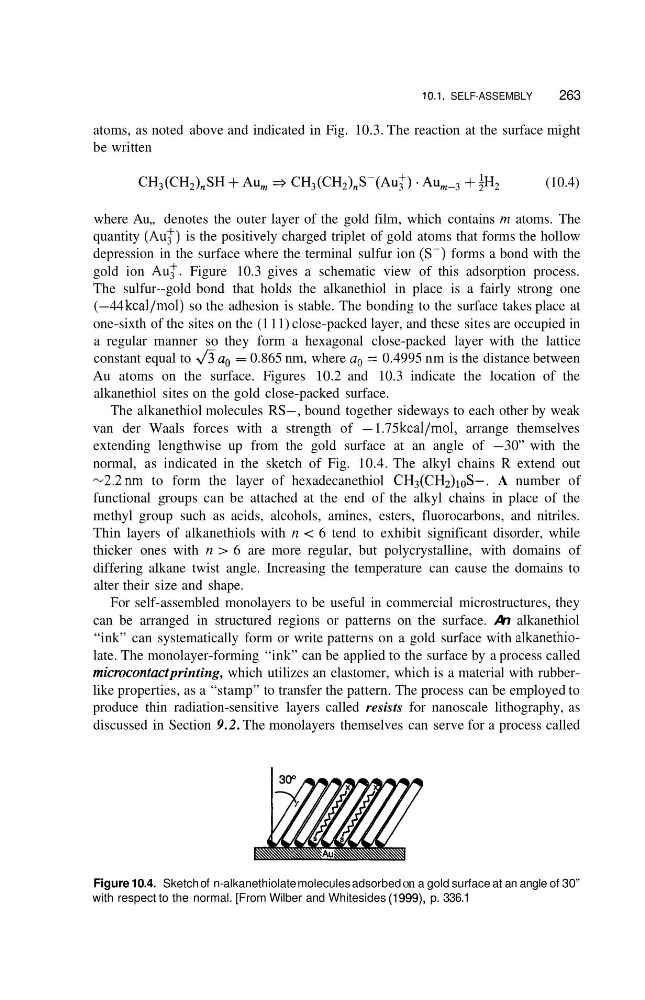
The alkanethiol molecules RS-, bound together sideways to each other by weak
van der Waals forces with a strength of -1.75 kcal/mol, arrange themselves
extending lengthwise up from the gold surface at an angle of -30” with the
normal, as indicated in the sketch of Fig. 10.4. The alkyl chains R extend out
-2.2nm to form the layer of hexadecanethiol CH3(CH2)10S-. A number of
functional groups can be attached at the end of the alkyl chains in place of the
methyl group such as acids, alcohols, amines, esters, fluorocarbons, and nitriles.
Thin layers of alkanethiols with n < 6 tend to exhibit significant disorder, while
thicker ones with n > 6 are more regular, but polycrystalline, with domains of
differing alkane twist angle. Increasing the temperature can cause the domains to
alter their size and shape.
For self-assembled monolayers to be useful in commercial microstructures, they
can be arranged in structured regions or patterns on the surface. An alkanethiol
“ink” can systematically form or write patterns on a gold surface with alkanethiolate. The monolayer-forming “ink” can be applied to the surface by a process called
microcontact printing, which utilizes an elastomer, which is a material with rubberlike properties, as a “stamp” to transfer the pattern. The process can be employed to
produce thin radiation-sensitive layers called resists for nanoscale lithography, as
discussed in Section 9.2. The monolayers themselves can serve for a process called
Figure 10.4. Sketch of n-alkanethiolate molecules adsorbed on a gold surface at an angle of 30”
with respect to the normal. [From Wilber and Whitesides (1999), p. 336.1
263
atoms, as noted above and indicated in Fig. 10.3. The reaction at the surface might
be written
(10.4)
where Au,, denotes the outer layer of the gold film, which contains m atoms. The
quantity (Au;) is the positively charged triplet of gold atoms that forms the hollow
depression in the surface where the terminal sulfur ion (S-) forms a bond with the
gold ion Au: . Figure 10.3 gives a schematic view of this adsorption process.
The sulfur--gold bond that holds the alkanethiol in place is a fairly strong one
(-44 kcal/mol) so the adhesion is stable. The bonding to the surface takes place at
one-sixth of the sites on the (1 1 1) close-packed layer, and these sites are occupied in
a regular manner so they form a hexagonal close-packed layer with the lattice
constant equal to &ao = 0.865 nm, where a. = 0.4995 nm is the distance between
Au atoms on the surface. Figures 10.2 and 10.3 indicate the location of the
alkanethiol sites on the gold close-packed surface.
The alkanethiol molecules RS-, bound together sideways to each other by weak
van der Waals forces with a strength of -1.75 kcal/mol, arrange themselves
extending lengthwise up from the gold surface at an angle of -30” with the
normal, as indicated in the sketch of Fig. 10.4. The alkyl chains R extend out
-2.2nm to form the layer of hexadecanethiol CH3(CH2)10S-. A number of
functional groups can be attached at the end of the alkyl chains in place of the
methyl group such as acids, alcohols, amines, esters, fluorocarbons, and nitriles.
Thin layers of alkanethiols with n < 6 tend to exhibit significant disorder, while
thicker ones with n > 6 are more regular, but polycrystalline, with domains of
differing alkane twist angle. Increasing the temperature can cause the domains to
alter their size and shape.
For self-assembled monolayers to be useful in commercial microstructures, they
can be arranged in structured regions or patterns on the surface. An alkanethiol
“ink” can systematically form or write patterns on a gold surface with alkanethiolate. The monolayer-forming “ink” can be applied to the surface by a process called
microcontact printing, which utilizes an elastomer, which is a material with rubberlike properties, as a “stamp” to transfer the pattern. The process can be employed to
produce thin radiation-sensitive layers called resists for nanoscale lithography, as
discussed in Section 9.2. The monolayers themselves can serve for a process called
Figure 10.4. Sketch of n-alkanethiolate molecules adsorbed on a gold surface at an angle of 30”
with respect to the normal. [From Wilber and Whitesides (1999), p. 336.1