

236
QUANTUM WELLS, WIRES, AND DOTS
Table 9.4. Number of electrons Nand density of states RE) = dN(E)/d€
as a function of the energy € for conduction electrons delocalized in
one, two, and three spatial dimensions
a
Delocalization
Number of Electrons N
Density of States D(E)
Dimensions
N = K , Ell2
D(E) = KlE-'I2
1
N 1 K2E
D(E) K2
2
N = K,E3l2
D(E) = $K3E'l2
3
"The values of the constants K l , K2, and K3 are given in Table A.2 (of Appendix A).
of metals and semiconductors, and make it clear why these features can be so
dependent on the dimensionality. Examples of how various properties of materials
depend on the density of states are given in Section 9.3.6.
9.3.4. Potential Wells
In the previous section we discussed the delocalization aspects of conduction
electrons in a bulk metal. These electrons were referred to as free electrons, but
perhaps unconjned electrons would be a better word for them. This is because when
the size of a conductor diminishes to the nanoregion, these electrons begin to
experience the effects of confinement, meaning that their motion becomes limited by
the physical size of the region or domain in which they move. The influence of
1
2
3
Energy, E
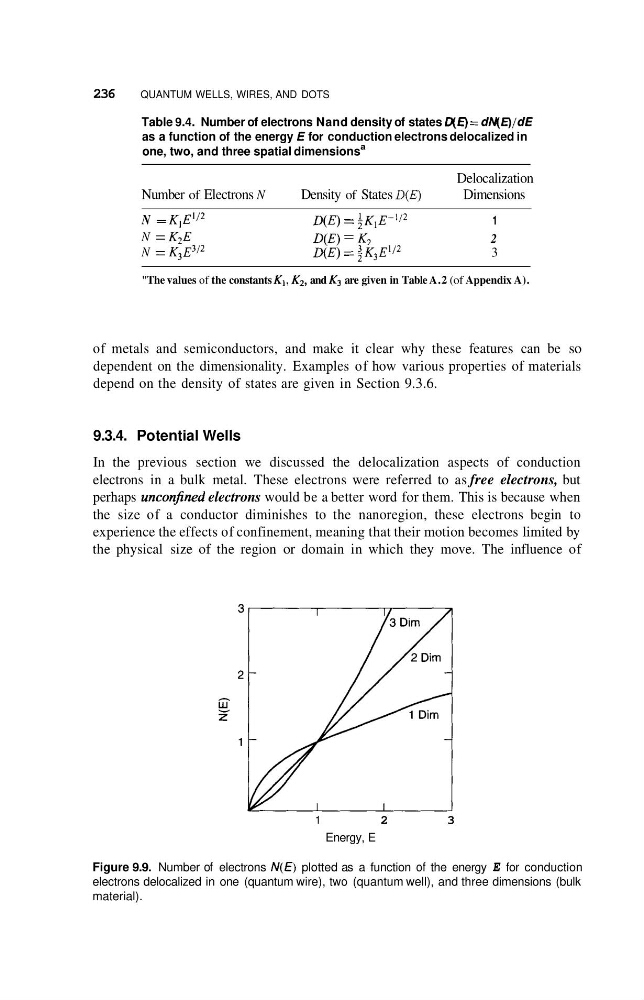
Figure 9.9. Number of electrons N(E) plotted as a function of the energy E for conduction
electrons delocalized in one (quantum wire), two (quantum well), and three dimensions (bulk
material).
QUANTUM WELLS, WIRES, AND DOTS
Table 9.4. Number of electrons Nand density of states RE) = dN(E)/d€
as a function of the energy € for conduction electrons delocalized in
one, two, and three spatial dimensions
a
Delocalization
Number of Electrons N
Density of States D(E)
Dimensions
N = K , Ell2
D(E) = KlE-'I2
1
N 1 K2E
D(E) K2
2
N = K,E3l2
D(E) = $K3E'l2
3
"The values of the constants K l , K2, and K3 are given in Table A.2 (of Appendix A).
of metals and semiconductors, and make it clear why these features can be so
dependent on the dimensionality. Examples of how various properties of materials
depend on the density of states are given in Section 9.3.6.
9.3.4. Potential Wells
In the previous section we discussed the delocalization aspects of conduction
electrons in a bulk metal. These electrons were referred to as free electrons, but
perhaps unconjned electrons would be a better word for them. This is because when
the size of a conductor diminishes to the nanoregion, these electrons begin to
experience the effects of confinement, meaning that their motion becomes limited by
the physical size of the region or domain in which they move. The influence of
1
2
3
Energy, E
Figure 9.9. Number of electrons N(E) plotted as a function of the energy E for conduction
electrons delocalized in one (quantum wire), two (quantum well), and three dimensions (bulk
material).