

9.3. SIZE AND DIMENSIONALITY EFFECTS
237
3
2
w n
1
I
I
1
2
3
Energy, E
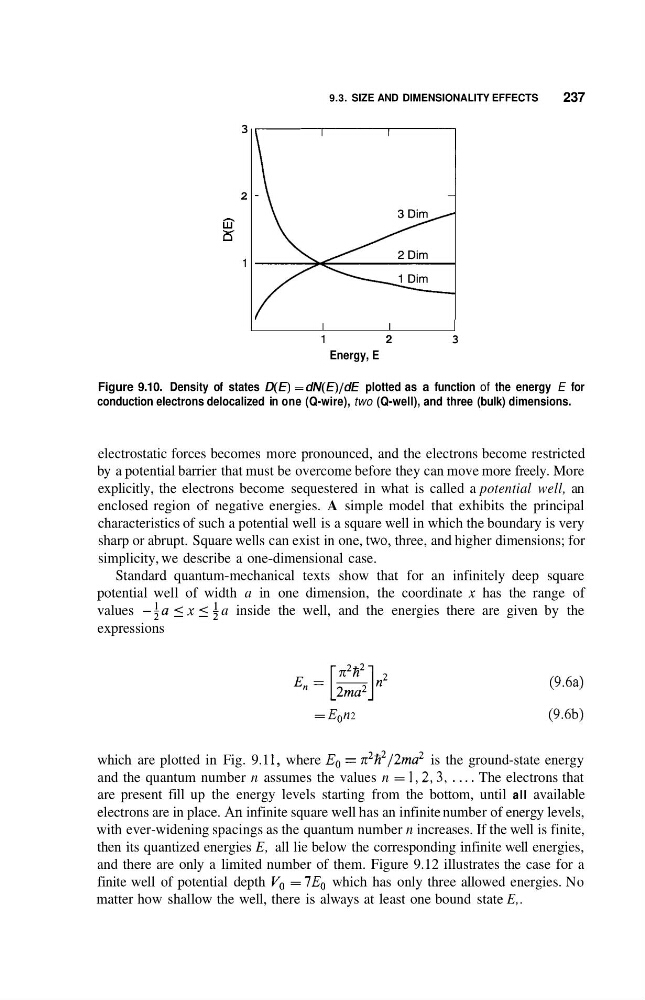
Figure 9.10. Density of states D(E) = dN(E)/dE plotted as a function of the energy E for
conduction electrons delocalized in one (Q-wire), two (Q-well), and three (bulk) dimensions.
electrostatic forces becomes more pronounced, and the electrons become restricted
by a potential barrier that must be overcome before they can move more freely. More
explicitly, the electrons become sequestered in what is called a potential well, an
enclosed region of negative energies. A simple model that exhibits the principal
characteristics of such a potential well is a square well in which the boundary is very
sharp or abrupt. Square wells can exist in one, two, three, and higher dimensions; for
simplicity, we describe a one-dimensional case.
Standard quantum-mechanical texts show that for an infinitely deep square
potential well of width a in one dimension, the coordinate x has the range of
values - +a 5 x 5 + a inside the well, and the energies there are given by the
expressions
(9.6a)
= Eon 2
(9.6b)
which are plotted in Fig. 9.1 1, where Eo = x2A2/2rna2 is the ground-state energy
and the quantum number n assumes the values n = 1,2,3, . . . . The electrons that
are present fill up the energy levels starting from the bottom, until all available
electrons are in place. An infinite square well has an infinite number of energy levels,
with ever-widening spacings as the quantum number n increases. If the well is finite,
then its quantized energies E, all lie below the corresponding infinite well energies,
and there are only a limited number of them. Figure 9.12 illustrates the case for a
finite well of potential depth Vo = 7E0 which has only three allowed energies. No
matter how shallow the well, there is always at least one bound state E,.
237
3
2
w n
1
I
I
1
2
3
Energy, E
Figure 9.10. Density of states D(E) = dN(E)/dE plotted as a function of the energy E for
conduction electrons delocalized in one (Q-wire), two (Q-well), and three (bulk) dimensions.
electrostatic forces becomes more pronounced, and the electrons become restricted
by a potential barrier that must be overcome before they can move more freely. More
explicitly, the electrons become sequestered in what is called a potential well, an
enclosed region of negative energies. A simple model that exhibits the principal
characteristics of such a potential well is a square well in which the boundary is very
sharp or abrupt. Square wells can exist in one, two, three, and higher dimensions; for
simplicity, we describe a one-dimensional case.
Standard quantum-mechanical texts show that for an infinitely deep square
potential well of width a in one dimension, the coordinate x has the range of
values - +a 5 x 5 + a inside the well, and the energies there are given by the
expressions
(9.6a)
= Eon 2
(9.6b)
which are plotted in Fig. 9.1 1, where Eo = x2A2/2rna2 is the ground-state energy
and the quantum number n assumes the values n = 1,2,3, . . . . The electrons that
are present fill up the energy levels starting from the bottom, until all available
electrons are in place. An infinite square well has an infinite number of energy levels,
with ever-widening spacings as the quantum number n increases. If the well is finite,
then its quantized energies E, all lie below the corresponding infinite well energies,
and there are only a limited number of them. Figure 9.12 illustrates the case for a
finite well of potential depth Vo = 7E0 which has only three allowed energies. No
matter how shallow the well, there is always at least one bound state E,.