

234
QUANTUM WELLS, WIRES, AND DOTS
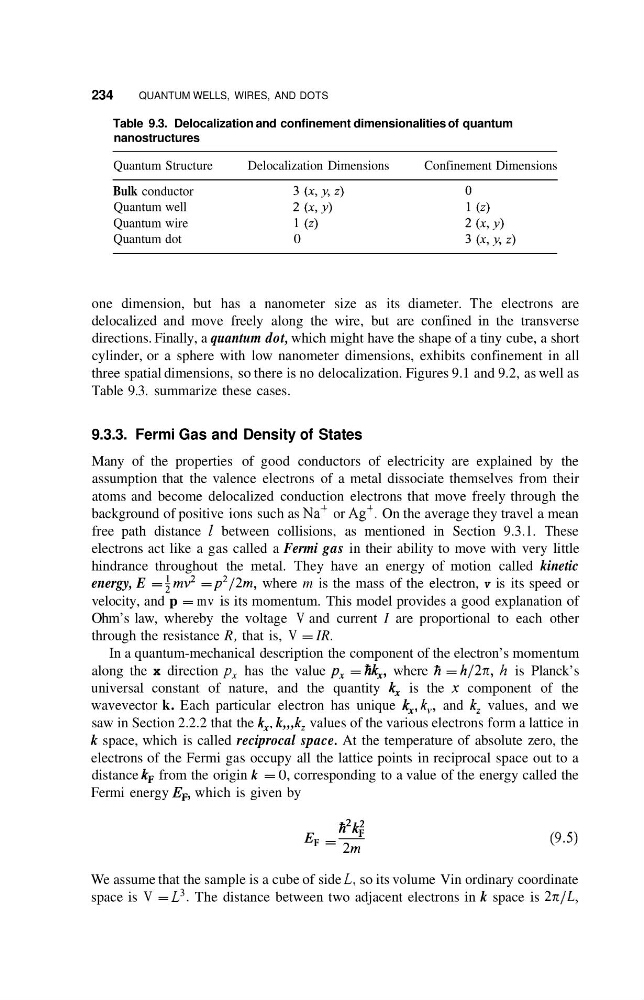
Table 9.3. Delocalization and confinement dimensionalities of quantum
nanostructures
Quantum Structure
Delocalization Dimensions
Confinement Dimensions
Bulk conductor
Quantum well
Quantum wire
Quantum dot
0
one dimension, but has a nanometer size as its diameter. The electrons are
delocalized and move freely along the wire, but are confined in the transverse
directions. Finally, a quantum dot, which might have the shape of a tiny cube, a short
cylinder, or a sphere with low nanometer dimensions, exhibits confinement in all
three spatial dimensions, so there is no delocalization. Figures 9.1 and 9.2, as well as
Table 9.3. summarize these cases.
9.3.3. Fermi Gas and Density of States
Many of the properties of good conductors of electricity are explained by the
assumption that the valence electrons of a metal dissociate themselves from their
atoms and become delocalized conduction electrons that move freely through the
background of positive ions such as Na’ or Ag’. On the average they travel a mean
free path distance 1 between collisions, as mentioned in Section 9.3.1. These
electrons act like a gas called a Fermi gas in their ability to move with very little
hindrance throughout the metal. They have an energy of motion called kinetic
energy, E = i m 3 = p 2 / 2 m , where m is the mass of the electron, v is its speed or
velocity, and p = mv is its momentum. This model provides a good explanation of
Ohm’s law, whereby the voltage V and current I are proportional to each other
through the resistance R, that is, V = IR.
In a quantum-mechanical description the component of the electron’s momentum
along the x direction p , has the value p , = hk,, where h = h/27c, h is Planck’s
universal constant of nature, and the quantity k, is the x component of the
wavevector k. Each particular electron has unique k,, k,,, and k, values, and we
saw in Section 2.2.2 that the k,. k,,, kz values of the various electrons form a lattice in
k space, which is called reciprocal space. At the temperature of absolute zero, the
electrons of the Fermi gas occupy all the lattice points in reciprocal space out to a
distance kF from the origin k = 0, corresponding to a value of the energy called the
Fermi energy EF, which is given by
h2kg
EF = 2m
(9.5)
We assume that the sample is a cube of side L, so its volume Vin ordinary coordinate
space is V = L3. The distance between two adjacent electrons in k space is 27c/L,
QUANTUM WELLS, WIRES, AND DOTS
Table 9.3. Delocalization and confinement dimensionalities of quantum
nanostructures
Quantum Structure
Delocalization Dimensions
Confinement Dimensions
Bulk conductor
Quantum well
Quantum wire
Quantum dot
0
one dimension, but has a nanometer size as its diameter. The electrons are
delocalized and move freely along the wire, but are confined in the transverse
directions. Finally, a quantum dot, which might have the shape of a tiny cube, a short
cylinder, or a sphere with low nanometer dimensions, exhibits confinement in all
three spatial dimensions, so there is no delocalization. Figures 9.1 and 9.2, as well as
Table 9.3. summarize these cases.
9.3.3. Fermi Gas and Density of States
Many of the properties of good conductors of electricity are explained by the
assumption that the valence electrons of a metal dissociate themselves from their
atoms and become delocalized conduction electrons that move freely through the
background of positive ions such as Na’ or Ag’. On the average they travel a mean
free path distance 1 between collisions, as mentioned in Section 9.3.1. These
electrons act like a gas called a Fermi gas in their ability to move with very little
hindrance throughout the metal. They have an energy of motion called kinetic
energy, E = i m 3 = p 2 / 2 m , where m is the mass of the electron, v is its speed or
velocity, and p = mv is its momentum. This model provides a good explanation of
Ohm’s law, whereby the voltage V and current I are proportional to each other
through the resistance R, that is, V = IR.
In a quantum-mechanical description the component of the electron’s momentum
along the x direction p , has the value p , = hk,, where h = h/27c, h is Planck’s
universal constant of nature, and the quantity k, is the x component of the
wavevector k. Each particular electron has unique k,, k,,, and k, values, and we
saw in Section 2.2.2 that the k,. k,,, kz values of the various electrons form a lattice in
k space, which is called reciprocal space. At the temperature of absolute zero, the
electrons of the Fermi gas occupy all the lattice points in reciprocal space out to a
distance kF from the origin k = 0, corresponding to a value of the energy called the
Fermi energy EF, which is given by
h2kg
EF = 2m
(9.5)
We assume that the sample is a cube of side L, so its volume Vin ordinary coordinate
space is V = L3. The distance between two adjacent electrons in k space is 27c/L,