

230
QUANTUM WELLS. WIRES, AND DOTS
Figure 9.6. Quantum-dot array formed by lithography from the initial configuration of Fig. 9.5.
This 24-fold quantum-dot array consists of six columns of four stacked quantum dots.
Fig 9.6. As an example of the advantages of fabricating quantum dot arrays, it
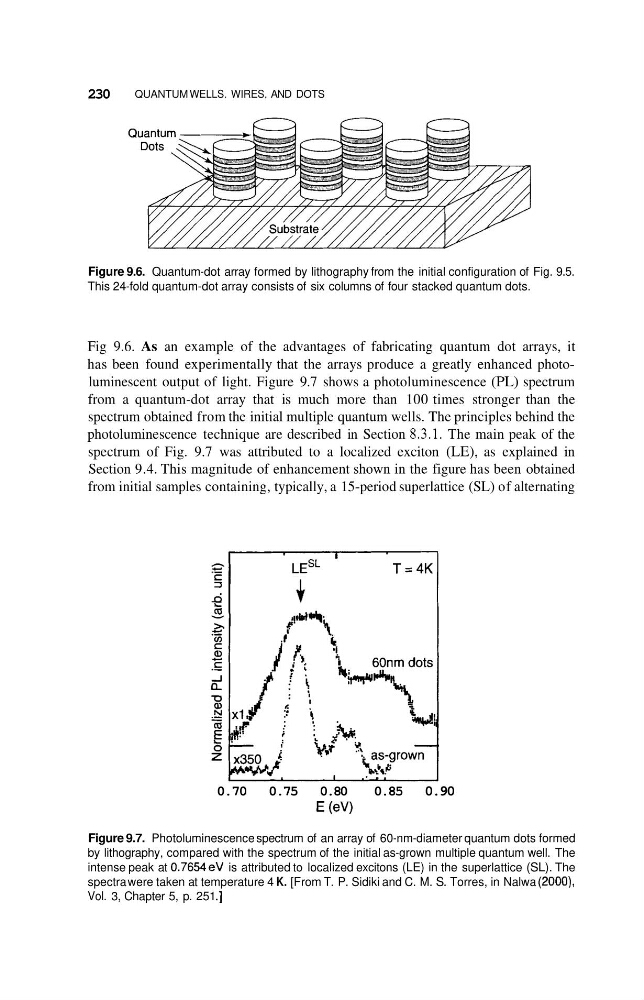
has been found experimentally that the arrays produce a greatly enhanced photoluminescent output of light. Figure 9.7 shows a photoluminescence (PL) spectrum
from a quantum-dot array that is much more than 100 times stronger than the
spectrum obtained from the initial multiple quantum wells. The principles behind the
photoluminescence technique are described in Section 8.3.1. The main peak of the
spectrum of Fig. 9.7 was attributed to a localized exciton (LE), as explained in
Section 9.4. This magnitude of enhancement shown in the figure has been obtained
from initial samples containing, typically, a 15-period superlattice (SL) of alternating
I
LE^^
T = 4 K
0.70 0.75 0.80
0.85 0.90
E (ev)
Figure 9.7. Photoluminescence spectrum of an array of 60-nm-diameter quantum dots formed
by lithography, compared with the spectrum of the initial as-grown multiple quantum well. The
intense peak at 0.7654eV is attributed to localized excitons (LE) in the superlattice (SL). The
spectra were taken at temperature 4 K. [From T. P. Sidiki and C. M. S. Torres, in Nalwa (2000),
Vol. 3, Chapter 5, p. 251 .]
QUANTUM WELLS. WIRES, AND DOTS
Figure 9.6. Quantum-dot array formed by lithography from the initial configuration of Fig. 9.5.
This 24-fold quantum-dot array consists of six columns of four stacked quantum dots.
Fig 9.6. As an example of the advantages of fabricating quantum dot arrays, it
has been found experimentally that the arrays produce a greatly enhanced photoluminescent output of light. Figure 9.7 shows a photoluminescence (PL) spectrum
from a quantum-dot array that is much more than 100 times stronger than the
spectrum obtained from the initial multiple quantum wells. The principles behind the
photoluminescence technique are described in Section 8.3.1. The main peak of the
spectrum of Fig. 9.7 was attributed to a localized exciton (LE), as explained in
Section 9.4. This magnitude of enhancement shown in the figure has been obtained
from initial samples containing, typically, a 15-period superlattice (SL) of alternating
I
LE^^
T = 4 K
0.70 0.75 0.80
0.85 0.90
E (ev)
Figure 9.7. Photoluminescence spectrum of an array of 60-nm-diameter quantum dots formed
by lithography, compared with the spectrum of the initial as-grown multiple quantum well. The
intense peak at 0.7654eV is attributed to localized excitons (LE) in the superlattice (SL). The
spectra were taken at temperature 4 K. [From T. P. Sidiki and C. M. S. Torres, in Nalwa (2000),
Vol. 3, Chapter 5, p. 251 .]