

8.3. LUMINESCENCE
221
400 nm
Laser
Electron-hole
pairs
/
Free excitons
Trapped
excitons
Fast
Fast
Trapped
electrons 8, holes
I
Non
Emission Emission
I
Slow
177-1 83 eV
- 187 eV - 185 eV
luminescence
radiative
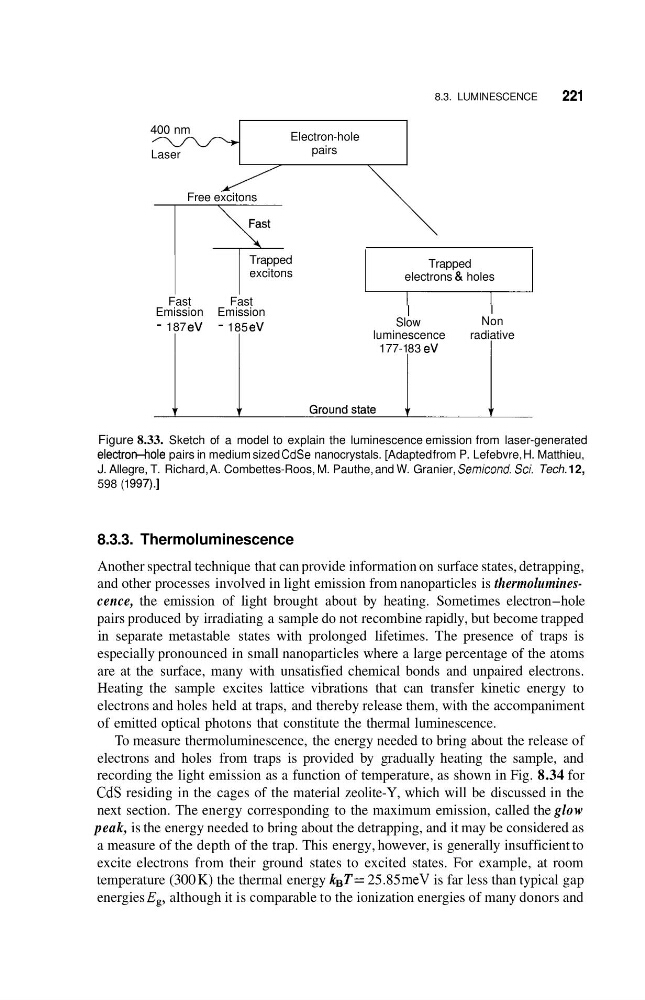
Figure 8.33. Sketch of a model to explain the luminescence emission from laser-generated
electrotwhole pairs in medium sized CdSe nanocrystals. [Adapted from P. Lefebvre, H. Matthieu,
J. Allegre, T. Richard, A. Combettes-Roos, M. Pauthe, and W. Granier, Semicond. Sci. Tech. 12,
598 (1 997).]
8.3.3. Thermoluminescence
Another spectral technique that can provide information on surface states, detrapping,
and other processes involved in light emission from nanoparticles is thermoluminescence, the emission of light brought about by heating. Sometimes electron-hole
pairs produced by irradiating a sample do not recombine rapidly, but become trapped
in separate metastable states with prolonged lifetimes. The presence of traps is
especially pronounced in small nanoparticles where a large percentage of the atoms
are at the surface, many with unsatisfied chemical bonds and unpaired electrons.
Heating the sample excites lattice vibrations that can transfer kinetic energy to
electrons and holes held at traps, and thereby release them, with the accompaniment
of emitted optical photons that constitute the thermal luminescence.
To measure thermoluminescence, the energy needed to bring about the release of
electrons and holes from traps is provided by gradually heating the sample, and
recording the light emission as a function of temperature, as shown in Fig. 8.34 for
CdS residing in the cages of the material zeolite-Y, which will be discussed in the
next section. The energy corresponding to the maximum emission, called the glow
peak, is the energy needed to bring about the detrapping, and it may be considered as
a measure of the depth of the trap. This energy, however, is generally insufficient to
excite electrons from their ground states to excited states. For example, at room
temperature (300 K) the thermal energy kBT= 25.85 meV is far less than typical gap
energies Eg, although it is comparable to the ionization energies of many donors and
221
400 nm
Laser
Electron-hole
pairs
/
Free excitons
Trapped
excitons
Fast
Fast
Trapped
electrons 8, holes
I
Non
Emission Emission
I
Slow
177-1 83 eV
- 187 eV - 185 eV
luminescence
radiative
Figure 8.33. Sketch of a model to explain the luminescence emission from laser-generated
electrotwhole pairs in medium sized CdSe nanocrystals. [Adapted from P. Lefebvre, H. Matthieu,
J. Allegre, T. Richard, A. Combettes-Roos, M. Pauthe, and W. Granier, Semicond. Sci. Tech. 12,
598 (1 997).]
8.3.3. Thermoluminescence
Another spectral technique that can provide information on surface states, detrapping,
and other processes involved in light emission from nanoparticles is thermoluminescence, the emission of light brought about by heating. Sometimes electron-hole
pairs produced by irradiating a sample do not recombine rapidly, but become trapped
in separate metastable states with prolonged lifetimes. The presence of traps is
especially pronounced in small nanoparticles where a large percentage of the atoms
are at the surface, many with unsatisfied chemical bonds and unpaired electrons.
Heating the sample excites lattice vibrations that can transfer kinetic energy to
electrons and holes held at traps, and thereby release them, with the accompaniment
of emitted optical photons that constitute the thermal luminescence.
To measure thermoluminescence, the energy needed to bring about the release of
electrons and holes from traps is provided by gradually heating the sample, and
recording the light emission as a function of temperature, as shown in Fig. 8.34 for
CdS residing in the cages of the material zeolite-Y, which will be discussed in the
next section. The energy corresponding to the maximum emission, called the glow
peak, is the energy needed to bring about the detrapping, and it may be considered as
a measure of the depth of the trap. This energy, however, is generally insufficient to
excite electrons from their ground states to excited states. For example, at room
temperature (300 K) the thermal energy kBT= 25.85 meV is far less than typical gap
energies Eg, although it is comparable to the ionization energies of many donors and