

10
INTRODUCTION TO PHYSICS OF THE SOLID STATE
A -
B
B - A
A -
B
B - A
A - B
B - A
A - B
B - A
Figure 2.2. Sketch of a two-dimensional crystal structure based on a primitive rectangular lattice
containing two diatomic molecules A-B in each unit cell.
A crystal structure is formed by associating with a lattice a regular arrangement of
atoms or molecules. Figure 2.2 presents a two-dimensional crystal structure based on
a primitive rectangular lattice containing two diatomic molecules A-B in each unit
cell. A single unit cell can generate the overall lattice.
In three dimensions there are three lattice constants, a, b, and c, and three angles:
c( between b and c; b between a and c, and y between lattice constants a and b. There
are 14 Bravais lattices, ranging from the lowest-symmetry triclinic type in which all
three lattice constants and all three angles differ from each other (a # b # c and
c( # b # y), to the highest-symmetry cubic case in which all the lattice constants are
equal and all the angles are 90" (a = b = c and c( = b = y = 90"). There are
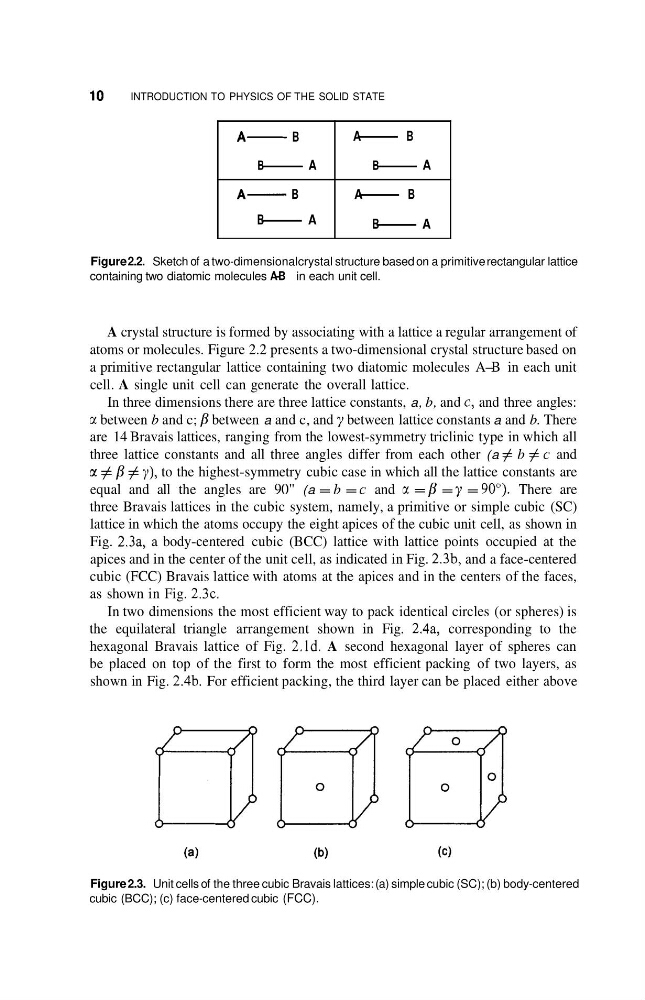
three Bravais lattices in the cubic system, namely, a primitive or simple cubic (SC)
lattice in which the atoms occupy the eight apices of the cubic unit cell, as shown in
Fig. 2.3a, a body-centered cubic (BCC) lattice with lattice points occupied at the
apices and in the center of the unit cell, as indicated in Fig. 2.3b, and a face-centered
cubic (FCC) Bravais lattice with atoms at the apices and in the centers of the faces,
as shown in Fig. 2 . 3 ~ .
In two dimensions the most efficient way to pack identical circles (or spheres) is
the equilateral triangle arrangement shown in Fig. 2.4a, corresponding to the
hexagonal Bravais lattice of Fig. 2.ld. A second hexagonal layer of spheres can
be placed on top of the first to form the most efficient packing of two layers, as
shown in Fig. 2.4b. For efficient packing, the third layer can be placed either above
Figure 2.3. Unit cells of the three cubic Bravais lattices: (a) simple cubic (SC); (b) body-centered
cubic (BCC); (c) face-centered cubic (FCC).
INTRODUCTION TO PHYSICS OF THE SOLID STATE
A -
B
B - A
A -
B
B - A
A - B
B - A
A - B
B - A
Figure 2.2. Sketch of a two-dimensional crystal structure based on a primitive rectangular lattice
containing two diatomic molecules A-B in each unit cell.
A crystal structure is formed by associating with a lattice a regular arrangement of
atoms or molecules. Figure 2.2 presents a two-dimensional crystal structure based on
a primitive rectangular lattice containing two diatomic molecules A-B in each unit
cell. A single unit cell can generate the overall lattice.
In three dimensions there are three lattice constants, a, b, and c, and three angles:
c( between b and c; b between a and c, and y between lattice constants a and b. There
are 14 Bravais lattices, ranging from the lowest-symmetry triclinic type in which all
three lattice constants and all three angles differ from each other (a # b # c and
c( # b # y), to the highest-symmetry cubic case in which all the lattice constants are
equal and all the angles are 90" (a = b = c and c( = b = y = 90"). There are
three Bravais lattices in the cubic system, namely, a primitive or simple cubic (SC)
lattice in which the atoms occupy the eight apices of the cubic unit cell, as shown in
Fig. 2.3a, a body-centered cubic (BCC) lattice with lattice points occupied at the
apices and in the center of the unit cell, as indicated in Fig. 2.3b, and a face-centered
cubic (FCC) Bravais lattice with atoms at the apices and in the centers of the faces,
as shown in Fig. 2 . 3 ~ .
In two dimensions the most efficient way to pack identical circles (or spheres) is
the equilateral triangle arrangement shown in Fig. 2.4a, corresponding to the
hexagonal Bravais lattice of Fig. 2.ld. A second hexagonal layer of spheres can
be placed on top of the first to form the most efficient packing of two layers, as
shown in Fig. 2.4b. For efficient packing, the third layer can be placed either above
Figure 2.3. Unit cells of the three cubic Bravais lattices: (a) simple cubic (SC); (b) body-centered
cubic (BCC); (c) face-centered cubic (FCC).