

2.1. STRUCTURE
11
T
X
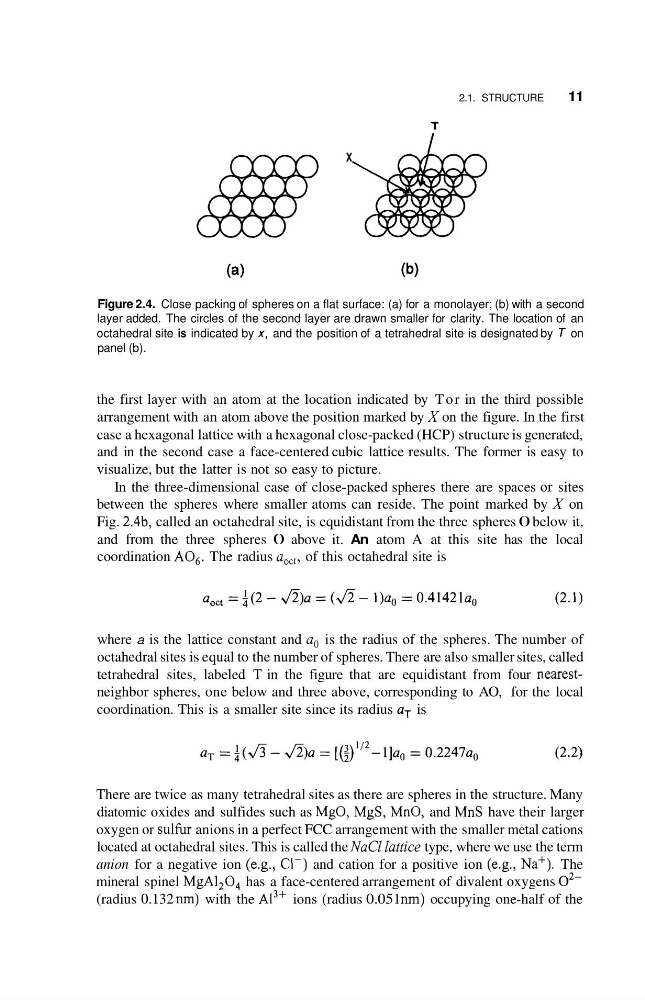
Figure 2.4. Close packing of spheres on a flat surface: (a) for a monolayer; (b) with a second
layer added. The circles of the second layer are drawn smaller for clarity. The location of an
octahedral site is indicated by x , and the position of a tetrahedral site is designated by T on
panel (b).
the first layer with an atom at the location indicated by T o r in the third possible
arrangement with an atom above the position marked by X on the figure. In the first
case a hexagonal lattice with a hexagonal close-packed (HCP) structure is generated,
and in the second case a face-centered cubic lattice results. The former is easy to
visualize, but the latter is not so easy to picture.
In the three-dimensional case of close-packed spheres there are spaces or sites
between the spheres where smaller atoms can reside. The point marked by X on
Fig. 2.4b, called an octahedral site, is equidistant from the three spheres 0 below it,
and from the three spheres 0 above it. An atom A at this site has the local
coordination AO,. The radius aoct, of this octahedral site is
where a is the lattice constant and a. is the radius of the spheres. The number of
octahedral sites is equal to the number of spheres. There are also smaller sites, called
tetrahedral sites, labeled T in the figure that are equidistant from four nearestneighbor spheres, one below and three above, corresponding to AO, for the local
coordination. This is a smaller site since its radius aT is
There are twice as many tetrahedral sites as there are spheres in the structure. Many
diatomic oxides and sulfides such as MgO, MgS, MnO, and MnS have their larger
oxygen or sulfur anions in a perfect FCC arrangement with the smaller metal cations
located at octahedral sites. This is called the NaCZ Zattice type, where we use the term
anion for a negative ion (e.g., Cl-) and cation for a positive ion (e.g., Na+). The
mineral spinel MgAI,O, has a face-centered arrangement of divalent oxygens 0,(radius 0.132 nm) with the A13+ ions (radius 0.05 1 nm) occupying one-half of the
11
T
X
Figure 2.4. Close packing of spheres on a flat surface: (a) for a monolayer; (b) with a second
layer added. The circles of the second layer are drawn smaller for clarity. The location of an
octahedral site is indicated by x , and the position of a tetrahedral site is designated by T on
panel (b).
the first layer with an atom at the location indicated by T o r in the third possible
arrangement with an atom above the position marked by X on the figure. In the first
case a hexagonal lattice with a hexagonal close-packed (HCP) structure is generated,
and in the second case a face-centered cubic lattice results. The former is easy to
visualize, but the latter is not so easy to picture.
In the three-dimensional case of close-packed spheres there are spaces or sites
between the spheres where smaller atoms can reside. The point marked by X on
Fig. 2.4b, called an octahedral site, is equidistant from the three spheres 0 below it,
and from the three spheres 0 above it. An atom A at this site has the local
coordination AO,. The radius aoct, of this octahedral site is
where a is the lattice constant and a. is the radius of the spheres. The number of
octahedral sites is equal to the number of spheres. There are also smaller sites, called
tetrahedral sites, labeled T in the figure that are equidistant from four nearestneighbor spheres, one below and three above, corresponding to AO, for the local
coordination. This is a smaller site since its radius aT is
There are twice as many tetrahedral sites as there are spheres in the structure. Many
diatomic oxides and sulfides such as MgO, MgS, MnO, and MnS have their larger
oxygen or sulfur anions in a perfect FCC arrangement with the smaller metal cations
located at octahedral sites. This is called the NaCZ Zattice type, where we use the term
anion for a negative ion (e.g., Cl-) and cation for a positive ion (e.g., Na+). The
mineral spinel MgAI,O, has a face-centered arrangement of divalent oxygens 0,(radius 0.132 nm) with the A13+ ions (radius 0.05 1 nm) occupying one-half of the