

2.1. STRUCTURE
9
mechanics, the resistivity and magnetization in electricity and magnetism, and the
dielectric constant in optics. When measurements are made in the micrometer
or nanometer range, many properties of materials change, such as mechanical,
ferroelectric, and ferromagnetic properties. The aim of the present book is to
examine characteristics of solids at the next lower level of size, namely, the
nanoscale level, perhaps from 1 to l00nm. Below this there is the atomic scale
near 0.1 nm, followed by the nuclear scale near a femtometer
m). In order to
understand properties at the nanoscale level it is necessary to know something about
the corresponding properties at the macroscopic and mesoscopic levels, and the
present chapter aims to provide some of this background.
Many important nanostmctures are composed of the group IV elements Si or Ge,
type 111-V semiconducting compounds such as GaAs, or type 11-VI semiconducting materials such as CdS, so these semiconductor materials will be used to illustrate
some of the bulk properties that become modified with incorporation into nanostructures. The Roman numerals IV, 111, V, and so on, refer to columns of the periodic
table. Appendix B provides tabulations of various properties of these semiconductors.
2.1.2. Crystal Structures
Most solids are crystalline with their atoms arranged in a regular manner. They have
what is called long-range order because the regularity can extend throughout the
crystal. In contrast to this, amorphous materials such as glass and wax lack longrange order, but they have what is called short-range order so the local environment
of each atom is similar to that of other equivalent atoms, but this regularity does not
persist over appreciable distances. Liquids also have short-range order, but lack
long-range order. Gases lack both long-range and short-range order.
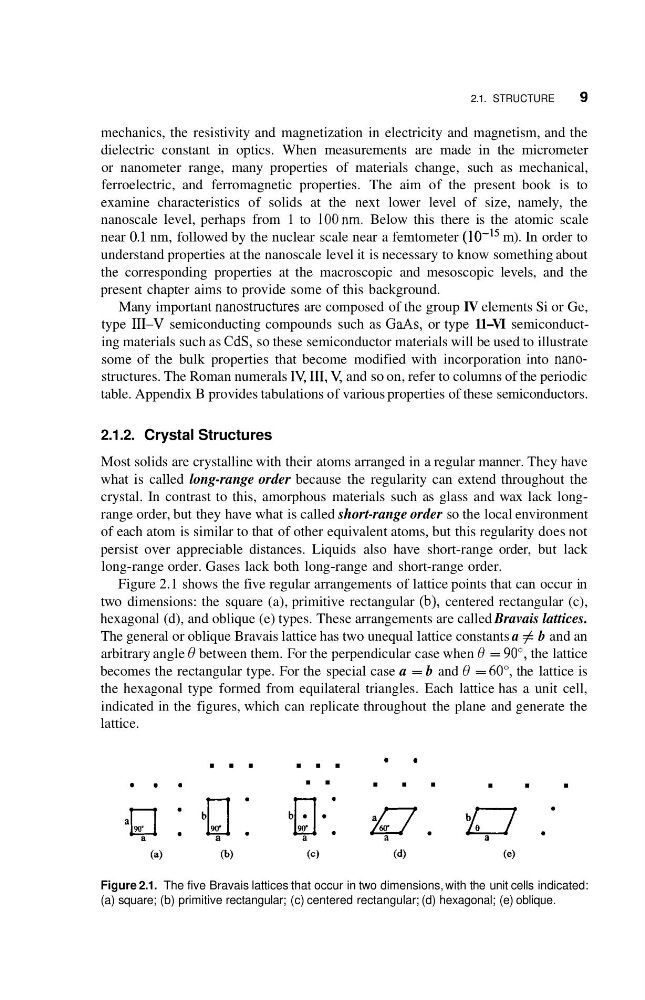
Figure 2.1 shows the five regular arrangements of lattice points that can occur in
two dimensions: the square (a), primitive rectangular (b), centered rectangular (c),
hexagonal (d), and oblique (e) types. These arrangements are called Bravais lattices.
The general or oblique Bravais lattice has two unequal lattice constants a # b and an
arbitrary angle 8 between them. For the perpendicular case when 19 = 90°, the lattice
becomes the rectangular type. For the special case a = b and 8 = 60°, the lattice is
the hexagonal type formed from equilateral triangles. Each lattice has a unit cell,
indicated in the figures, which can replicate throughout the plane and generate the
lattice.
a
.
. . . . . . . . .
.
.
a
. . .
. .
Figure 2.1. The five Bravais lattices that occur in two dimensions, with the unit cells indicated:
(a) square; (b) primitive rectangular; (c) centered rectangular; (d) hexagonal; (e) oblique.
9
mechanics, the resistivity and magnetization in electricity and magnetism, and the
dielectric constant in optics. When measurements are made in the micrometer
or nanometer range, many properties of materials change, such as mechanical,
ferroelectric, and ferromagnetic properties. The aim of the present book is to
examine characteristics of solids at the next lower level of size, namely, the
nanoscale level, perhaps from 1 to l00nm. Below this there is the atomic scale
near 0.1 nm, followed by the nuclear scale near a femtometer
m). In order to
understand properties at the nanoscale level it is necessary to know something about
the corresponding properties at the macroscopic and mesoscopic levels, and the
present chapter aims to provide some of this background.
Many important nanostmctures are composed of the group IV elements Si or Ge,
type 111-V semiconducting compounds such as GaAs, or type 11-VI semiconducting materials such as CdS, so these semiconductor materials will be used to illustrate
some of the bulk properties that become modified with incorporation into nanostructures. The Roman numerals IV, 111, V, and so on, refer to columns of the periodic
table. Appendix B provides tabulations of various properties of these semiconductors.
2.1.2. Crystal Structures
Most solids are crystalline with their atoms arranged in a regular manner. They have
what is called long-range order because the regularity can extend throughout the
crystal. In contrast to this, amorphous materials such as glass and wax lack longrange order, but they have what is called short-range order so the local environment
of each atom is similar to that of other equivalent atoms, but this regularity does not
persist over appreciable distances. Liquids also have short-range order, but lack
long-range order. Gases lack both long-range and short-range order.
Figure 2.1 shows the five regular arrangements of lattice points that can occur in
two dimensions: the square (a), primitive rectangular (b), centered rectangular (c),
hexagonal (d), and oblique (e) types. These arrangements are called Bravais lattices.
The general or oblique Bravais lattice has two unequal lattice constants a # b and an
arbitrary angle 8 between them. For the perpendicular case when 19 = 90°, the lattice
becomes the rectangular type. For the special case a = b and 8 = 60°, the lattice is
the hexagonal type formed from equilateral triangles. Each lattice has a unit cell,
indicated in the figures, which can replicate throughout the plane and generate the
lattice.
a
.
. . . . . . . . .
.
.
a
. . .
. .
Figure 2.1. The five Bravais lattices that occur in two dimensions, with the unit cells indicated:
(a) square; (b) primitive rectangular; (c) centered rectangular; (d) hexagonal; (e) oblique.