

196
OPTICAL AND VIBRATIONAL SPECTROSCOPY
t
Radiationless
Incident
photonhw,
transition
Luminescent
i -
emission hq,,
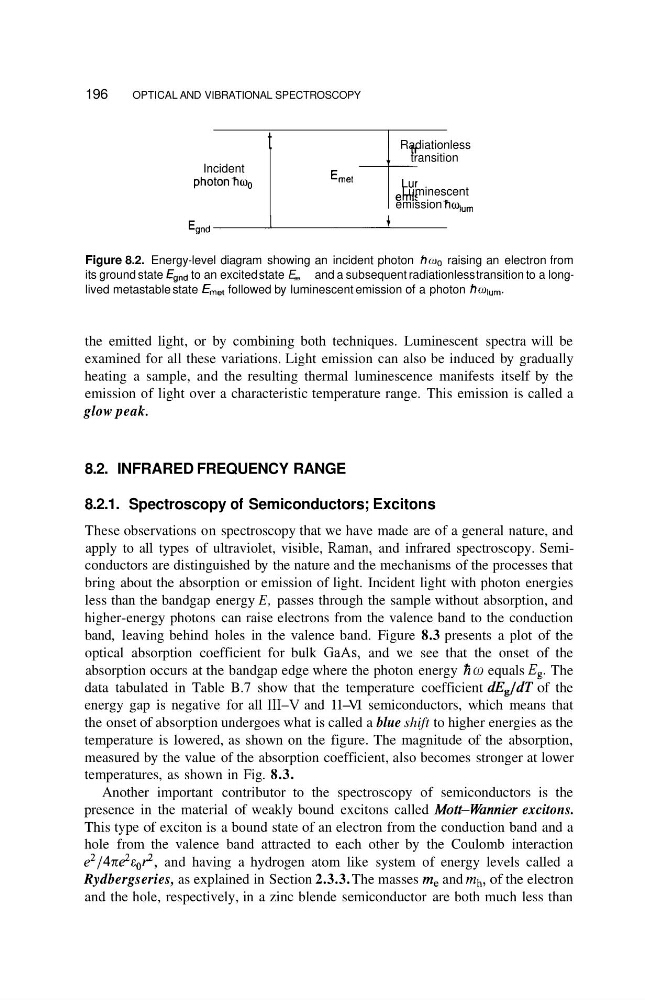
Figure 8.2. Energy-level diagram showing an incident photon htuo raising an electron from
its ground state Egnd to an excited state E,,,, and a subsequent radiationless transition to a longlived metastable state E,,,,, followed by luminescent emission of a photon ho,,,.
the emitted light, or by combining both techniques. Luminescent spectra will be
examined for all these variations. Light emission can also be induced by gradually
heating a sample, and the resulting thermal luminescence manifests itself by the
emission of light over a characteristic temperature range. This emission is called a
glow peak.
8.2. INFRARED FREQUENCY RANGE
8.2.1. Spectroscopy of Semiconductors; Excitons
These observations on spectroscopy that we have made are of a general nature, and
apply to all types of ultraviolet, visible, Raman, and infrared spectroscopy. Semiconductors are distinguished by the nature and the mechanisms of the processes that
bring about the absorption or emission of light. Incident light with photon energies
less than the bandgap energy E, passes through the sample without absorption, and
higher-energy photons can raise electrons from the valence band to the conduction
band, leaving behind holes in the valence band. Figure 8.3 presents a plot of the
optical absorption coefficient for bulk GaAs, and we see that the onset of the
absorption occurs at the bandgap edge where the photon energy A o equals Eg. The
data tabulated in Table B.7 show that the temperature coefficient dE,/dT of the
energy gap is negative for all 111-V and 11-VI semiconductors, which means that
the onset of absorption undergoes what is called a blue shift to higher energies as the
temperature is lowered, as shown on the figure. The magnitude of the absorption,
measured by the value of the absorption coefficient, also becomes stronger at lower
temperatures, as shown in Fig. 8.3.
Another important contributor to the spectroscopy of semiconductors is the
presence in the material of weakly bound excitons called Mott-Wannier excitons.
This type of exciton is a bound state of an electron from the conduction band and a
hole from the valence band attracted to each other by the Coulomb interaction
e 2 / 4 7 d ~ , ? , and having a hydrogen atom like system of energy levels called a
Rydbergseries, as explained in Section 2.3.3. The masses me and mh, of the electron
and the hole, respectively, in a zinc blende semiconductor are both much less than
OPTICAL AND VIBRATIONAL SPECTROSCOPY
t
Radiationless
Incident
photonhw,
transition
Luminescent
i -
emission hq,,
Figure 8.2. Energy-level diagram showing an incident photon htuo raising an electron from
its ground state Egnd to an excited state E,,,, and a subsequent radiationless transition to a longlived metastable state E,,,,, followed by luminescent emission of a photon ho,,,.
the emitted light, or by combining both techniques. Luminescent spectra will be
examined for all these variations. Light emission can also be induced by gradually
heating a sample, and the resulting thermal luminescence manifests itself by the
emission of light over a characteristic temperature range. This emission is called a
glow peak.
8.2. INFRARED FREQUENCY RANGE
8.2.1. Spectroscopy of Semiconductors; Excitons
These observations on spectroscopy that we have made are of a general nature, and
apply to all types of ultraviolet, visible, Raman, and infrared spectroscopy. Semiconductors are distinguished by the nature and the mechanisms of the processes that
bring about the absorption or emission of light. Incident light with photon energies
less than the bandgap energy E, passes through the sample without absorption, and
higher-energy photons can raise electrons from the valence band to the conduction
band, leaving behind holes in the valence band. Figure 8.3 presents a plot of the
optical absorption coefficient for bulk GaAs, and we see that the onset of the
absorption occurs at the bandgap edge where the photon energy A o equals Eg. The
data tabulated in Table B.7 show that the temperature coefficient dE,/dT of the
energy gap is negative for all 111-V and 11-VI semiconductors, which means that
the onset of absorption undergoes what is called a blue shift to higher energies as the
temperature is lowered, as shown on the figure. The magnitude of the absorption,
measured by the value of the absorption coefficient, also becomes stronger at lower
temperatures, as shown in Fig. 8.3.
Another important contributor to the spectroscopy of semiconductors is the
presence in the material of weakly bound excitons called Mott-Wannier excitons.
This type of exciton is a bound state of an electron from the conduction band and a
hole from the valence band attracted to each other by the Coulomb interaction
e 2 / 4 7 d ~ , ? , and having a hydrogen atom like system of energy levels called a
Rydbergseries, as explained in Section 2.3.3. The masses me and mh, of the electron
and the hole, respectively, in a zinc blende semiconductor are both much less than