

1 0 -
I R f
I A
8.1. INTRODUCTION
195
- 1 1
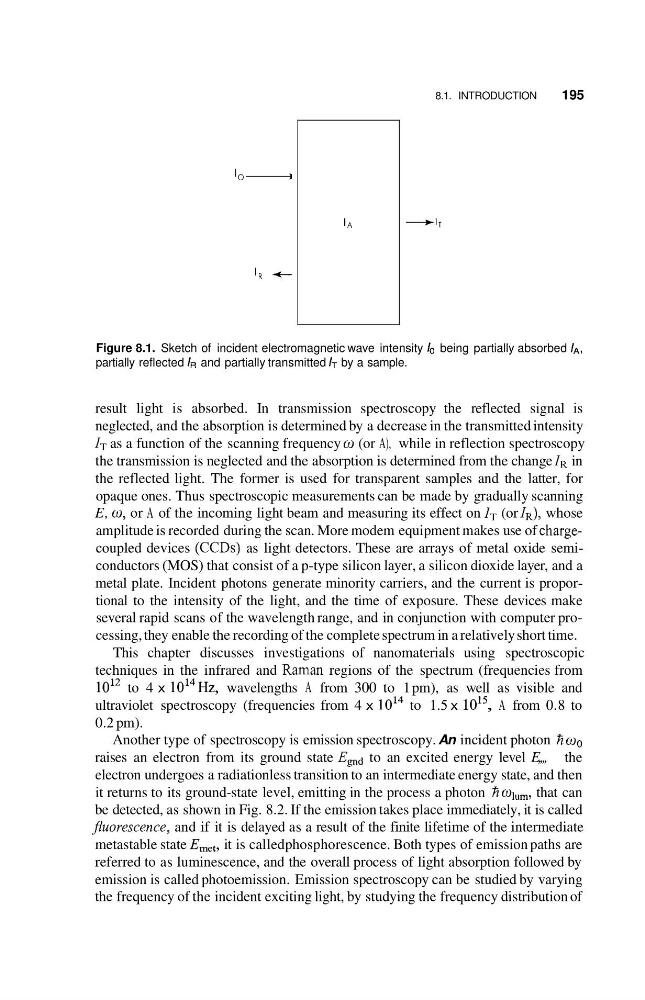
Figure 8.1. Sketch of incident electromagnetic wave intensity Io being partially absorbed In,
partially reflected IR and partially transmitted IT by a sample.
result light is absorbed. In transmission spectroscopy the reflected signal is
neglected, and the absorption is determined by a decrease in the transmitted intensity
ZT as a function of the scanning frequency o (or A), while in reflection spectroscopy
the transmission is neglected and the absorption is determined from the change Z
, in
the reflected light. The former is used for transparent samples and the latter, for
opaque ones. Thus spectroscopic measurements can be made by gradually scanning
E, o, or A of the incoming light beam and measuring its effect on ZT (or IR), whose
amplitude is recorded during the scan. More modem equipment makes use of chargecoupled devices (CCDs) as light detectors. These are arrays of metal oxide semiconductors (MOS) that consist of a p-type silicon layer, a silicon dioxide layer, and a
metal plate. Incident photons generate minority carriers, and the current is proportional to the intensity of the light, and the time of exposure. These devices make
several rapid scans of the wavelength range, and in conjunction with computer processing, they enable the recording of the complete spectrum in a relatively short time.
This chapter discusses investigations of nanomaterials using spectroscopic
techniques in the infrared and Raman regions of the spectrum (frequencies from
10l2 to 4 x 10¹⁴Hz, wavelengths A from 300 to 1 pm), as well as visible and
ultraviolet spectroscopy (frequencies from 4 x 10¹⁴ to 1.5 x
A from 0.8 to
0.2 pm).
Another type of spectroscopy is emission spectroscopy. An incident photon h oo
raises an electron from its ground state Egnd to an excited energy level E,,,, the
electron undergoes a radiationless transition to an intermediate energy state, and then
it returns to its ground-state level, emitting in the process a photon h alum, that can
be detected, as shown in Fig. 8.2. If the emission takes place immediately, it is called
Jluorescence, and if it is delayed as a result of the finite lifetime of the intermediate
metastable state Emet, it is calledphosphorescence. Both types of emission paths are
referred to as luminescence, and the overall process of light absorption followed by
emission is called photoemission. Emission spectroscopy can be studied by varying
the frequency of the incident exciting light, by studying the frequency distribution of
I R f
I A
8.1. INTRODUCTION
195
- 1 1
Figure 8.1. Sketch of incident electromagnetic wave intensity Io being partially absorbed In,
partially reflected IR and partially transmitted IT by a sample.
result light is absorbed. In transmission spectroscopy the reflected signal is
neglected, and the absorption is determined by a decrease in the transmitted intensity
ZT as a function of the scanning frequency o (or A), while in reflection spectroscopy
the transmission is neglected and the absorption is determined from the change Z
, in
the reflected light. The former is used for transparent samples and the latter, for
opaque ones. Thus spectroscopic measurements can be made by gradually scanning
E, o, or A of the incoming light beam and measuring its effect on ZT (or IR), whose
amplitude is recorded during the scan. More modem equipment makes use of chargecoupled devices (CCDs) as light detectors. These are arrays of metal oxide semiconductors (MOS) that consist of a p-type silicon layer, a silicon dioxide layer, and a
metal plate. Incident photons generate minority carriers, and the current is proportional to the intensity of the light, and the time of exposure. These devices make
several rapid scans of the wavelength range, and in conjunction with computer processing, they enable the recording of the complete spectrum in a relatively short time.
This chapter discusses investigations of nanomaterials using spectroscopic
techniques in the infrared and Raman regions of the spectrum (frequencies from
10l2 to 4 x 10¹⁴Hz, wavelengths A from 300 to 1 pm), as well as visible and
ultraviolet spectroscopy (frequencies from 4 x 10¹⁴ to 1.5 x
A from 0.8 to
0.2 pm).
Another type of spectroscopy is emission spectroscopy. An incident photon h oo
raises an electron from its ground state Egnd to an excited energy level E,,,, the
electron undergoes a radiationless transition to an intermediate energy state, and then
it returns to its ground-state level, emitting in the process a photon h alum, that can
be detected, as shown in Fig. 8.2. If the emission takes place immediately, it is called
Jluorescence, and if it is delayed as a result of the finite lifetime of the intermediate
metastable state Emet, it is calledphosphorescence. Both types of emission paths are
referred to as luminescence, and the overall process of light absorption followed by
emission is called photoemission. Emission spectroscopy can be studied by varying
the frequency of the incident exciting light, by studying the frequency distribution of