

174
NANOSTRUCTURED FERROMAGNETISM
d, NANOMETERS
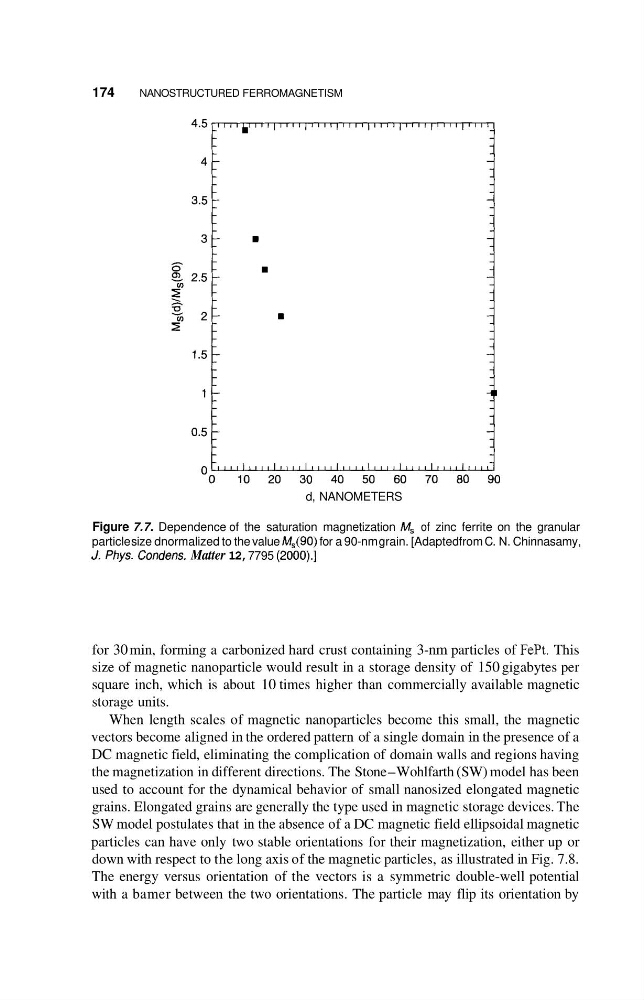
Figure 7.7. Dependence of the saturation magnetization Ms of zinc ferrite on the granular
particle size dnormalized to the value Ms(90) for a 90-nm grain. [Adapted from C. N. Chinnasamy,
J. Phys. Condens. Matter 12, 7795 (2000).]
for 30 min, forming a carbonized hard crust containing 3-nm particles of FePt. This
size of magnetic nanoparticle would result in a storage density of 150 gigabytes per
square inch, which is about 10 times higher than commercially available magnetic
storage units.
When length scales of magnetic nanoparticles become this small, the magnetic
vectors become aligned in the ordered pattern of a single domain in the presence of a
DC magnetic field, eliminating the complication of domain walls and regions having
the magnetization in different directions. The Stone-Wohlfarth (SW) model has been
used to account for the dynamical behavior of small nanosized elongated magnetic
grains. Elongated grains are generally the type used in magnetic storage devices. The
SW model postulates that in the absence of a DC magnetic field ellipsoidal magnetic
particles can have only two stable orientations for their magnetization, either up or
down with respect to the long axis of the magnetic particles, as illustrated in Fig. 7.8.
The energy versus orientation of the vectors is a symmetric double-well potential
with a bamer between the two orientations. The particle may flip its orientation by
NANOSTRUCTURED FERROMAGNETISM
d, NANOMETERS
Figure 7.7. Dependence of the saturation magnetization Ms of zinc ferrite on the granular
particle size dnormalized to the value Ms(90) for a 90-nm grain. [Adapted from C. N. Chinnasamy,
J. Phys. Condens. Matter 12, 7795 (2000).]
for 30 min, forming a carbonized hard crust containing 3-nm particles of FePt. This
size of magnetic nanoparticle would result in a storage density of 150 gigabytes per
square inch, which is about 10 times higher than commercially available magnetic
storage units.
When length scales of magnetic nanoparticles become this small, the magnetic
vectors become aligned in the ordered pattern of a single domain in the presence of a
DC magnetic field, eliminating the complication of domain walls and regions having
the magnetization in different directions. The Stone-Wohlfarth (SW) model has been
used to account for the dynamical behavior of small nanosized elongated magnetic
grains. Elongated grains are generally the type used in magnetic storage devices. The
SW model postulates that in the absence of a DC magnetic field ellipsoidal magnetic
particles can have only two stable orientations for their magnetization, either up or
down with respect to the long axis of the magnetic particles, as illustrated in Fig. 7.8.
The energy versus orientation of the vectors is a symmetric double-well potential
with a bamer between the two orientations. The particle may flip its orientation by