

7.3. DYNAMICS OF NANOMAGNETS
173
2.1 I I I I , , , , , ~ I I I , , I l , , ~ , , I I
I I I I , ~ , , I , , I , I I ~ l l , ,
1.9 -
-I1
1.7 -
-
1.5 -
-
- m
Lo
-
1.3 -
-
v
a?
1.1 -
-
0.9 -
-
0.7 -
-
0.5 " " 1 " ~ 1 " 1 1 1 " " ~ " ' " " " " " ' ' " ' ~ ' ' '
0
10 20 30 40 50 60 70 80 90
d. NANOMETERS
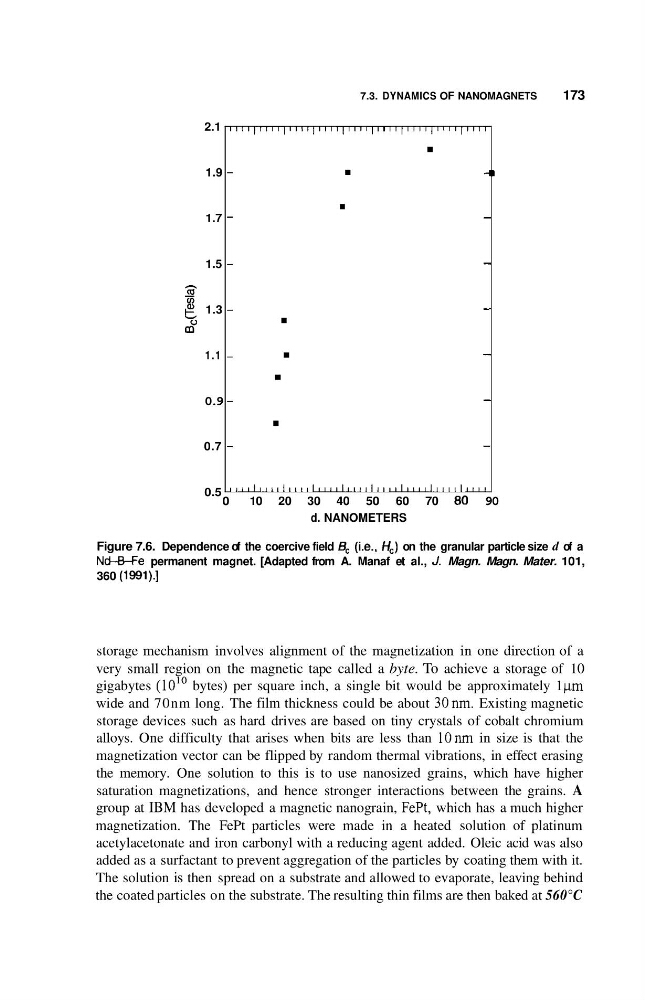
Figure 7.6. Dependence of the coercive field B, (i.e., H,) on the granular particle size d of a
N6B-Fe permanent magnet. [Adapted from A. Manaf et al., J. Magn. Magn. Mater. 101,
360 (1991).]
storage mechanism involves alignment of the magnetization in one direction of a
very small region on the magnetic tape called a byte. To achieve a storage of 10
gigabytes (10'' bytes) per square inch, a single bit would be approximately 1 pm
wide and 70nm long. The film thickness could be about 30nm. Existing magnetic
storage devices such as hard drives are based on tiny crystals of cobalt chromium
alloys. One difficulty that arises when bits are less than lOnm in size is that the
magnetization vector can be flipped by random thermal vibrations, in effect erasing
the memory. One solution to this is to use nanosized grains, which have higher
saturation magnetizations, and hence stronger interactions between the grains. A
group at IBM has developed a magnetic nanograin, FePt, which has a much higher
magnetization. The FePt particles were made in a heated solution of platinum
acetylacetonate and iron carbonyl with a reducing agent added. Oleic acid was also
added as a surfactant to prevent aggregation of the particles by coating them with it.
The solution is then spread on a substrate and allowed to evaporate, leaving behind
the coated particles on the substrate. The resulting thin films are then baked at 560°C
173
2.1 I I I I , , , , , ~ I I I , , I l , , ~ , , I I
I I I I , ~ , , I , , I , I I ~ l l , ,
1.9 -
-I1
1.7 -
-
1.5 -
-
- m
Lo
-
1.3 -
-
v
a?
1.1 -
-
0.9 -
-
0.7 -
-
0.5 " " 1 " ~ 1 " 1 1 1 " " ~ " ' " " " " " ' ' " ' ~ ' ' '
0
10 20 30 40 50 60 70 80 90
d. NANOMETERS
Figure 7.6. Dependence of the coercive field B, (i.e., H,) on the granular particle size d of a
N6B-Fe permanent magnet. [Adapted from A. Manaf et al., J. Magn. Magn. Mater. 101,
360 (1991).]
storage mechanism involves alignment of the magnetization in one direction of a
very small region on the magnetic tape called a byte. To achieve a storage of 10
gigabytes (10'' bytes) per square inch, a single bit would be approximately 1 pm
wide and 70nm long. The film thickness could be about 30nm. Existing magnetic
storage devices such as hard drives are based on tiny crystals of cobalt chromium
alloys. One difficulty that arises when bits are less than lOnm in size is that the
magnetization vector can be flipped by random thermal vibrations, in effect erasing
the memory. One solution to this is to use nanosized grains, which have higher
saturation magnetizations, and hence stronger interactions between the grains. A
group at IBM has developed a magnetic nanograin, FePt, which has a much higher
magnetization. The FePt particles were made in a heated solution of platinum
acetylacetonate and iron carbonyl with a reducing agent added. Oleic acid was also
added as a surfactant to prevent aggregation of the particles by coating them with it.
The solution is then spread on a substrate and allowed to evaporate, leaving behind
the coated particles on the substrate. The resulting thin films are then baked at 560°C