

172
O
.
l
5
~
0.7 0
10 20 30 40 50 60 70 80 90
NANOSTRUCTURED FERROMAGNETISM
100
0.95 '
I
h
m
u)
-
e.
z 0.9
!
Y
L
-
-
9
2
I -
z
9 0.8
a
5
U
-
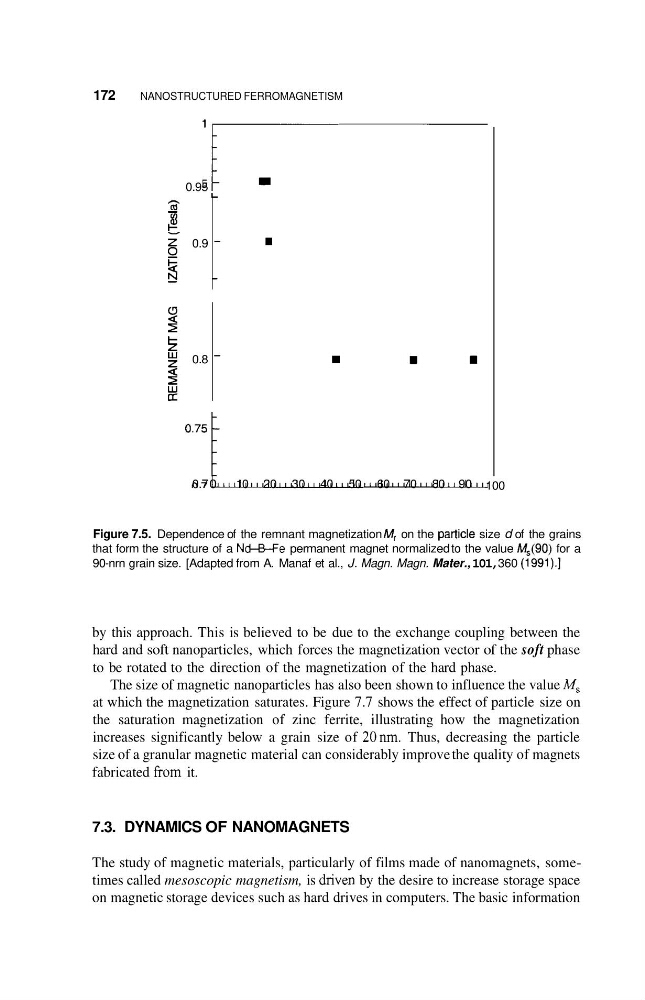
Figure 7.5. Dependence of the remnant magnetization Mr on the particle size d of the grains
that form the structure of a Nd-EMe permanent magnet normalized to the value Ms(90) for a
90-nrn grain size. [Adapted from A. Manaf et al., J. Magn. Magn. Mater., 101, 360 (1991).]
by this approach. This is believed to be due to the exchange coupling between the
hard and soft nanoparticles, which forces the magnetization vector of the soft phase
to be rotated to the direction of the magnetization of the hard phase.
The size of magnetic nanoparticles has also been shown to influence the value M,
at which the magnetization saturates. Figure 7.7 shows the effect of particle size on
the saturation magnetization of zinc ferrite, illustrating how the magnetization
increases significantly below a grain size of 20nm. Thus, decreasing the particle
size of a granular magnetic material can considerably improve the quality of magnets
fabricated from it.
7.3. DYNAMICS OF NANOMAGNETS
The study of magnetic materials, particularly of films made of nanomagnets, sometimes called mesoscopic magnetism, is dnven by the desire to increase storage space
on magnetic storage devices such as hard drives in computers. The basic information
O
.
l
5
~
0.7 0
10 20 30 40 50 60 70 80 90
NANOSTRUCTURED FERROMAGNETISM
100
0.95 '
I
h
m
u)
-
e.
z 0.9
!
Y
L
-
-
9
2
I -
z
9 0.8
a
5
U
-
Figure 7.5. Dependence of the remnant magnetization Mr on the particle size d of the grains
that form the structure of a Nd-EMe permanent magnet normalized to the value Ms(90) for a
90-nrn grain size. [Adapted from A. Manaf et al., J. Magn. Magn. Mater., 101, 360 (1991).]
by this approach. This is believed to be due to the exchange coupling between the
hard and soft nanoparticles, which forces the magnetization vector of the soft phase
to be rotated to the direction of the magnetization of the hard phase.
The size of magnetic nanoparticles has also been shown to influence the value M,
at which the magnetization saturates. Figure 7.7 shows the effect of particle size on
the saturation magnetization of zinc ferrite, illustrating how the magnetization
increases significantly below a grain size of 20nm. Thus, decreasing the particle
size of a granular magnetic material can considerably improve the quality of magnets
fabricated from it.
7.3. DYNAMICS OF NANOMAGNETS
The study of magnetic materials, particularly of films made of nanomagnets, sometimes called mesoscopic magnetism, is dnven by the desire to increase storage space
on magnetic storage devices such as hard drives in computers. The basic information