

7.2. EFFECT OF BULK NANOSTRUCTURING ON
171
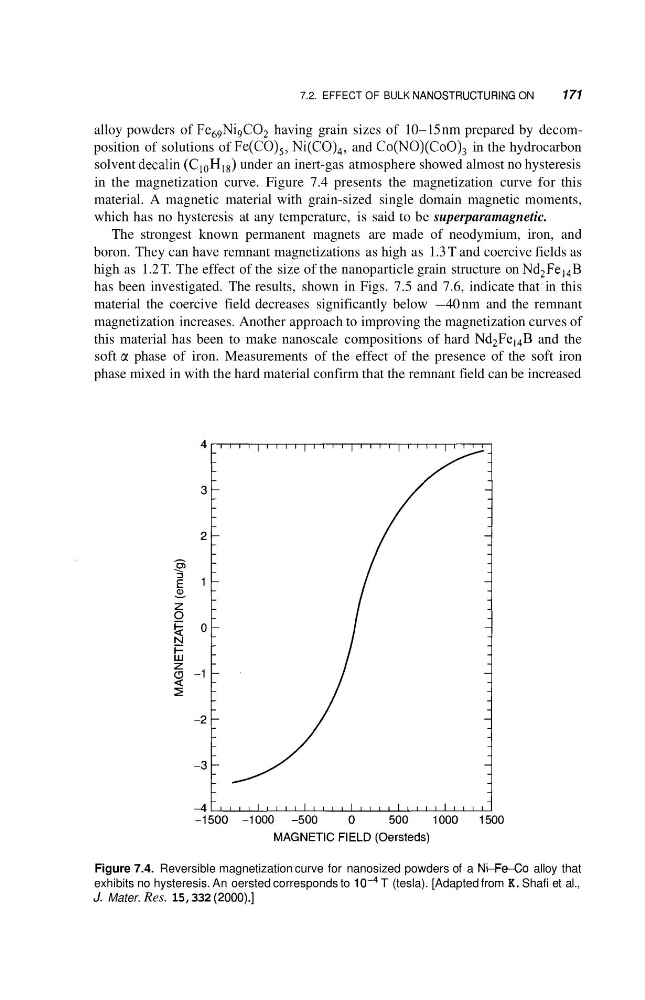
alloy powders of Fe,,Ni,CO, having grain sizes of 10-15 nm prepared by decomposition of solutions of Fe(CO),, Ni(CO),, and Co(NO)(CoO), in the hydrocarbon
solvent decalin (C,oH,,) under an inert-gas atmosphere showed almost no hysteresis
in the magnetization curve. Figure 7.4 presents the magnetization curve for this
material. A magnetic material with grain-sized single domain magnetic moments,
which has no hysteresis at any temperature, is said to be superparamagnetic.
The strongest known permanent magnets are made of neodymium, iron, and
boron. They can have remnant magnetizations as high as 1.3 T and coercive fields as
high as 1.2 T. The effect of the size of the nanoparticle grain structure on Nd,Fe,,B
has been investigated. The results, shown in Figs. 7.5 and 7.6, indicate that in this
material the coercive field decreases significantly below -40 nm and the remnant
magnetization increases. Another approach to improving the magnetization curves of
this material has been to make nanoscale compositions of hard Nd,Fe,,B and the
soft c1 phase of iron. Measurements of the effect of the presence of the soft iron
phase mixed in with the hard material confirm that the remnant field can be increased
Figure 7.4. Reversible magnetization curve for nanosized powders of a NLF&o alloy that
exhibits no hysteresis. An oersted corresponds to
T (tesla). [Adapted from K. Shafi et al.,
J. Mater. Res. 15, 332 (2000).]
171
alloy powders of Fe,,Ni,CO, having grain sizes of 10-15 nm prepared by decomposition of solutions of Fe(CO),, Ni(CO),, and Co(NO)(CoO), in the hydrocarbon
solvent decalin (C,oH,,) under an inert-gas atmosphere showed almost no hysteresis
in the magnetization curve. Figure 7.4 presents the magnetization curve for this
material. A magnetic material with grain-sized single domain magnetic moments,
which has no hysteresis at any temperature, is said to be superparamagnetic.
The strongest known permanent magnets are made of neodymium, iron, and
boron. They can have remnant magnetizations as high as 1.3 T and coercive fields as
high as 1.2 T. The effect of the size of the nanoparticle grain structure on Nd,Fe,,B
has been investigated. The results, shown in Figs. 7.5 and 7.6, indicate that in this
material the coercive field decreases significantly below -40 nm and the remnant
magnetization increases. Another approach to improving the magnetization curves of
this material has been to make nanoscale compositions of hard Nd,Fe,,B and the
soft c1 phase of iron. Measurements of the effect of the presence of the soft iron
phase mixed in with the hard material confirm that the remnant field can be increased
Figure 7.4. Reversible magnetization curve for nanosized powders of a NLF&o alloy that
exhibits no hysteresis. An oersted corresponds to
T (tesla). [Adapted from K. Shafi et al.,
J. Mater. Res. 15, 332 (2000).]