

170
NANOSTRUCTURED FERROMAGNETISM
M
t
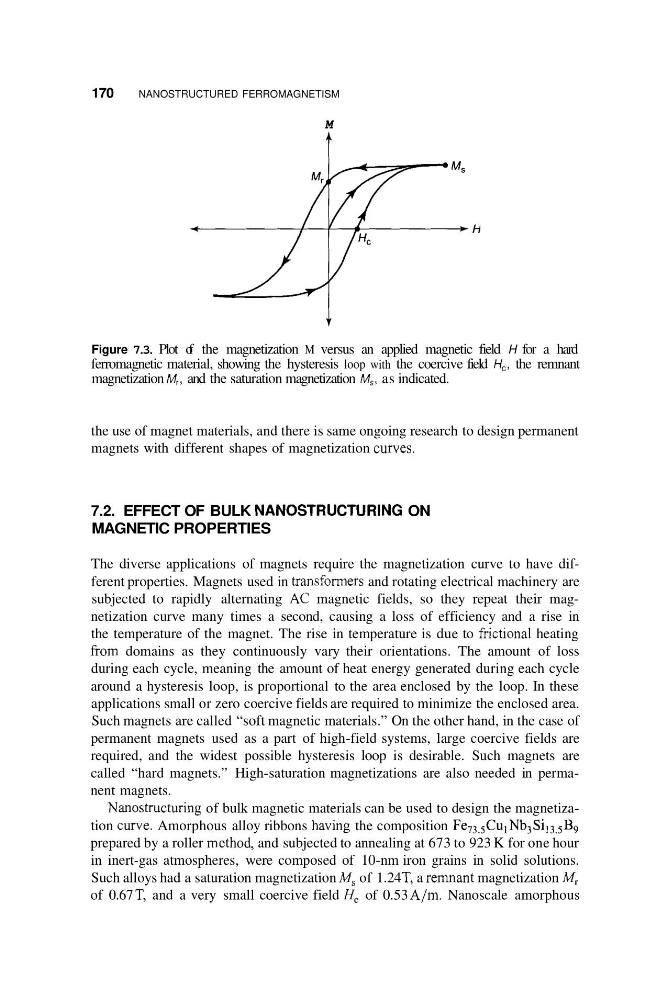
Figure 7.3. Plot of the magnetization M versus an applied magnetic field H for a hard
ferromagnetic material, showing the hysteresis loop with the coercive field Hc, the remnant
magnetization Mr, and the saturation magnetization Ms, as indicated.
the use of magnet materials, and there is same ongoing research to design permanent
magnets with different shapes of magnetization curves.
7.2. EFFECT OF BULK NANOSTRUCTURING ON
MAGNETIC PROPERTIES
The diverse applications of magnets require the magnetization curve to have different properties. Magnets used in transformers and rotating electrical machinery are
subjected to rapidly alternating AC magnetic fields, so they repeat their magnetization curve many times a second, causing a loss of efficiency and a rise in
the temperature of the magnet. The rise in temperature is due to frictional heating
from domains as they continuously vary their orientations. The amount of loss
during each cycle, meaning the amount of heat energy generated during each cycle
around a hysteresis loop, is proportional to the area enclosed by the loop. In these
applications small or zero coercive fields are required to minimize the enclosed area.
Such magnets are called “soft magnetic materials.” On the other hand, in the case of
permanent magnets used as a part of high-field systems, large coercive fields are
required, and the widest possible hysteresis loop is desirable. Such magnets are
called “hard magnets.” High-saturation magnetizations are also needed in permanent magnets.
Nanostructuring of bulk magnetic materials can be used to design the magnetization curve. Amorphous alloy ribbons having the composition Fe,3.5CulNb3Si,3.5B9
prepared by a roller method and subjected to annealing at 673 to 923 K for one hour
in inert-gas atmospheres, were composed of 10-nm iron grains in solid solutions.
Such alloys had a saturation magnetization M, of 1.24 T, a remnant magnetization M,
of 0.67 T, and a very small coercive field H, of 0.53 A/m. Nanoscale amorphous
NANOSTRUCTURED FERROMAGNETISM
M
t
Figure 7.3. Plot of the magnetization M versus an applied magnetic field H for a hard
ferromagnetic material, showing the hysteresis loop with the coercive field Hc, the remnant
magnetization Mr, and the saturation magnetization Ms, as indicated.
the use of magnet materials, and there is same ongoing research to design permanent
magnets with different shapes of magnetization curves.
7.2. EFFECT OF BULK NANOSTRUCTURING ON
MAGNETIC PROPERTIES
The diverse applications of magnets require the magnetization curve to have different properties. Magnets used in transformers and rotating electrical machinery are
subjected to rapidly alternating AC magnetic fields, so they repeat their magnetization curve many times a second, causing a loss of efficiency and a rise in
the temperature of the magnet. The rise in temperature is due to frictional heating
from domains as they continuously vary their orientations. The amount of loss
during each cycle, meaning the amount of heat energy generated during each cycle
around a hysteresis loop, is proportional to the area enclosed by the loop. In these
applications small or zero coercive fields are required to minimize the enclosed area.
Such magnets are called “soft magnetic materials.” On the other hand, in the case of
permanent magnets used as a part of high-field systems, large coercive fields are
required, and the widest possible hysteresis loop is desirable. Such magnets are
called “hard magnets.” High-saturation magnetizations are also needed in permanent magnets.
Nanostructuring of bulk magnetic materials can be used to design the magnetization curve. Amorphous alloy ribbons having the composition Fe,3.5CulNb3Si,3.5B9
prepared by a roller method and subjected to annealing at 673 to 923 K for one hour
in inert-gas atmospheres, were composed of 10-nm iron grains in solid solutions.
Such alloys had a saturation magnetization M, of 1.24 T, a remnant magnetization M,
of 0.67 T, and a very small coercive field H, of 0.53 A/m. Nanoscale amorphous