

7.1. BASICS OF FERROMAGNETISM
169
INITIAL
CONFIGURATION
,i :k
DOMAIN
ROTATl ON
(b)
DOMAIN
GROWTH
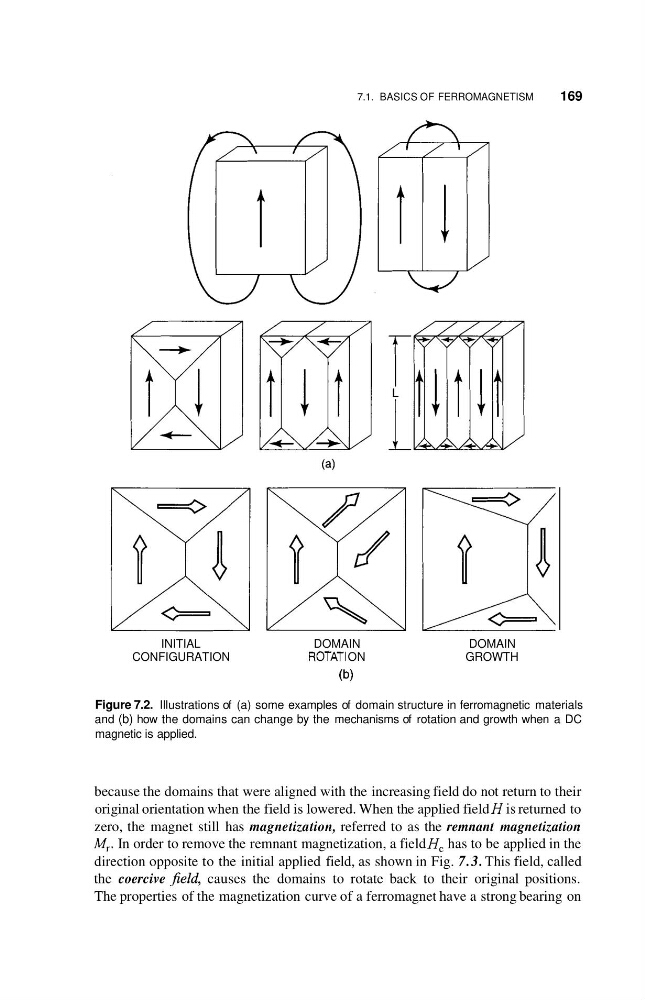
Figure 7.2. Illustrations of (a) some examples of domain structure in ferromagnetic materials
and (b) how the domains can change by the mechanisms of rotation and growth when a DC
magnetic is applied.
because the domains that were aligned with the increasing field do not return to their
original orientation when the field is lowered. When the applied field H is returned to
zero, the magnet still has magnetization, referred to as the remnant magnetization
M,. In order to remove the remnant magnetization, a field H, has to be applied in the
direction opposite to the initial applied field, as shown in Fig. 7.3. This field, called
the coercive jield, causes the domains to rotate back to their original positions.
The properties of the magnetization curve of a ferromagnet have a strong bearing on
169
INITIAL
CONFIGURATION
,i :k
DOMAIN
ROTATl ON
(b)
DOMAIN
GROWTH
Figure 7.2. Illustrations of (a) some examples of domain structure in ferromagnetic materials
and (b) how the domains can change by the mechanisms of rotation and growth when a DC
magnetic is applied.
because the domains that were aligned with the increasing field do not return to their
original orientation when the field is lowered. When the applied field H is returned to
zero, the magnet still has magnetization, referred to as the remnant magnetization
M,. In order to remove the remnant magnetization, a field H, has to be applied in the
direction opposite to the initial applied field, as shown in Fig. 7.3. This field, called
the coercive jield, causes the domains to rotate back to their original positions.
The properties of the magnetization curve of a ferromagnet have a strong bearing on