

7.3. DYNAMICS OF NANOMAGNETS
175
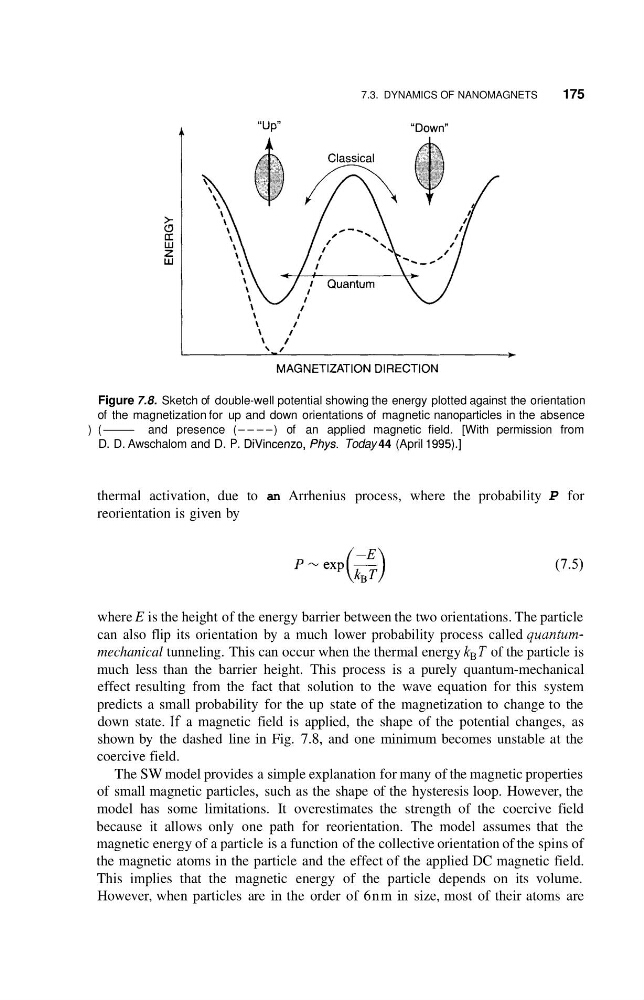
Figure 7.8. Sketch of double-well potential showing the energy plotted against the orientation
of the magnetization for up and down orientations of magnetic nanoparticles in the absence
(
-
)
and presence (----) of an applied magnetic field. [With permission from
D. D. Awschalom and D. P. DiVincenzo, Phys. Today 44 (April 1995).]
thermal activation, due to an Arrhenius process, where the probability P for
reorientation is given by
where E is the height of the energy barrier between the two orientations. The particle
can also flip its orientation by a much lower probability process called quunturnmechanical tunneling. This can occur when the thermal energy kBT of the particle is
much less than the barrier height. This process is a purely quantum-mechanical
effect resulting from the fact that solution to the wave equation for this system
predicts a small probability for the up state of the magnetization to change to the
down state. If a magnetic field is applied, the shape of the potential changes, as
shown by the dashed line in Fig. 7.8, and one minimum becomes unstable at the
coercive field.
The SW model provides a simple explanation for many of the magnetic properties
of small magnetic particles, such as the shape of the hysteresis loop. However, the
model has some limitations. It overestimates the strength of the coercive field
because it allows only one path for reorientation. The model assumes that the
magnetic energy of a particle is a function of the collective orientation of the spins of
the magnetic atoms in the particle and the effect of the applied DC magnetic field.
This implies that the magnetic energy of the particle depends on its volume.
However, when particles are in the order of 6nm in size, most of their atoms are
175
Figure 7.8. Sketch of double-well potential showing the energy plotted against the orientation
of the magnetization for up and down orientations of magnetic nanoparticles in the absence
(
-
)
and presence (----) of an applied magnetic field. [With permission from
D. D. Awschalom and D. P. DiVincenzo, Phys. Today 44 (April 1995).]
thermal activation, due to an Arrhenius process, where the probability P for
reorientation is given by
where E is the height of the energy barrier between the two orientations. The particle
can also flip its orientation by a much lower probability process called quunturnmechanical tunneling. This can occur when the thermal energy kBT of the particle is
much less than the barrier height. This process is a purely quantum-mechanical
effect resulting from the fact that solution to the wave equation for this system
predicts a small probability for the up state of the magnetization to change to the
down state. If a magnetic field is applied, the shape of the potential changes, as
shown by the dashed line in Fig. 7.8, and one minimum becomes unstable at the
coercive field.
The SW model provides a simple explanation for many of the magnetic properties
of small magnetic particles, such as the shape of the hysteresis loop. However, the
model has some limitations. It overestimates the strength of the coercive field
because it allows only one path for reorientation. The model assumes that the
magnetic energy of a particle is a function of the collective orientation of the spins of
the magnetic atoms in the particle and the effect of the applied DC magnetic field.
This implies that the magnetic energy of the particle depends on its volume.
However, when particles are in the order of 6nm in size, most of their atoms are