

7.1. BASICS OF FERROMAGNETISM
167
an antiparallel scheme, that is, opposite to each other, as shown in Fig. 7.14 and
hence the material has no net magnetic moment. In the present chapter we are
concerned mainly with ferromagnetic ordering.
Now let us consider the question of why the individual atomic magnets align in
some materials and not others. When a DC magnetic field is applied to a bar magnet,
the magnetic moment tends to align with the direction of the applied field. In a crystal
each atom having a magnetic moment has a magnetic field about it. If the magnetic
moment is large enough, the resulting large DC magnetic field can force a nearest
neighbor to align in the same direction provided the interaction energy is larger than
the thermal vibrational energy kBT of the atoms in the lattice. The interaction
between atomic magnetic moments is of two types: the so-called exchange interaction and the dipolar interaction. The exchange interaction is a purely quantummechanical effect, and is generally the stronger of the two interactions.
In the case of a small particle such as an electron that has a magnetic moment, the
application of a DC magnetic field forces its spin vector to align such that it can have
only two projections in the direction of the DC magnetic field which are 2C 4 pB,
where pB is the unit magnetic moment called the Bohr magneton. The wavefunction
representing the state +$pB is designated a, and for - ipB it is b. The numbers 2C$
are called the spin quantum numbers m,. For a two-electron system it is not possible
to specify which electron is in which state. The Pauli exclusion principle does not
allow two electrons in the same energy level to have the same spin quantum numbers
m,. Quantum mechanics deals with this situation by requiring that the wavefunction of the electrons be antisymmetric, that is, change sign if the two electrons
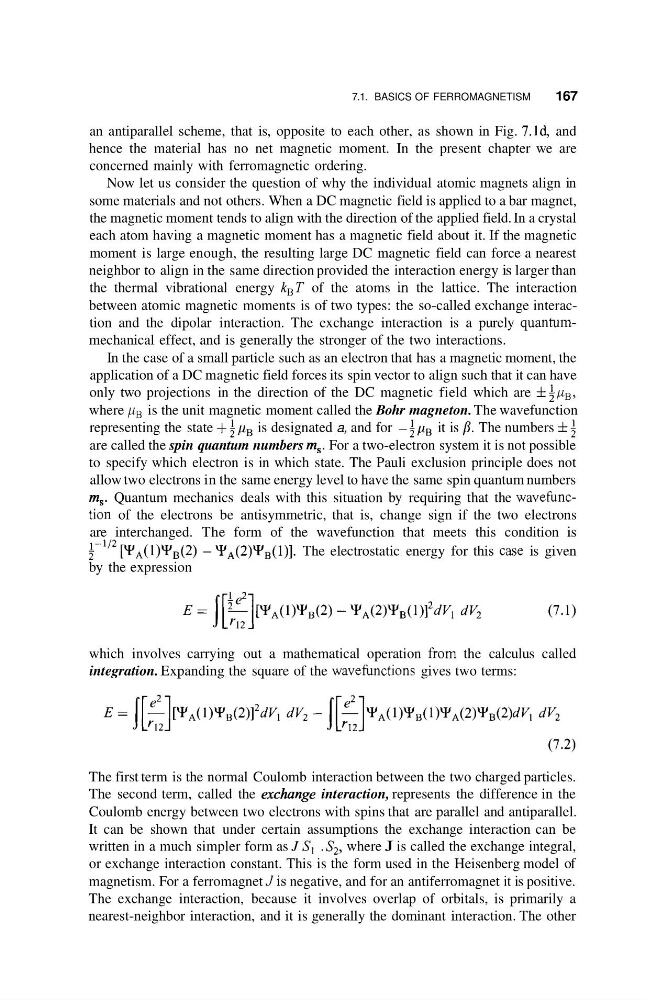
are interchanged. The form of the wavefunction that meets this condition is
f-l” [yA(l)vB(2) - YA(2)vB(l)]. The electrostatic energy for this case is given
by the expression
which involves carrying out a mathematical operation from the calculus called
integration. Expanding the square of the wavefimctions gives two terms:
The first term is the normal Coulomb interaction between the two charged particles.
The second term, called the e,rchange interaction, represents the difference in the
Coulomb energy between two electrons with spins that are parallel and antiparallel.
It can be shown that under certain assumptions the exchange interaction can be
written in a much simpler form as J S, . S2, where J is called the exchange integral,
or exchange interaction constant. This is the form used in the Heisenberg model of
magnetism. For a ferromagnet J i s negative, and for an antiferromagnet it is positive.
The exchange interaction, because it involves overlap of orbitals, is primarily a
nearest-neighbor interaction, and it is generally the dominant interaction. The other
167
an antiparallel scheme, that is, opposite to each other, as shown in Fig. 7.14 and
hence the material has no net magnetic moment. In the present chapter we are
concerned mainly with ferromagnetic ordering.
Now let us consider the question of why the individual atomic magnets align in
some materials and not others. When a DC magnetic field is applied to a bar magnet,
the magnetic moment tends to align with the direction of the applied field. In a crystal
each atom having a magnetic moment has a magnetic field about it. If the magnetic
moment is large enough, the resulting large DC magnetic field can force a nearest
neighbor to align in the same direction provided the interaction energy is larger than
the thermal vibrational energy kBT of the atoms in the lattice. The interaction
between atomic magnetic moments is of two types: the so-called exchange interaction and the dipolar interaction. The exchange interaction is a purely quantummechanical effect, and is generally the stronger of the two interactions.
In the case of a small particle such as an electron that has a magnetic moment, the
application of a DC magnetic field forces its spin vector to align such that it can have
only two projections in the direction of the DC magnetic field which are 2C 4 pB,
where pB is the unit magnetic moment called the Bohr magneton. The wavefunction
representing the state +$pB is designated a, and for - ipB it is b. The numbers 2C$
are called the spin quantum numbers m,. For a two-electron system it is not possible
to specify which electron is in which state. The Pauli exclusion principle does not
allow two electrons in the same energy level to have the same spin quantum numbers
m,. Quantum mechanics deals with this situation by requiring that the wavefunction of the electrons be antisymmetric, that is, change sign if the two electrons
are interchanged. The form of the wavefunction that meets this condition is
f-l” [yA(l)vB(2) - YA(2)vB(l)]. The electrostatic energy for this case is given
by the expression
which involves carrying out a mathematical operation from the calculus called
integration. Expanding the square of the wavefimctions gives two terms:
The first term is the normal Coulomb interaction between the two charged particles.
The second term, called the e,rchange interaction, represents the difference in the
Coulomb energy between two electrons with spins that are parallel and antiparallel.
It can be shown that under certain assumptions the exchange interaction can be
written in a much simpler form as J S, . S2, where J is called the exchange integral,
or exchange interaction constant. This is the form used in the Heisenberg model of
magnetism. For a ferromagnet J i s negative, and for an antiferromagnet it is positive.
The exchange interaction, because it involves overlap of orbitals, is primarily a
nearest-neighbor interaction, and it is generally the dominant interaction. The other