

166
NANOSTRUCTURED FERROMAGNETISM
fill it, so it is incomplete to the extent of four electrons. This incompletely filled
electron d shell causes the iron atom to have a strong magnetic moment.
When crystals such as bulk iron are formed from atoms having a net magnetic
moment a number of different situations can occur relating to how the magnetic
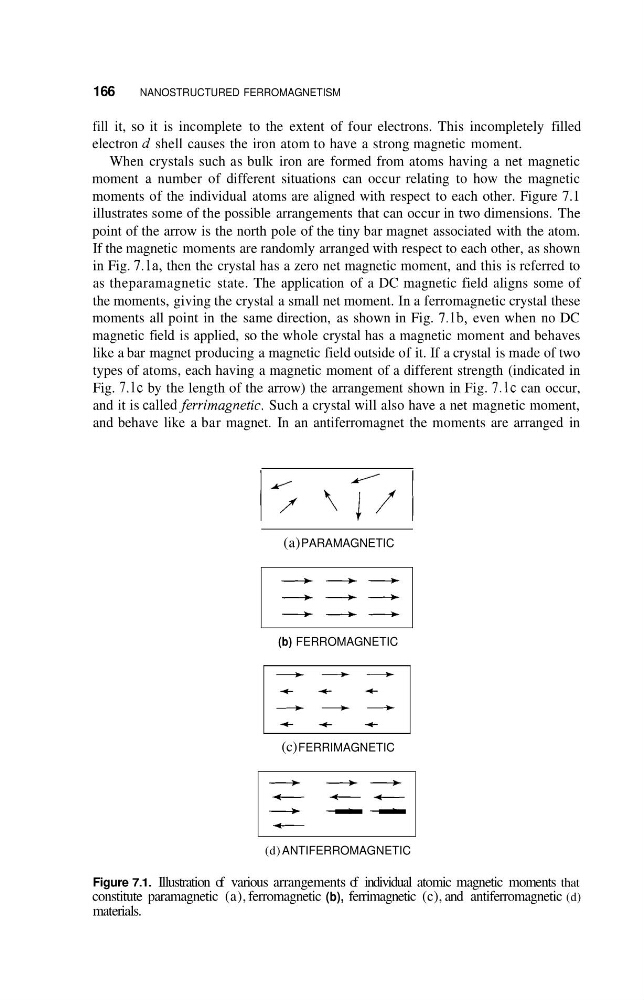
moments of the individual atoms are aligned with respect to each other. Figure 7.1
illustrates some of the possible arrangements that can occur in two dimensions. The
point of the arrow is the north pole of the tiny bar magnet associated with the atom.
If the magnetic moments are randomly arranged with respect to each other, as shown
in Fig. 7.la, then the crystal has a zero net magnetic moment, and this is referred to
as theparamagnetic state. The application of a DC magnetic field aligns some of
the moments, giving the crystal a small net moment. In a ferromagnetic crystal these
moments all point in the same direction, as shown in Fig. 7.lb, even when no DC
magnetic field is applied, so the whole crystal has a magnetic moment and behaves
like a bar magnet producing a magnetic field outside of it. If a crystal is made of two
types of atoms, each having a magnetic moment of a different strength (indicated in
Fig. 7.lc by the length of the arrow) the arrangement shown in Fig. 7.lc can occur,
and it is calledferrimagnetic. Such a crystal will also have a net magnetic moment,
and behave like a bar magnet. In an antiferromagnet the moments are arranged in
(a) PARAMAGNETIC
+ + +
+ + +
+ + +
(b) FERROMAGNETIC
(c) FERRIMAGNETIC
+ + +
f-- f - -
+
+ +
- -(d) ANTIFERROMAGNETIC
Figure 7.1. Illustration of various arrangements of individual atomic magnetic moments that
constitute paramagnetic (a), ferromagnetic (b), ferrimagnetic (c), and antiferromagnetic (d)
materials.
NANOSTRUCTURED FERROMAGNETISM
fill it, so it is incomplete to the extent of four electrons. This incompletely filled
electron d shell causes the iron atom to have a strong magnetic moment.
When crystals such as bulk iron are formed from atoms having a net magnetic
moment a number of different situations can occur relating to how the magnetic
moments of the individual atoms are aligned with respect to each other. Figure 7.1
illustrates some of the possible arrangements that can occur in two dimensions. The
point of the arrow is the north pole of the tiny bar magnet associated with the atom.
If the magnetic moments are randomly arranged with respect to each other, as shown
in Fig. 7.la, then the crystal has a zero net magnetic moment, and this is referred to
as theparamagnetic state. The application of a DC magnetic field aligns some of
the moments, giving the crystal a small net moment. In a ferromagnetic crystal these
moments all point in the same direction, as shown in Fig. 7.lb, even when no DC
magnetic field is applied, so the whole crystal has a magnetic moment and behaves
like a bar magnet producing a magnetic field outside of it. If a crystal is made of two
types of atoms, each having a magnetic moment of a different strength (indicated in
Fig. 7.lc by the length of the arrow) the arrangement shown in Fig. 7.lc can occur,
and it is calledferrimagnetic. Such a crystal will also have a net magnetic moment,
and behave like a bar magnet. In an antiferromagnet the moments are arranged in
(a) PARAMAGNETIC
+ + +
+ + +
+ + +
(b) FERROMAGNETIC
(c) FERRIMAGNETIC
+ + +
f-- f - -
+
+ +
- -(d) ANTIFERROMAGNETIC
Figure 7.1. Illustration of various arrangements of individual atomic magnetic moments that
constitute paramagnetic (a), ferromagnetic (b), ferrimagnetic (c), and antiferromagnetic (d)
materials.