

6.2. NANOSTRUCTURED CRYSTALS
161
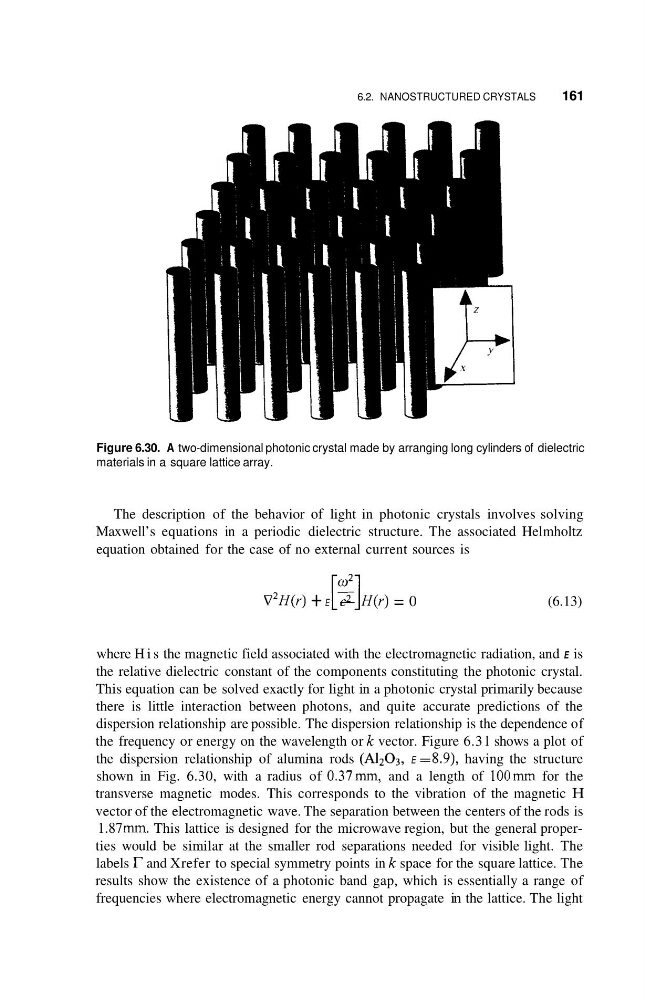
Figure 6.30. A two-dimensional photonic crystal made by arranging long cylinders of dielectric
materials in a square lattice array.
The description of the behavior of light in photonic crystals involves solving
Maxwell’s equations in a periodic dielectric structure. The associated Helmholtz
equation obtained for the case of no external current sources is
V2H(r) + E [;I - H(r) = 0
(6.13)
where H i s the magnetic field associated with the electromagnetic radiation, and E is
the relative dielectric constant of the components constituting the photonic crystal.
This equation can be solved exactly for light in a photonic crystal primarily because
there is little interaction between photons, and quite accurate predictions of the
dispersion relationship are possible. The dispersion relationship is the dependence of
the frequency or energy on the wavelength or k vector. Figure 6.3 1 shows a plot of
the dispersion relationship of alumina rods (A1203, E = 8.9), having the structure
shown in Fig. 6.30, with a radius of 0.37mm, and a length of lOOmm for the
transverse magnetic modes. This corresponds to the vibration of the magnetic H
vector of the electromagnetic wave. The separation between the centers of the rods is
1.87 mm. This lattice is designed for the microwave region, but the general properties would be similar at the smaller rod separations needed for visible light. The
labels l7 and Xrefer to special symmetry points in k space for the square lattice. The
results show the existence of a photonic band gap, which is essentially a range of
frequencies where electromagnetic energy cannot propagate in the lattice. The light
161
Figure 6.30. A two-dimensional photonic crystal made by arranging long cylinders of dielectric
materials in a square lattice array.
The description of the behavior of light in photonic crystals involves solving
Maxwell’s equations in a periodic dielectric structure. The associated Helmholtz
equation obtained for the case of no external current sources is
V2H(r) + E [;I - H(r) = 0
(6.13)
where H i s the magnetic field associated with the electromagnetic radiation, and E is
the relative dielectric constant of the components constituting the photonic crystal.
This equation can be solved exactly for light in a photonic crystal primarily because
there is little interaction between photons, and quite accurate predictions of the
dispersion relationship are possible. The dispersion relationship is the dependence of
the frequency or energy on the wavelength or k vector. Figure 6.3 1 shows a plot of
the dispersion relationship of alumina rods (A1203, E = 8.9), having the structure
shown in Fig. 6.30, with a radius of 0.37mm, and a length of lOOmm for the
transverse magnetic modes. This corresponds to the vibration of the magnetic H
vector of the electromagnetic wave. The separation between the centers of the rods is
1.87 mm. This lattice is designed for the microwave region, but the general properties would be similar at the smaller rod separations needed for visible light. The
labels l7 and Xrefer to special symmetry points in k space for the square lattice. The
results show the existence of a photonic band gap, which is essentially a range of
frequencies where electromagnetic energy cannot propagate in the lattice. The light