

6.2. NANOSTRUCTURED CRYSTALS
159
repulsions the lattice structure is face-centered cubic. Increasing the range of the
repulsion, or lowering the concentration, allows the formation of the slightly less
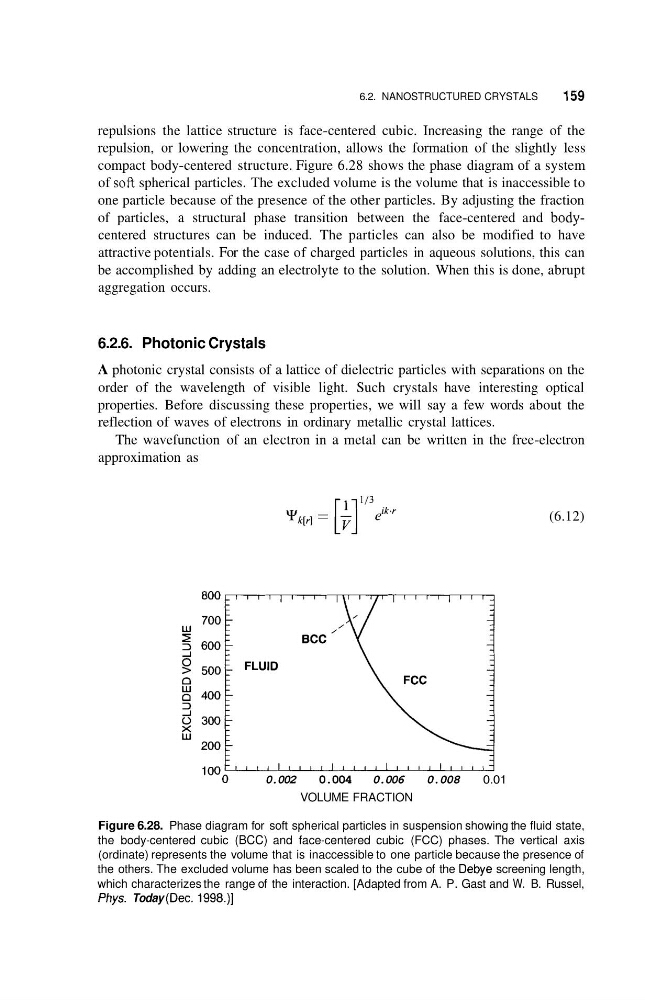
compact body-centered structure. Figure 6.28 shows the phase diagram of a system
of soft spherical particles. The excluded volume is the volume that is inaccessible to
one particle because of the presence of the other particles. By adjusting the fraction
of particles, a structural phase transition between the face-centered and bodycentered structures can be induced. The particles can also be modified to have
attractive potentials. For the case of charged particles in aqueous solutions, this can
be accomplished by adding an electrolyte to the solution. When this is done, abrupt
aggregation occurs.
6.2.6. Photonic Crystals
A photonic crystal consists of a lattice of dielectric particles with separations on the
order of the wavelength of visible light. Such crystals have interesting optical
properties. Before discussing these properties, we will say a few words about the
reflection of waves of electrons in ordinary metallic crystal lattices.
The wavefunction of an electron in a metal can be written in the free-electron
approximation as
(6.12)
0.002
0.004
0.006
0.008
0.01
VOLUME FRACTION
Figure 6.28. Phase diagram for soft spherical particles in suspension showing the fluid state,
the body-centered cubic (BCC) and face-centered cubic (FCC) phases. The vertical axis
(ordinate) represents the volume that is inaccessible to one particle because the presence of
the others. The excluded volume has been scaled to the cube of the Debye screening length,
which characterizes the range of the interaction. [Adapted from A. P. Gast and W. B. Russel,
Phys. Today (Dec. 1998.)]
159
repulsions the lattice structure is face-centered cubic. Increasing the range of the
repulsion, or lowering the concentration, allows the formation of the slightly less
compact body-centered structure. Figure 6.28 shows the phase diagram of a system
of soft spherical particles. The excluded volume is the volume that is inaccessible to
one particle because of the presence of the other particles. By adjusting the fraction
of particles, a structural phase transition between the face-centered and bodycentered structures can be induced. The particles can also be modified to have
attractive potentials. For the case of charged particles in aqueous solutions, this can
be accomplished by adding an electrolyte to the solution. When this is done, abrupt
aggregation occurs.
6.2.6. Photonic Crystals
A photonic crystal consists of a lattice of dielectric particles with separations on the
order of the wavelength of visible light. Such crystals have interesting optical
properties. Before discussing these properties, we will say a few words about the
reflection of waves of electrons in ordinary metallic crystal lattices.
The wavefunction of an electron in a metal can be written in the free-electron
approximation as
(6.12)
0.002
0.004
0.006
0.008
0.01
VOLUME FRACTION
Figure 6.28. Phase diagram for soft spherical particles in suspension showing the fluid state,
the body-centered cubic (BCC) and face-centered cubic (FCC) phases. The vertical axis
(ordinate) represents the volume that is inaccessible to one particle because the presence of
the others. The excluded volume has been scaled to the cube of the Debye screening length,
which characterizes the range of the interaction. [Adapted from A. P. Gast and W. B. Russel,
Phys. Today (Dec. 1998.)]