

158
BULK NANOSTRUCTURED MATERIALS
6.2.5. Nanoparticle Lattices in Colloidal Suspensions
Colloidal suspensions consist of small spherical particles 10-100 nm in size suspended in a liquid. The interaction between the particles is hard-sphere repulsion,
meaning that the center of the particles cannot get closer than the diameters of the
particles. However it is possible to increase the range of the repulsive force between
the particles in order to prevent them from aggregating. This can be done by putting
an electrostatic charge on the particles. Another method is to attach soluble polymer
chains to the particles, in effect producing a dense brush with flexible bristles around
the particle. When the particles with these brush polymers about them approach each
other, the brushes compress and generate a repulsion between the particles. In both
charge and polymer brush suspensions the repulsion extends over a range that can be
comparable to the size of the particles. This is called “soft repulsion.” When such
particles occupy over 50% of the volume of the material, the particles begin to order
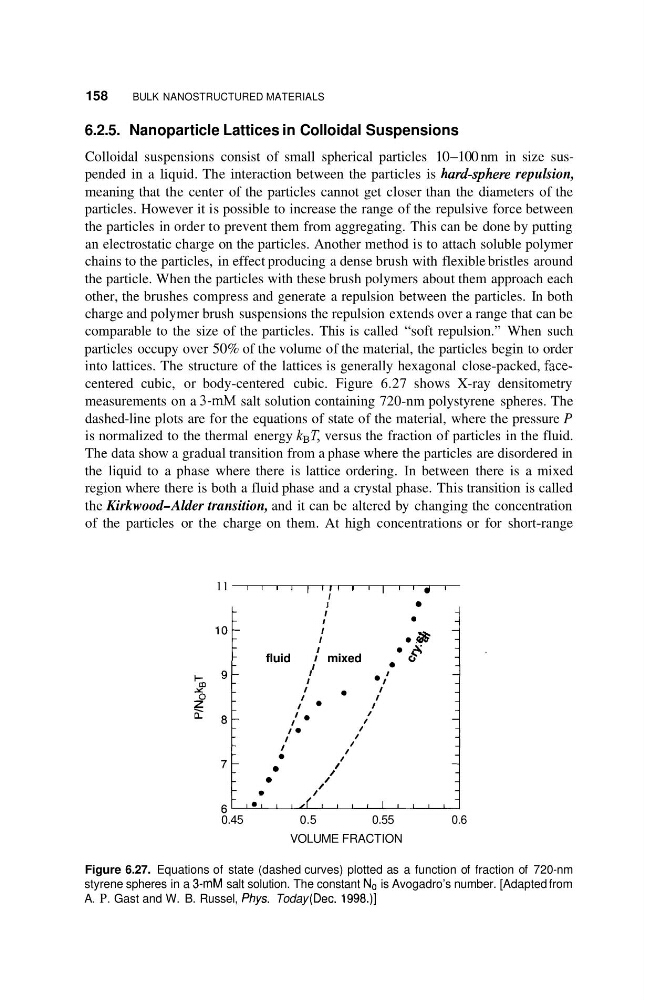
into lattices. The structure of the lattices is generally hexagonal close-packed, facecentered cubic, or body-centered cubic. Figure 6.27 shows X-ray densitometry
measurements on a 3-mM salt solution containing 720-nm polystyrene spheres. The
dashed-line plots are for the equations of state of the material, where the pressure P
is normalized to the thermal energy kB7; versus the fraction of particles in the fluid.
The data show a gradual transition from a phase where the particles are disordered in
the liquid to a phase where there is lattice ordering. In between there is a mixed
region where there is both a fluid phase and a crystal phase. This transition is called
the Kirkwood-Alder transition, and it can be altered by changing the concentration
of the particles or the charge on them. At high concentrations or for short-range
11 I I I I , I l l I I I I I ,
I
I
I
0
’ . E
?
t
I
I
. a ‘
D
0 4
fluid
/ mixed * c
0
I
/
0
/
/
I
0.45
0.5
0.55
0.6
VOLUME FRACTION
Figure 6.27. Equations of state (dashed curves) plotted as a function of fraction of 720-nm
styrene spheres in a 3-mM salt solution. The constant No is Avogadro’s number. [Adapted from
A. P. Gast and W. B. Russel, Phys. Today (Dec. 1998.)]
BULK NANOSTRUCTURED MATERIALS
6.2.5. Nanoparticle Lattices in Colloidal Suspensions
Colloidal suspensions consist of small spherical particles 10-100 nm in size suspended in a liquid. The interaction between the particles is hard-sphere repulsion,
meaning that the center of the particles cannot get closer than the diameters of the
particles. However it is possible to increase the range of the repulsive force between
the particles in order to prevent them from aggregating. This can be done by putting
an electrostatic charge on the particles. Another method is to attach soluble polymer
chains to the particles, in effect producing a dense brush with flexible bristles around
the particle. When the particles with these brush polymers about them approach each
other, the brushes compress and generate a repulsion between the particles. In both
charge and polymer brush suspensions the repulsion extends over a range that can be
comparable to the size of the particles. This is called “soft repulsion.” When such
particles occupy over 50% of the volume of the material, the particles begin to order
into lattices. The structure of the lattices is generally hexagonal close-packed, facecentered cubic, or body-centered cubic. Figure 6.27 shows X-ray densitometry
measurements on a 3-mM salt solution containing 720-nm polystyrene spheres. The
dashed-line plots are for the equations of state of the material, where the pressure P
is normalized to the thermal energy kB7; versus the fraction of particles in the fluid.
The data show a gradual transition from a phase where the particles are disordered in
the liquid to a phase where there is lattice ordering. In between there is a mixed
region where there is both a fluid phase and a crystal phase. This transition is called
the Kirkwood-Alder transition, and it can be altered by changing the concentration
of the particles or the charge on them. At high concentrations or for short-range
11 I I I I , I l l I I I I I ,
I
I
I
0
’ . E
?
t
I
I
. a ‘
D
0 4
fluid
/ mixed * c
0
I
/
0
/
/
I
0.45
0.5
0.55
0.6
VOLUME FRACTION
Figure 6.27. Equations of state (dashed curves) plotted as a function of fraction of 720-nm
styrene spheres in a 3-mM salt solution. The constant No is Avogadro’s number. [Adapted from
A. P. Gast and W. B. Russel, Phys. Today (Dec. 1998.)]