

6.1. SOLID DISORDERED NANOSTRUCTURES
151
This silicon is called porous silicon (PoSi). By controlling the processing conditions,
pores of nanometer dimensions can be made. Research interest in porous silicon was
intensified in 1990 when it was discovered that it was fluorescent at room temperature. Luminescence refers to the absorption of energy by matter, and its reemission as visible or near-visible light. If the emission occurs within lops s of the
excitation, then the process is calledjuorescence, and if there is a delay in the
emission it is called phosphorescence. Nonporous silicon has a weak fluorescence
between 0.96 and 1.20 eV in the region of the band gap, which is I . 125 eV at 300 K.
This fluorescence is due to band gap transitions in the silicon. However, as shown in
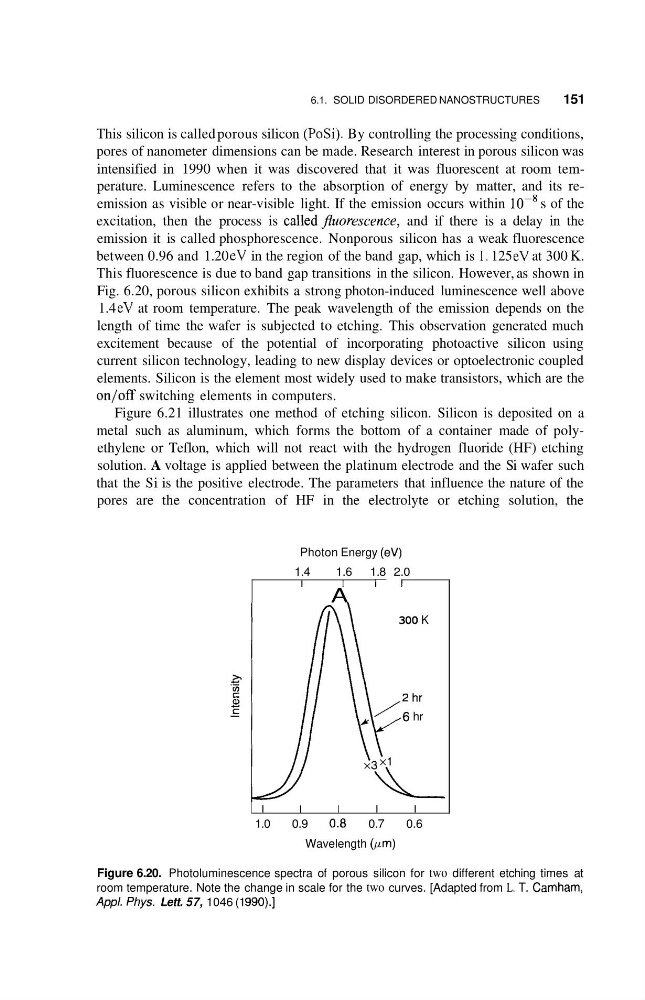
Fig. 6.20, porous silicon exhibits a strong photon-induced luminescence well above
1.4 eV at room temperature. The peak wavelength of the emission depends on the
length of time the wafer is subjected to etching. This observation generated much
excitement because of the potential of incorporating photoactive silicon using
current silicon technology, leading to new display devices or optoelectronic coupled
elements. Silicon is the element most widely used to make transistors, which are the
on/off switching elements in computers.
Figure 6.21 illustrates one method of etching silicon. Silicon is deposited on a
metal such as aluminum, which forms the bottom of a container made of polyethylene or Teflon, which will not react with the hydrogen fluoride (HF) etching
solution. A voltage is applied between the platinum electrode and the Si wafer such
that the Si is the positive electrode. The parameters that influence the nature of the
pores are the concentration of HF in the electrolyte or etching solution, the
Photon Energy (eV)
1.4
1.6
1.8 2.0
I
I
I
1
A
300 K
, 6 hr
I
I
I
I
I
1.0
0.9
0.8
0.7
0.6
Wavelength (wm)
Figure 6.20. Photoluminescence spectra of porous silicon for two different etching times at
room temperature. Note the change in scale for the two curves. [Adapted from L. T. Camham,
Appl. fhys. Lett. 57, 1046 (1 990).]
151
This silicon is called porous silicon (PoSi). By controlling the processing conditions,
pores of nanometer dimensions can be made. Research interest in porous silicon was
intensified in 1990 when it was discovered that it was fluorescent at room temperature. Luminescence refers to the absorption of energy by matter, and its reemission as visible or near-visible light. If the emission occurs within lops s of the
excitation, then the process is calledjuorescence, and if there is a delay in the
emission it is called phosphorescence. Nonporous silicon has a weak fluorescence
between 0.96 and 1.20 eV in the region of the band gap, which is I . 125 eV at 300 K.
This fluorescence is due to band gap transitions in the silicon. However, as shown in
Fig. 6.20, porous silicon exhibits a strong photon-induced luminescence well above
1.4 eV at room temperature. The peak wavelength of the emission depends on the
length of time the wafer is subjected to etching. This observation generated much
excitement because of the potential of incorporating photoactive silicon using
current silicon technology, leading to new display devices or optoelectronic coupled
elements. Silicon is the element most widely used to make transistors, which are the
on/off switching elements in computers.
Figure 6.21 illustrates one method of etching silicon. Silicon is deposited on a
metal such as aluminum, which forms the bottom of a container made of polyethylene or Teflon, which will not react with the hydrogen fluoride (HF) etching
solution. A voltage is applied between the platinum electrode and the Si wafer such
that the Si is the positive electrode. The parameters that influence the nature of the
pores are the concentration of HF in the electrolyte or etching solution, the
Photon Energy (eV)
1.4
1.6
1.8 2.0
I
I
I
1
A
300 K
, 6 hr
I
I
I
I
I
1.0
0.9
0.8
0.7
0.6
Wavelength (wm)
Figure 6.20. Photoluminescence spectra of porous silicon for two different etching times at
room temperature. Note the change in scale for the two curves. [Adapted from L. T. Camham,
Appl. fhys. Lett. 57, 1046 (1 990).]