

6.1. SOLID DISORDERED NANOSTRUCTURES
149
the optical absorption shifts to shorter wavelengths when the nanoparticle size
decreases from 80 to 20 nm. The spectrum is due to plasma absorption in the metal
nanoparticles. At very high frequencies the conduction electrons in a metal behave
like a plasma, that is, like an electrically neutral ionized gas in which the negative
charges are the mobile electron, and the positive charges reside on the stationary
background atoms. Provided the clusters are smaller than the wavelength of the
incident visible light, and are well dispersed so that they can be considered noninteracting, the electromagnetic wave of the light beam causes an oscillation of the
electron plasma that results in absorption of the light. A theory developed by Mie
may be used to calculate the absorption coefficient versus the wavelength of the
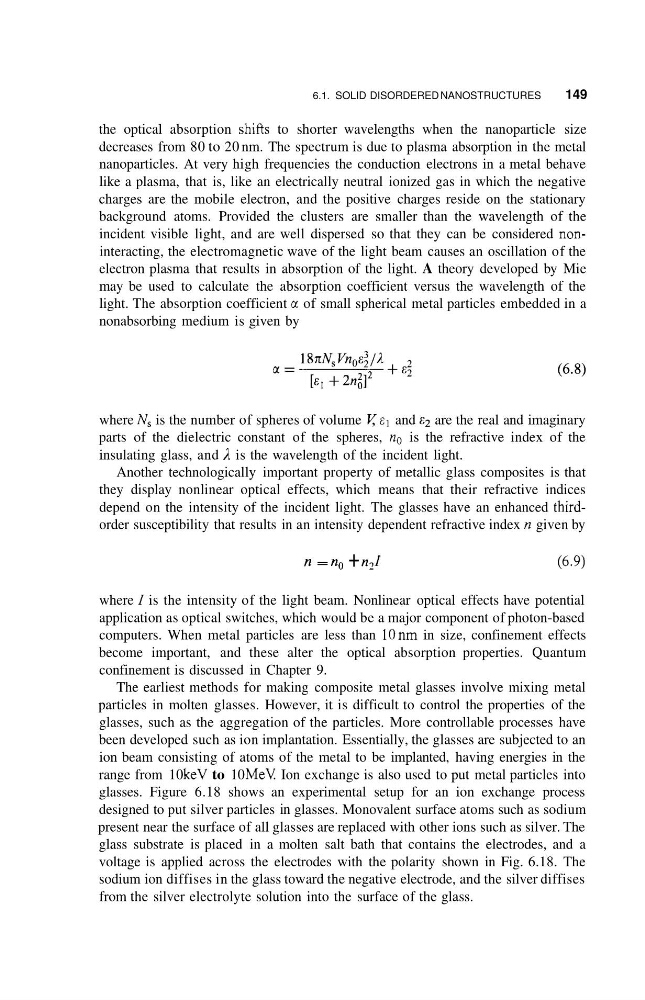
light. The absorption coefficient c1 of small spherical metal particles embedded in a
nonabsorbing medium is given by
where N, is the number of spheres of volume E , and c2 are the real and imaginary
parts of the dielectric constant of the spheres, no is the refractive index of the
insulating glass, and A is the wavelength of the incident light.
Another technologically important property of metallic glass composites is that
they display nonlinear optical effects, which means that their refractive indices
depend on the intensity of the incident light. The glasses have an enhanced thirdorder susceptibility that results in an intensity dependent refractive index n given by
n = no + n21
(6.9)
where Z is the intensity of the light beam. Nonlinear optical effects have potential
application as optical switches, which would be a major component of photon-based
computers. When metal particles are less than lOnm in size, confinement effects
become important, and these alter the optical absorption properties. Quantum
confinement is discussed in Chapter 9.
The earliest methods for making composite metal glasses involve mixing metal
particles in molten glasses. However, it is difficult to control the properties of the
glasses, such as the aggregation of the particles. More controllable processes have
been developed such as ion implantation. Essentially, the glasses are subjected to an
ion beam consisting of atoms of the metal to be implanted, having energies in the
range from 10 keV to 10 MeV Ion exchange is also used to put metal particles into
glasses. Figure 6.18 shows an experimental setup for an ion exchange process
designed to put silver particles in glasses. Monovalent surface atoms such as sodium
present near the surface of all glasses are replaced with other ions such as silver. The
glass substrate is placed in a molten salt bath that contains the electrodes, and a
voltage is applied across the electrodes with the polarity shown in Fig. 6.18. The
sodium ion diffises in the glass toward the negative electrode, and the silver diffises
from the silver electrolyte solution into the surface of the glass.
149
the optical absorption shifts to shorter wavelengths when the nanoparticle size
decreases from 80 to 20 nm. The spectrum is due to plasma absorption in the metal
nanoparticles. At very high frequencies the conduction electrons in a metal behave
like a plasma, that is, like an electrically neutral ionized gas in which the negative
charges are the mobile electron, and the positive charges reside on the stationary
background atoms. Provided the clusters are smaller than the wavelength of the
incident visible light, and are well dispersed so that they can be considered noninteracting, the electromagnetic wave of the light beam causes an oscillation of the
electron plasma that results in absorption of the light. A theory developed by Mie
may be used to calculate the absorption coefficient versus the wavelength of the
light. The absorption coefficient c1 of small spherical metal particles embedded in a
nonabsorbing medium is given by
where N, is the number of spheres of volume E , and c2 are the real and imaginary
parts of the dielectric constant of the spheres, no is the refractive index of the
insulating glass, and A is the wavelength of the incident light.
Another technologically important property of metallic glass composites is that
they display nonlinear optical effects, which means that their refractive indices
depend on the intensity of the incident light. The glasses have an enhanced thirdorder susceptibility that results in an intensity dependent refractive index n given by
n = no + n21
(6.9)
where Z is the intensity of the light beam. Nonlinear optical effects have potential
application as optical switches, which would be a major component of photon-based
computers. When metal particles are less than lOnm in size, confinement effects
become important, and these alter the optical absorption properties. Quantum
confinement is discussed in Chapter 9.
The earliest methods for making composite metal glasses involve mixing metal
particles in molten glasses. However, it is difficult to control the properties of the
glasses, such as the aggregation of the particles. More controllable processes have
been developed such as ion implantation. Essentially, the glasses are subjected to an
ion beam consisting of atoms of the metal to be implanted, having energies in the
range from 10 keV to 10 MeV Ion exchange is also used to put metal particles into
glasses. Figure 6.18 shows an experimental setup for an ion exchange process
designed to put silver particles in glasses. Monovalent surface atoms such as sodium
present near the surface of all glasses are replaced with other ions such as silver. The
glass substrate is placed in a molten salt bath that contains the electrodes, and a
voltage is applied across the electrodes with the polarity shown in Fig. 6.18. The
sodium ion diffises in the glass toward the negative electrode, and the silver diffises
from the silver electrolyte solution into the surface of the glass.