

148
BULK NANOSTRUCTURED MATERIALS
has been found that in the bulk granular superconductor Nb3Sn decreasing the grain
size of the sample can increase the critical current.
In Chapter 4 we saw that the optical absorption properties of nanoparticles,
determined by transitions to excited states, depend on their size and structure. In
principle, it should therefore be possible to engineer the optical properties of bulk
nanostructured materials. A high-strength transparent metal would have many
application possibilities. In the next sections we will discuss some examples of
how nanostructure influences the optical properties of materials.
6.1.7. Metal Nanocluster Composite Glasses
One of the oldest applications of nanotechnology is the colored stained-glass
windows in medieval cathedrals which are a result of nanosized metallic particles
embedded in the glass. Glasses containing a low concentration of dispersed
nanoclusters display a variety of unusual optical properties that have application
potential. The peak wavelength of the optical absorption, which largely determines
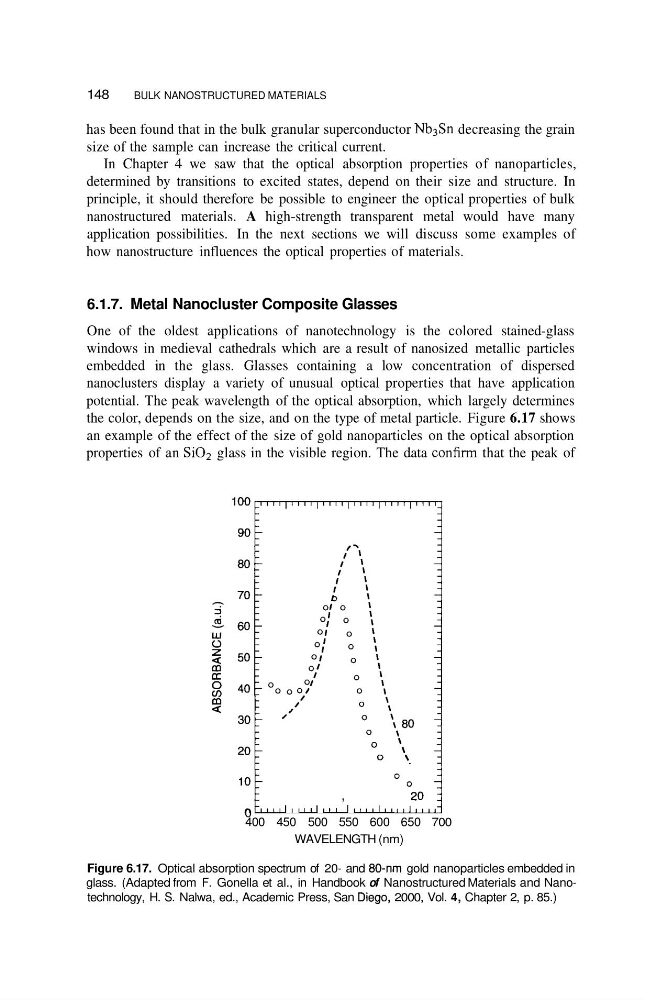
the color, depends on the size, and on the type of metal particle. Figure 6.17 shows
an example of the effect of the size of gold nanoparticles on the optical absorption
properties of an SiOz glass in the visible region. The data confirm that the peak of
O
\\
O
' .
'OI,,, I , , , , I , , , , I , , , , , , , ; , O f 1
0
400 450 500 550 600 650 700
WAVELENGTH (nm)
Figure 6.17. Optical absorption spectrum of 20- and 80-nm gold nanoparticles embedded in
glass. (Adapted from F. Gonella et al., in Handbook of Nanostructured Materials and Nanotechnology, H. S. Nalwa, ed., Academic Press, San Diego, 2000, Vol. 4, Chapter 2, p. 85.)
BULK NANOSTRUCTURED MATERIALS
has been found that in the bulk granular superconductor Nb3Sn decreasing the grain
size of the sample can increase the critical current.
In Chapter 4 we saw that the optical absorption properties of nanoparticles,
determined by transitions to excited states, depend on their size and structure. In
principle, it should therefore be possible to engineer the optical properties of bulk
nanostructured materials. A high-strength transparent metal would have many
application possibilities. In the next sections we will discuss some examples of
how nanostructure influences the optical properties of materials.
6.1.7. Metal Nanocluster Composite Glasses
One of the oldest applications of nanotechnology is the colored stained-glass
windows in medieval cathedrals which are a result of nanosized metallic particles
embedded in the glass. Glasses containing a low concentration of dispersed
nanoclusters display a variety of unusual optical properties that have application
potential. The peak wavelength of the optical absorption, which largely determines
the color, depends on the size, and on the type of metal particle. Figure 6.17 shows
an example of the effect of the size of gold nanoparticles on the optical absorption
properties of an SiOz glass in the visible region. The data confirm that the peak of
O
\\
O
' .
'OI,,, I , , , , I , , , , I , , , , , , , ; , O f 1
0
400 450 500 550 600 650 700
WAVELENGTH (nm)
Figure 6.17. Optical absorption spectrum of 20- and 80-nm gold nanoparticles embedded in
glass. (Adapted from F. Gonella et al., in Handbook of Nanostructured Materials and Nanotechnology, H. S. Nalwa, ed., Academic Press, San Diego, 2000, Vol. 4, Chapter 2, p. 85.)