

130
CARBON NANOSTRUCTURES
VOLTS
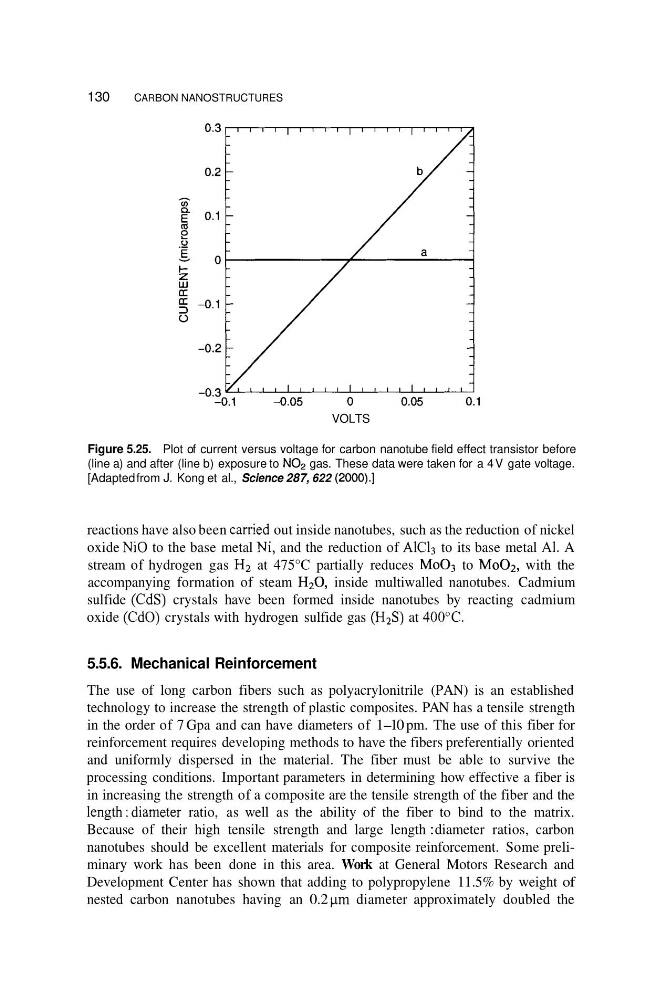
Figure 5.25. Plot of current versus voltage for carbon nanotube field effect transistor before
(line a) and after (line b) exposure to NOp gas. These data were taken for a 4 V gate voltage.
[Adapted from J. Kong et al., Science 287, 622 (2000).]
reactions have also been camed out inside nanotubes, such as the reduction of nickel
oxide NiO to the base metal Ni, and the reduction of AlC13 to its base metal AI. A
stream of hydrogen gas H2 at 475°C partially reduces Moo3 to Mo02, with the
accompanying formation of steam H20, inside multiwalled nanotubes. Cadmium
sulfide (CdS) crystals have been formed inside nanotubes by reacting cadmium
oxide (CdO) crystals with hydrogen sulfide gas (H2S) at 400°C.
5.5.6. Mechanical Reinforcement
The use of long carbon fibers such as polyacrylonitrile (PAN) is an established
technology to increase the strength of plastic composites. PAN has a tensile strength
in the order of 7 Gpa and can have diameters of 1-10 pm. The use of this fiber for
reinforcement requires developing methods to have the fibers preferentially oriented
and uniformly dispersed in the material. The fiber must be able to survive the
processing conditions. Important parameters in determining how effective a fiber is
in increasing the strength of a composite are the tensile strength of the fiber and the
1ength:diameter ratio, as well as the ability of the fiber to bind to the matrix.
Because of their high tensile strength and large length : diameter ratios, carbon
nanotubes should be excellent materials for composite reinforcement. Some preliminary work has been done in this area. Work at General Motors Research and
Development Center has shown that adding to polypropylene 11.5% by weight of
nested carbon nanotubes having an 0.2 pm diameter approximately doubled the
CARBON NANOSTRUCTURES
VOLTS
Figure 5.25. Plot of current versus voltage for carbon nanotube field effect transistor before
(line a) and after (line b) exposure to NOp gas. These data were taken for a 4 V gate voltage.
[Adapted from J. Kong et al., Science 287, 622 (2000).]
reactions have also been camed out inside nanotubes, such as the reduction of nickel
oxide NiO to the base metal Ni, and the reduction of AlC13 to its base metal AI. A
stream of hydrogen gas H2 at 475°C partially reduces Moo3 to Mo02, with the
accompanying formation of steam H20, inside multiwalled nanotubes. Cadmium
sulfide (CdS) crystals have been formed inside nanotubes by reacting cadmium
oxide (CdO) crystals with hydrogen sulfide gas (H2S) at 400°C.
5.5.6. Mechanical Reinforcement
The use of long carbon fibers such as polyacrylonitrile (PAN) is an established
technology to increase the strength of plastic composites. PAN has a tensile strength
in the order of 7 Gpa and can have diameters of 1-10 pm. The use of this fiber for
reinforcement requires developing methods to have the fibers preferentially oriented
and uniformly dispersed in the material. The fiber must be able to survive the
processing conditions. Important parameters in determining how effective a fiber is
in increasing the strength of a composite are the tensile strength of the fiber and the
1ength:diameter ratio, as well as the ability of the fiber to bind to the matrix.
Because of their high tensile strength and large length : diameter ratios, carbon
nanotubes should be excellent materials for composite reinforcement. Some preliminary work has been done in this area. Work at General Motors Research and
Development Center has shown that adding to polypropylene 11.5% by weight of
nested carbon nanotubes having an 0.2 pm diameter approximately doubled the