

5.5. APPLICATIONS OF CARBON NANOTUBES
131
tensile strength of the polypropylene. A study at the University of Tokyo showed that
incorporation of 5% by volume of nanotubes in aluminum increased the tensile
strength by a factor of 2 compared to pure aluminum subjected to the same
processing. The composites were prepared by hot pressing and hot extrusion.
Aluminum powder and carbon nanotubes were mixed and heated to over 800 K in
a vacuum, and then compressed with steel dies. After this the melt was extruded into
rods. This work is very important in that it demonstrates that the carbon nanotubes
can be put into aluminum, and are chemically stable through the necessary processing. The researchers believe a substantial increase in the tensile strength can be
achieved by producing a more homogenous and an aligned distribution of nanotubes
in the material. Theoretical estimates suggest that with optimum fabrication a 10%
volume fraction of nanotubes should increase the tensile strength by a factor of 6.
However, the possibility that nanotube walls slide with respect to each other in
MWNTs, or that individual SWNTs slip in the bundles of tubes, may mean that the
actual strengths that are obtainable will be less than expected. The atomically smooth
surfaces of nanotubes may mean that they will not have strong interface interactions
with the material being reinforced. On the other hand, carbon nanotubes have been
shown to form strong bonds with iron which is the main constituent of steel,
suggesting the possibility that nanotubes could be used to increase the tensile
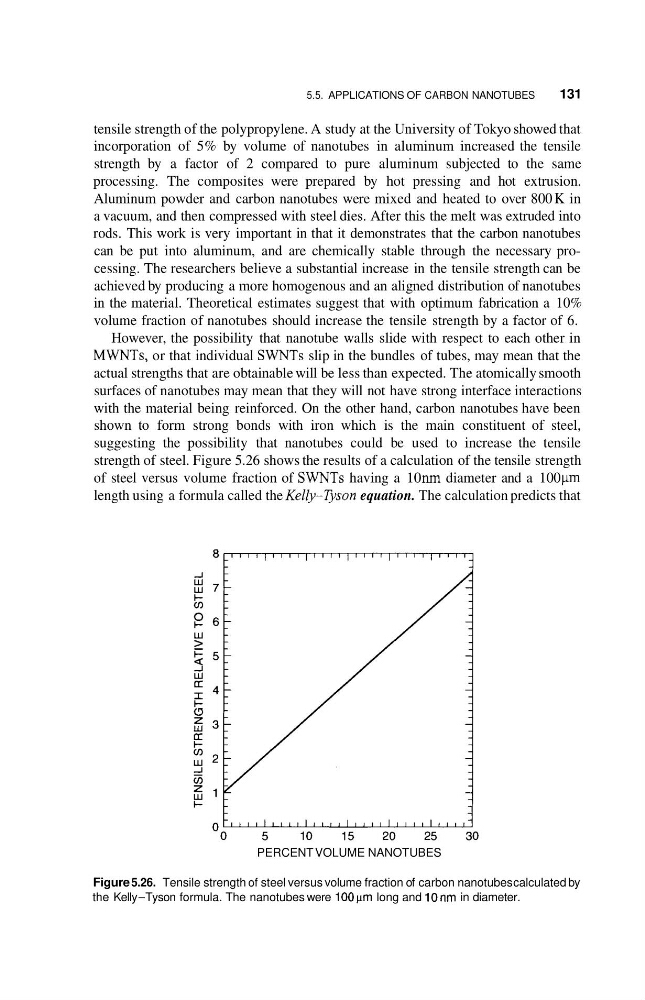
strength of steel. Figure 5.26 shows the results of a calculation of the tensile strength
of steel versus volume fraction of SWNTs having a 10 nm diameter and a 100 pm
length using a formula called the Kelly-@son equation. The calculation predicts that
PERCENT VOLUME NANOTUBES
Figure 5.26. Tensile strength of steel versus volume fraction of carbon nanotubes calculated by
the Kelly-Tyson formula. The nanotubes were 100pm long and lOnm in diameter.
131
tensile strength of the polypropylene. A study at the University of Tokyo showed that
incorporation of 5% by volume of nanotubes in aluminum increased the tensile
strength by a factor of 2 compared to pure aluminum subjected to the same
processing. The composites were prepared by hot pressing and hot extrusion.
Aluminum powder and carbon nanotubes were mixed and heated to over 800 K in
a vacuum, and then compressed with steel dies. After this the melt was extruded into
rods. This work is very important in that it demonstrates that the carbon nanotubes
can be put into aluminum, and are chemically stable through the necessary processing. The researchers believe a substantial increase in the tensile strength can be
achieved by producing a more homogenous and an aligned distribution of nanotubes
in the material. Theoretical estimates suggest that with optimum fabrication a 10%
volume fraction of nanotubes should increase the tensile strength by a factor of 6.
However, the possibility that nanotube walls slide with respect to each other in
MWNTs, or that individual SWNTs slip in the bundles of tubes, may mean that the
actual strengths that are obtainable will be less than expected. The atomically smooth
surfaces of nanotubes may mean that they will not have strong interface interactions
with the material being reinforced. On the other hand, carbon nanotubes have been
shown to form strong bonds with iron which is the main constituent of steel,
suggesting the possibility that nanotubes could be used to increase the tensile
strength of steel. Figure 5.26 shows the results of a calculation of the tensile strength
of steel versus volume fraction of SWNTs having a 10 nm diameter and a 100 pm
length using a formula called the Kelly-@son equation. The calculation predicts that
PERCENT VOLUME NANOTUBES
Figure 5.26. Tensile strength of steel versus volume fraction of carbon nanotubes calculated by
the Kelly-Tyson formula. The nanotubes were 100pm long and lOnm in diameter.