

5.5. APPLICATIONS OF CARBON NANOTUBES
129
450 :
400 3
350 1
300 :
-
v)
5 250 1
+
200 i
150 1
100 1
50 T
2667
-
0 ~ " ' ' I ' " ' I ' ' ' ' I ' ' ' ' I ' '
2400
2500
2600
2700
2800
WAVENUMBER (cm-')
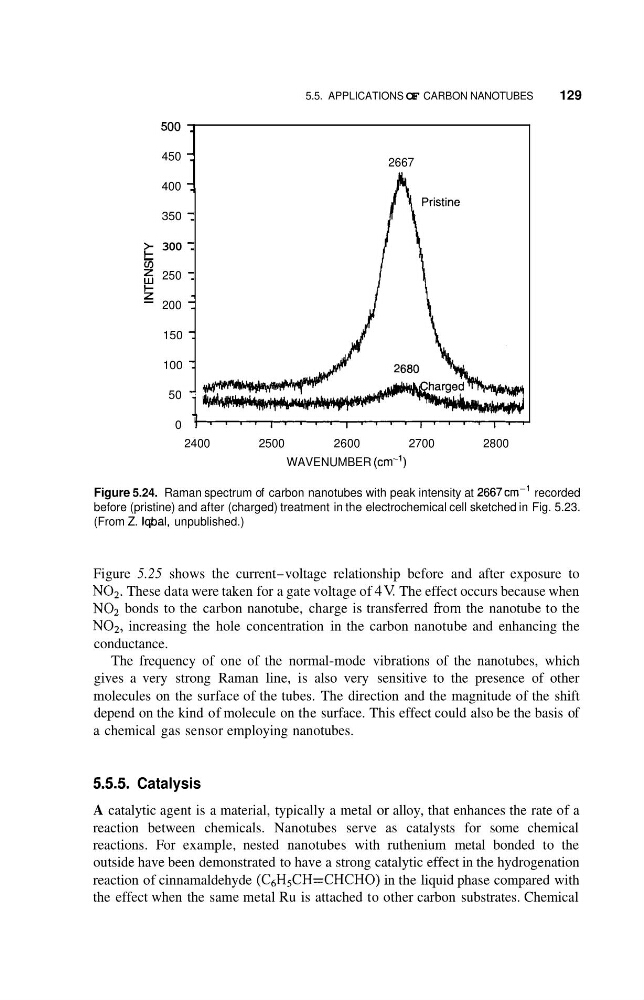
Figure 5.24. Raman spectrum of carbon nanotubes with peak intensity at 2667cm-' recorded
before (pristine) and after (charged) treatment in the electrochemical cell sketched in Fig. 5.23.
(From Z. Iqbal, unpublished.)
Figure 5.25 shows the current-voltage relationship before and after exposure to
NOz. These data were taken for a gate voltage of 4 V. The effect occurs because when
NOz bonds to the carbon nanotube, charge is transferred from the nanotube to the
NOz, increasing the hole concentration in the carbon nanotube and enhancing the
conductance.
The frequency of one of the normal-mode vibrations of the nanotubes, which
gives a very strong Raman line, is also very sensitive to the presence of other
molecules on the surface of the tubes. The direction and the magnitude of the shift
depend on the kind of molecule on the surface. This effect could also be the basis of
a chemical gas sensor employing nanotubes.
5.5.5. Catalysis
A catalytic agent is a material, typically a metal or alloy, that enhances the rate of a
reaction between chemicals. Nanotubes serve as catalysts for some chemical
reactions. For example, nested nanotubes with ruthenium metal bonded to the
outside have been demonstrated to have a strong catalytic effect in the hydrogenation
reaction of cinnamaldehyde (C6H5CH=CHCHO) in the liquid phase compared with
the effect when the same metal Ru is attached to other carbon substrates. Chemical
129
450 :
400 3
350 1
300 :
-
v)
5 250 1
+
200 i
150 1
100 1
50 T
2667
-
0 ~ " ' ' I ' " ' I ' ' ' ' I ' ' ' ' I ' '
2400
2500
2600
2700
2800
WAVENUMBER (cm-')
Figure 5.24. Raman spectrum of carbon nanotubes with peak intensity at 2667cm-' recorded
before (pristine) and after (charged) treatment in the electrochemical cell sketched in Fig. 5.23.
(From Z. Iqbal, unpublished.)
Figure 5.25 shows the current-voltage relationship before and after exposure to
NOz. These data were taken for a gate voltage of 4 V. The effect occurs because when
NOz bonds to the carbon nanotube, charge is transferred from the nanotube to the
NOz, increasing the hole concentration in the carbon nanotube and enhancing the
conductance.
The frequency of one of the normal-mode vibrations of the nanotubes, which
gives a very strong Raman line, is also very sensitive to the presence of other
molecules on the surface of the tubes. The direction and the magnitude of the shift
depend on the kind of molecule on the surface. This effect could also be the basis of
a chemical gas sensor employing nanotubes.
5.5.5. Catalysis
A catalytic agent is a material, typically a metal or alloy, that enhances the rate of a
reaction between chemicals. Nanotubes serve as catalysts for some chemical
reactions. For example, nested nanotubes with ruthenium metal bonded to the
outside have been demonstrated to have a strong catalytic effect in the hydrogenation
reaction of cinnamaldehyde (C6H5CH=CHCHO) in the liquid phase compared with
the effect when the same metal Ru is attached to other carbon substrates. Chemical