

5.5. APPLICATIONS OF CARBON NANOTUBES
127
CARBON NANOTUBE
ELECTRODE
I
I
I
I
I
I
I
I
I
I
\
I
I
I
I
I
I
I
I
I
\
I
I
\
t
I
I
\
I
I
I
I
\
I
I
\
I
I
\
OPEN SWITCH
CLOSED SWITCH \
INSULATOR
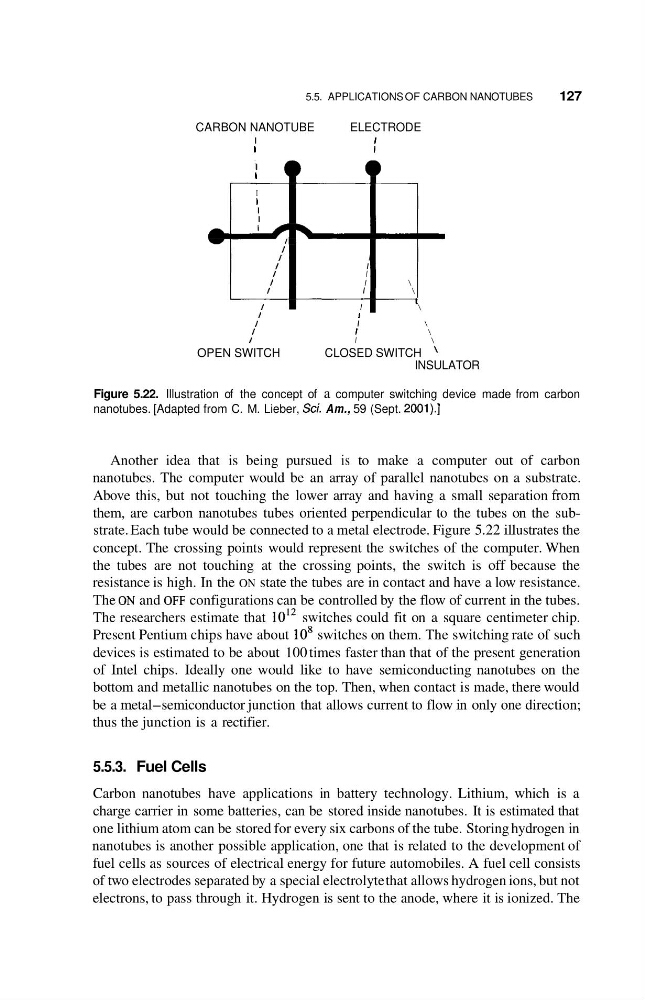
Figure 5.22. Illustration of the concept of a computer switching device made from carbon
nanotubes. [Adapted from C. M. Lieber, Sci. Am., 59 (Sept. 2001).]
Another idea that is being pursued is to make a computer out of carbon
nanotubes. The computer would be an array of parallel nanotubes on a substrate.
Above this, but not touching the lower array and having a small separation from
them, are carbon nanotubes tubes oriented perpendicular to the tubes on the substrate. Each tube would be connected to a metal electrode. Figure 5.22 illustrates the
concept. The crossing points would represent the switches of the computer. When
the tubes are not touching at the crossing points, the switch is off because the
resistance is high. In the ON state the tubes are in contact and have a low resistance.
The ON and OFF configurations can be controlled by the flow of current in the tubes.
The researchers estimate that IO'* switches could fit on a square centimeter chip.
Present Pentium chips have about lo8 switches on them. The switching rate of such
devices is estimated to be about 100 times faster than that of the present generation
of Intel chips. Ideally one would like to have semiconducting nanotubes on the
bottom and metallic nanotubes on the top. Then, when contact is made, there would
be a metal-semiconductor junction that allows current to flow in only one direction;
thus the junction is a rectifier.
5.5.3. Fuel Cells
Carbon nanotubes have applications in battery technology. Lithium, which is a
charge carrier in some batteries, can be stored inside nanotubes. It is estimated that
one lithium atom can be stored for every six carbons of the tube. Storing hydrogen in
nanotubes is another possible application, one that is related to the development of
fuel cells as sources of electrical energy for future automobiles. A fuel cell consists
of two electrodes separated by a special electrolyte that allows hydrogen ions, but not
electrons, to pass through it. Hydrogen is sent to the anode, where it is ionized. The
127
CARBON NANOTUBE
ELECTRODE
I
I
I
I
I
I
I
I
I
I
\
I
I
I
I
I
I
I
I
I
\
I
I
\
t
I
I
\
I
I
I
I
\
I
I
\
I
I
\
OPEN SWITCH
CLOSED SWITCH \
INSULATOR
Figure 5.22. Illustration of the concept of a computer switching device made from carbon
nanotubes. [Adapted from C. M. Lieber, Sci. Am., 59 (Sept. 2001).]
Another idea that is being pursued is to make a computer out of carbon
nanotubes. The computer would be an array of parallel nanotubes on a substrate.
Above this, but not touching the lower array and having a small separation from
them, are carbon nanotubes tubes oriented perpendicular to the tubes on the substrate. Each tube would be connected to a metal electrode. Figure 5.22 illustrates the
concept. The crossing points would represent the switches of the computer. When
the tubes are not touching at the crossing points, the switch is off because the
resistance is high. In the ON state the tubes are in contact and have a low resistance.
The ON and OFF configurations can be controlled by the flow of current in the tubes.
The researchers estimate that IO'* switches could fit on a square centimeter chip.
Present Pentium chips have about lo8 switches on them. The switching rate of such
devices is estimated to be about 100 times faster than that of the present generation
of Intel chips. Ideally one would like to have semiconducting nanotubes on the
bottom and metallic nanotubes on the top. Then, when contact is made, there would
be a metal-semiconductor junction that allows current to flow in only one direction;
thus the junction is a rectifier.
5.5.3. Fuel Cells
Carbon nanotubes have applications in battery technology. Lithium, which is a
charge carrier in some batteries, can be stored inside nanotubes. It is estimated that
one lithium atom can be stored for every six carbons of the tube. Storing hydrogen in
nanotubes is another possible application, one that is related to the development of
fuel cells as sources of electrical energy for future automobiles. A fuel cell consists
of two electrodes separated by a special electrolyte that allows hydrogen ions, but not
electrons, to pass through it. Hydrogen is sent to the anode, where it is ionized. The