

120
CARBONNANOSTRUCTURES
At higher energies sharp peaks are observed in the density of states, referred to
as van Hove singularities, and are characteristic of low-dimensional conducting
materials. The peaks occur at the bottom and top of a number of subbands. As we
have discussed earlier, electrons in the quantum theory can be viewed as waves. If
the electron wavelength is not a multiple of the circumference of the tube, it will
destructively interfere with itself, and therefore only electron wavelengths that are
integer multiples of the circumference of the tubes are allowed. This severely limits
the number of energy states available for conduction around the cylinder. The
dominant remaining conduction path is along the axis of the tubes, making carbon
nanotubes function as one-dimensional quantum wires. A more detailed discussion
of quantum wires is presented later, in Chapter 9. The electronic states of the tubes
do not form a single wide electronic energy band, but instead split into onedimensional subbands that are evident in the data in Fig. 5.16. As we will see later,
these states can be modeled by a potential well having a depth equal to the length of
the nanotube.
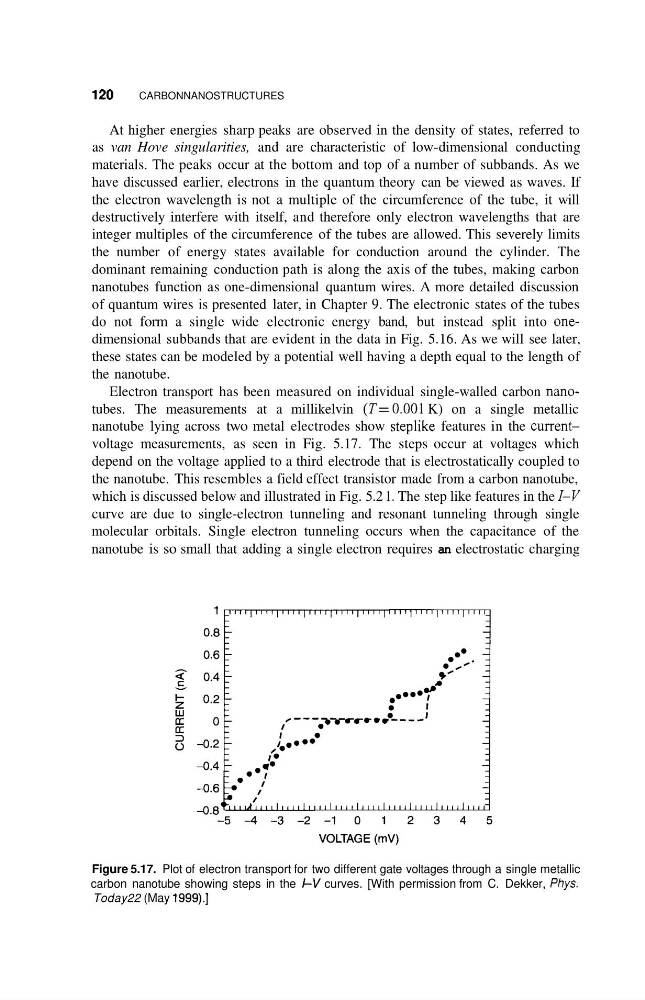
Electron transport has been measured on individual single-walled carbon nanotubes. The measurements at a millikelvin (T=O.OOl K) on a single metallic
nanotube lying across two metal electrodes show steplike features in the currentvoltage measurements, as seen in Fig. 5.17. The steps occur at voltages which
depend on the voltage applied to a third electrode that is electrostatically coupled to
the nanotube. This resembles a field effect transistor made from a carbon nanotube,
which is discussed below and illustrated in Fig. 5.2 1. The step like features in the I-V
curve are due to single-electron tunneling and resonant tunneling through single
molecular orbitals. Single electron tunneling occurs when the capacitance of the
nanotube is so small that adding a single electron requires an electrostatic charging
Figure 5.17. Plot of electron transport for two different gate voltages through a single metallic
carbon nanotube showing steps in the /-V curves. [With permission from C. Dekker, Phys.
Today22 (May 1999).]
CARBONNANOSTRUCTURES
At higher energies sharp peaks are observed in the density of states, referred to
as van Hove singularities, and are characteristic of low-dimensional conducting
materials. The peaks occur at the bottom and top of a number of subbands. As we
have discussed earlier, electrons in the quantum theory can be viewed as waves. If
the electron wavelength is not a multiple of the circumference of the tube, it will
destructively interfere with itself, and therefore only electron wavelengths that are
integer multiples of the circumference of the tubes are allowed. This severely limits
the number of energy states available for conduction around the cylinder. The
dominant remaining conduction path is along the axis of the tubes, making carbon
nanotubes function as one-dimensional quantum wires. A more detailed discussion
of quantum wires is presented later, in Chapter 9. The electronic states of the tubes
do not form a single wide electronic energy band, but instead split into onedimensional subbands that are evident in the data in Fig. 5.16. As we will see later,
these states can be modeled by a potential well having a depth equal to the length of
the nanotube.
Electron transport has been measured on individual single-walled carbon nanotubes. The measurements at a millikelvin (T=O.OOl K) on a single metallic
nanotube lying across two metal electrodes show steplike features in the currentvoltage measurements, as seen in Fig. 5.17. The steps occur at voltages which
depend on the voltage applied to a third electrode that is electrostatically coupled to
the nanotube. This resembles a field effect transistor made from a carbon nanotube,
which is discussed below and illustrated in Fig. 5.2 1. The step like features in the I-V
curve are due to single-electron tunneling and resonant tunneling through single
molecular orbitals. Single electron tunneling occurs when the capacitance of the
nanotube is so small that adding a single electron requires an electrostatic charging
Figure 5.17. Plot of electron transport for two different gate voltages through a single metallic
carbon nanotube showing steps in the /-V curves. [With permission from C. Dekker, Phys.
Today22 (May 1999).]