

5.4. CARBON NANOTUBES
121
energy greater than the thermal energy kBT. Electron transport is blocked at low
voltages, which is called Coulomb blockade, and this is discussed in more detail in
Chapter 9 (Section 9.5). By gradually increasing the gate voltage, electrons can be
added to the tube one by one. Electron transport in the tube occurs by means of
electron tunneling through discrete electron states. The current at each step in Fig.
5.17 is caused by one additional molecular orbital. This means that the electrons in
the nanotube are not strongly localized, but rather are spatially extended over a large
distance along the tube. Generally in one-dimensional systems the presence of
a defect will cause a localization of the electrons. However, a defect in a nanotube
will not cause localization because the effect will be averaged over the entire tube
circumference because of the doughnut shape of the electron wavefunction.
In the metallic state the conductivity of the nanotubes is very high. It is estimated
that they can carry a billion amperes per square centimeter. Copper wire fails at one
million amperes per square centimeter because resistive heating melts the wire. One
reason for the high conductivity of the carbon tubes is that they have very few
defects to scatter electrons, and thus a very low resistance. High currents do not heat
the tubes in the same way that they heat copper wires. Nanotubes also have a very
high thermal conductivity, almost a factor of 2 more than that of diamond. This
means that they are also very good conductors of heat.
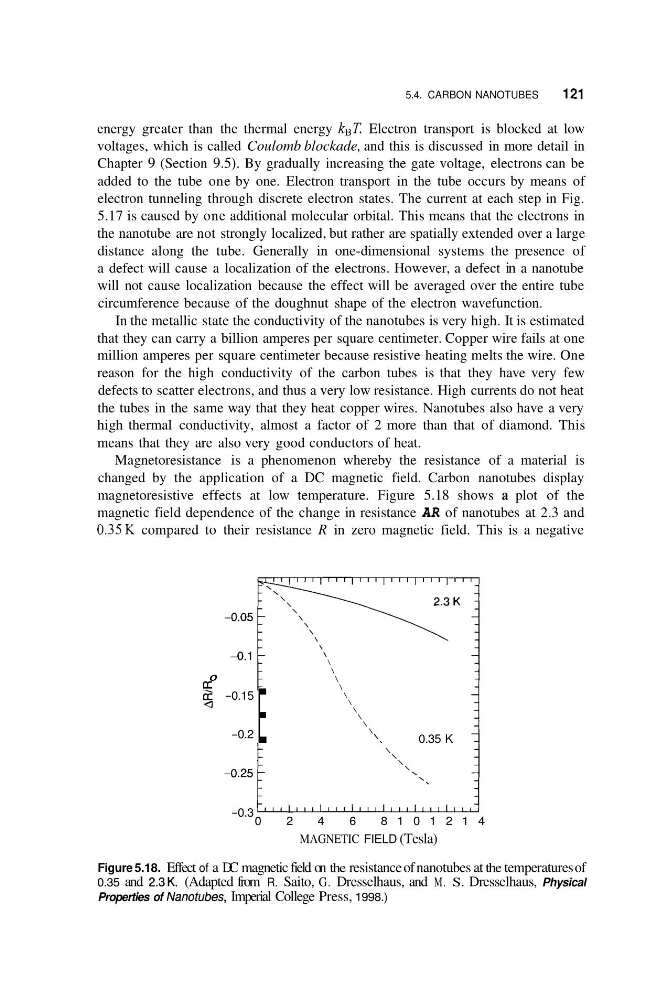
Magnetoresistance is a phenomenon whereby the resistance of a material is
changed by the application of a DC magnetic field. Carbon nanotubes display
magnetoresistive effects at low temperature. Figure 5.18 shows a plot of the
magnetic field dependence of the change in resistance AR of nanotubes at 2.3 and
0.35K compared to their resistance R in zero magnetic field. This is a negative
0
g
\
\
\
\
\
\
\
\
\
\
E '\ 0.35 K
2 -0.15
U
-0.2
L
\
-0.3
0
2
4
6
8 1 0 1 2 1 4
MAGNETIC FIELD (Tesla)
Figure 5.18. Effect of a DC magnetic field on the resistance of nanotubes at the temperatures of
0.35 and 2.3K. (Adapted from R. Saito, G. Dresselhaus, and M. S. Dresselhaus, Physical
Properties of Nanotubes, Imperial College Press, 1998.)
121
energy greater than the thermal energy kBT. Electron transport is blocked at low
voltages, which is called Coulomb blockade, and this is discussed in more detail in
Chapter 9 (Section 9.5). By gradually increasing the gate voltage, electrons can be
added to the tube one by one. Electron transport in the tube occurs by means of
electron tunneling through discrete electron states. The current at each step in Fig.
5.17 is caused by one additional molecular orbital. This means that the electrons in
the nanotube are not strongly localized, but rather are spatially extended over a large
distance along the tube. Generally in one-dimensional systems the presence of
a defect will cause a localization of the electrons. However, a defect in a nanotube
will not cause localization because the effect will be averaged over the entire tube
circumference because of the doughnut shape of the electron wavefunction.
In the metallic state the conductivity of the nanotubes is very high. It is estimated
that they can carry a billion amperes per square centimeter. Copper wire fails at one
million amperes per square centimeter because resistive heating melts the wire. One
reason for the high conductivity of the carbon tubes is that they have very few
defects to scatter electrons, and thus a very low resistance. High currents do not heat
the tubes in the same way that they heat copper wires. Nanotubes also have a very
high thermal conductivity, almost a factor of 2 more than that of diamond. This
means that they are also very good conductors of heat.
Magnetoresistance is a phenomenon whereby the resistance of a material is
changed by the application of a DC magnetic field. Carbon nanotubes display
magnetoresistive effects at low temperature. Figure 5.18 shows a plot of the
magnetic field dependence of the change in resistance AR of nanotubes at 2.3 and
0.35K compared to their resistance R in zero magnetic field. This is a negative
0
g
\
\
\
\
\
\
\
\
\
\
E '\ 0.35 K
2 -0.15
U
-0.2
L
\
-0.3
0
2
4
6
8 1 0 1 2 1 4
MAGNETIC FIELD (Tesla)
Figure 5.18. Effect of a DC magnetic field on the resistance of nanotubes at the temperatures of
0.35 and 2.3K. (Adapted from R. Saito, G. Dresselhaus, and M. S. Dresselhaus, Physical
Properties of Nanotubes, Imperial College Press, 1998.)