

11 8
CARBON NANOSTRUCTURES
having different orientations in the graphite sheet are shown in Fig. 5.1 I. When Tis
parallel to the C-C bonds of the carbon hexagons, the structure shown in Fig. 5.1 la
is obtained, and it is referred to as the "armchair" structure. The tubes sketched in
Figs. 5.1 lb and 5.1 IC, referred to respectively as the zigzag and the chiral structures,
are formed by rolling about a T vector having different orientations in the graphite
plane, but not parallel to C-C bonds. Looking down the tube of the chiral structure,
one would see a spiraling row of carbon atoms. Generally nanotubes are closed at
both ends, which involves the introduction of a pentagonal topological arrangement
on each end of the cylinder. The tubes are essentially cylinders with each end
attached to half of a large hllerenelike structure. In the case of SWNTs metal
particles are found at the ends of the tubes, which is evidence for the catalytic role of
the metal particles in their formation.
5.4.3. Electrical Properties
Carbon nanotubes have the most interesting property that they are metallic or
semiconducting, dependmg on the diameter and chirality of the tube. Chirality refers
to how the tubes are rolled with respect to the direction of the T vector in the graphite
plane, as discussed above. Synthesis generally results in a mixture of tubes twothirds of which are semiconducting and one-third metallic. The metallic tubes have
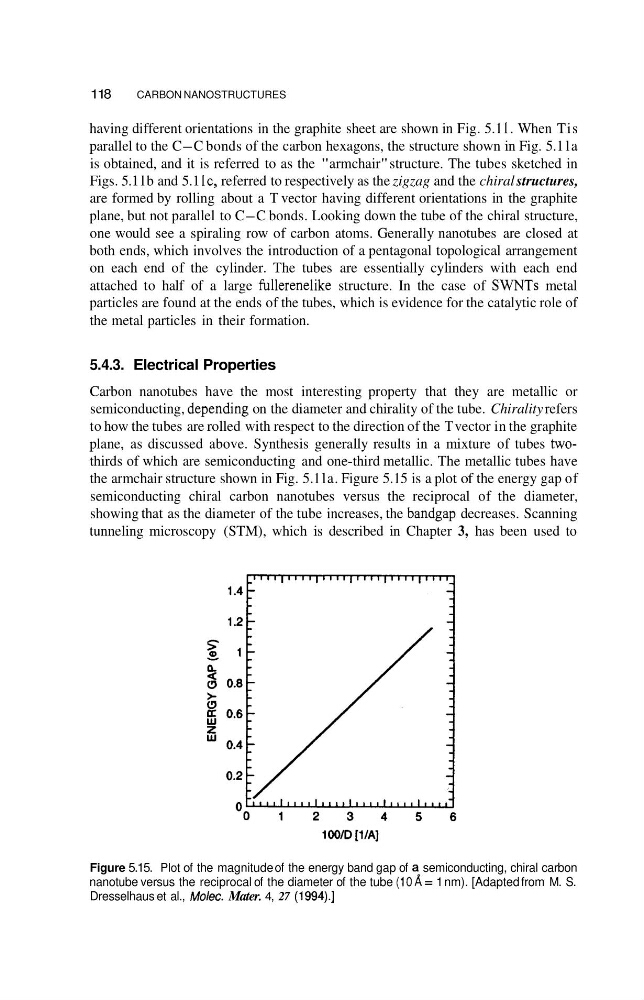
the armchair structure shown in Fig. 5.1 la. Figure 5.15 is a plot of the energy gap of
semiconducting chiral carbon nanotubes versus the reciprocal of the diameter,
showing that as the diameter of the tube increases, the bandgap decreases. Scanning
tunneling microscopy (STM), which is described in Chapter 3, has been used to
Figure 5.15. Plot of the magnitude of the energy band gap of a- semiconducting, chiral carbon
nanotube versus the reciprocal of the diameter of the tube (10A= 1 nm). [Adapted from M. S.
Dresselhaus et al., Molec. Mater. 4, 27 (1994).]
CARBON NANOSTRUCTURES
having different orientations in the graphite sheet are shown in Fig. 5.1 I. When Tis
parallel to the C-C bonds of the carbon hexagons, the structure shown in Fig. 5.1 la
is obtained, and it is referred to as the "armchair" structure. The tubes sketched in
Figs. 5.1 lb and 5.1 IC, referred to respectively as the zigzag and the chiral structures,
are formed by rolling about a T vector having different orientations in the graphite
plane, but not parallel to C-C bonds. Looking down the tube of the chiral structure,
one would see a spiraling row of carbon atoms. Generally nanotubes are closed at
both ends, which involves the introduction of a pentagonal topological arrangement
on each end of the cylinder. The tubes are essentially cylinders with each end
attached to half of a large hllerenelike structure. In the case of SWNTs metal
particles are found at the ends of the tubes, which is evidence for the catalytic role of
the metal particles in their formation.
5.4.3. Electrical Properties
Carbon nanotubes have the most interesting property that they are metallic or
semiconducting, dependmg on the diameter and chirality of the tube. Chirality refers
to how the tubes are rolled with respect to the direction of the T vector in the graphite
plane, as discussed above. Synthesis generally results in a mixture of tubes twothirds of which are semiconducting and one-third metallic. The metallic tubes have
the armchair structure shown in Fig. 5.1 la. Figure 5.15 is a plot of the energy gap of
semiconducting chiral carbon nanotubes versus the reciprocal of the diameter,
showing that as the diameter of the tube increases, the bandgap decreases. Scanning
tunneling microscopy (STM), which is described in Chapter 3, has been used to
Figure 5.15. Plot of the magnitude of the energy band gap of a- semiconducting, chiral carbon
nanotube versus the reciprocal of the diameter of the tube (10A= 1 nm). [Adapted from M. S.
Dresselhaus et al., Molec. Mater. 4, 27 (1994).]