

108
CARBON NANOSTRUCTURES
c - c - c - c - c
1.271
1.275
D-h
D-h
DZh
1.316
c '
c .
C
I
I c - c - c - c - c - c - c
\
;
/
1.270
1.264
1.280
c 90.4" c
D3h
D-h
c - c - c - c - c - c - c - c - c
1.269
1.261
1.269
1.283
D-h
c - c - c
I
\ 1.24
C
107.1"
\\
I 1.38
c - c - c
c4h
1.290
c - c - c
/
\
C
C
I
\
C
c \ 119.4' /
c
,
n
,
c
C
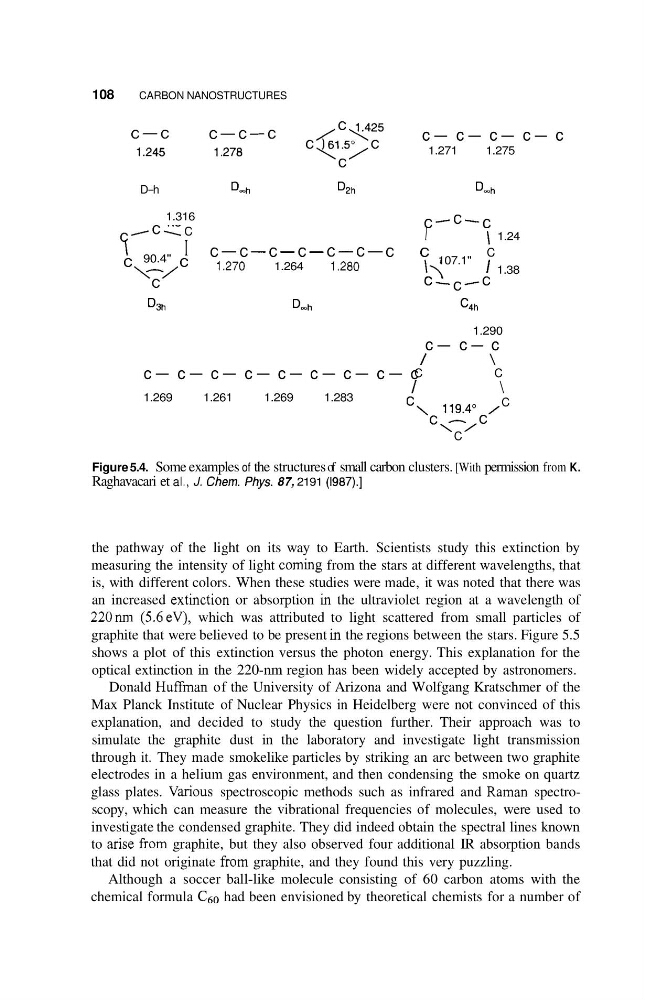
Figure 5.4. Some examples of the structures of small carbon clusters. [With permission from K.
Raghavacari et al., J. Chem. Phys. 87, 2191 (1987).]
the pathway of the light on its way to Earth. Scientists study this extinction by
measuring the intensity of light coming from the stars at different wavelengths, that
is, with different colors. When these studies were made, it was noted that there was
an increased extinction or absorption in the ultraviolet region at a wavelength of
220nm (5.6eV), which was attributed to light scattered from small particles of
graphite that were believed to be present in the regions between the stars. Figure 5.5
shows a plot of this extinction versus the photon energy. This explanation for the
optical extinction in the 220-nm region has been widely accepted by astronomers.
Donald Huffman of the University of Arizona and Wolfgang Kratschmer of the
Max Planck Institute of Nuclear Physics in Heidelberg were not convinced of this
explanation, and decided to study the question further. Their approach was to
simulate the graphite dust in the laboratory and investigate light transmission
through it. They made smokelike particles by striking an arc between two graphite
electrodes in a helium gas environment, and then condensing the smoke on quartz
glass plates. Various spectroscopic methods such as infrared and Raman spectroscopy, which can measure the vibrational frequencies of molecules, were used to
investigate the condensed graphite. They did indeed obtain the spectral lines known
to arise from graphite, but they also observed four additional IR absorption bands
that did not originate from graphite, and they found this very puzzling.
Although a soccer ball-like molecule consisting of 60 carbon atoms with the
chemical formula C60 had been envisioned by theoretical chemists for a number of
CARBON NANOSTRUCTURES
c - c - c - c - c
1.271
1.275
D-h
D-h
DZh
1.316
c '
c .
C
I
I c - c - c - c - c - c - c
\
;
/
1.270
1.264
1.280
c 90.4" c
D3h
D-h
c - c - c - c - c - c - c - c - c
1.269
1.261
1.269
1.283
D-h
c - c - c
I
\ 1.24
C
107.1"
\\
I 1.38
c - c - c
c4h
1.290
c - c - c
/
\
C
C
I
\
C
c \ 119.4' /
c
,
n
,
c
C
Figure 5.4. Some examples of the structures of small carbon clusters. [With permission from K.
Raghavacari et al., J. Chem. Phys. 87, 2191 (1987).]
the pathway of the light on its way to Earth. Scientists study this extinction by
measuring the intensity of light coming from the stars at different wavelengths, that
is, with different colors. When these studies were made, it was noted that there was
an increased extinction or absorption in the ultraviolet region at a wavelength of
220nm (5.6eV), which was attributed to light scattered from small particles of
graphite that were believed to be present in the regions between the stars. Figure 5.5
shows a plot of this extinction versus the photon energy. This explanation for the
optical extinction in the 220-nm region has been widely accepted by astronomers.
Donald Huffman of the University of Arizona and Wolfgang Kratschmer of the
Max Planck Institute of Nuclear Physics in Heidelberg were not convinced of this
explanation, and decided to study the question further. Their approach was to
simulate the graphite dust in the laboratory and investigate light transmission
through it. They made smokelike particles by striking an arc between two graphite
electrodes in a helium gas environment, and then condensing the smoke on quartz
glass plates. Various spectroscopic methods such as infrared and Raman spectroscopy, which can measure the vibrational frequencies of molecules, were used to
investigate the condensed graphite. They did indeed obtain the spectral lines known
to arise from graphite, but they also observed four additional IR absorption bands
that did not originate from graphite, and they found this very puzzling.
Although a soccer ball-like molecule consisting of 60 carbon atoms with the
chemical formula C60 had been envisioned by theoretical chemists for a number of