

5.3. CARBON CLUSTERS
107
- 0
20
40
60
80 .
100
120
Cluster Size N
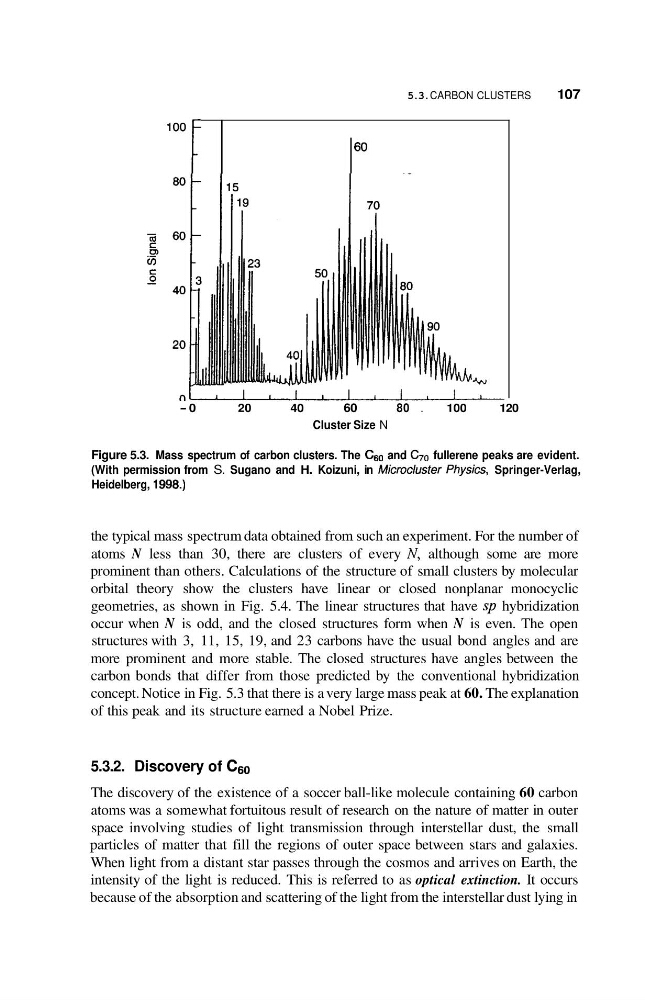
Figure 5.3. Mass spectrum of carbon clusters. The Cs0 and C70 fullerene peaks are evident.
(With permission from S. Sugano and H. Koizuni, in Microcluster Physics, Springer-Verlag,
Heidelberg, 1998.)
the typical mass spectrum data obtained from such an experiment. For the number of
atoms N less than 30, there are clusters of every N, although some are more
prominent than others. Calculations of the structure of small clusters by molecular
orbital theory show the clusters have linear or closed nonplanar monocyclic
geometries, as shown in Fig. 5.4. The linear structures that have sp hybridization
occur when N is odd, and the closed structures form when N is even. The open
structures with 3, 11, 15, 19, and 23 carbons have the usual bond angles and are
more prominent and more stable. The closed structures have angles between the
carbon bonds that differ from those predicted by the conventional hybridization
concept. Notice in Fig. 5.3 that there is a very large mass peak at 60. The explanation
of this peak and its structure earned a Nobel Prize.
5.3.2. Discovery of Cs0
The discovery of the existence of a soccer ball-like molecule containing 60 carbon
atoms was a somewhat fortuitous result of research on the nature of matter in outer
space involving studies of light transmission through interstellar dust, the small
particles of matter that fill the regions of outer space between stars and galaxies.
When light from a distant star passes through the cosmos and arrives on Earth, the
intensity of the light is reduced. This is referred to as optical extinction. It occurs
because of the absorption and scattering of the light from the interstellar dust lying in
107
- 0
20
40
60
80 .
100
120
Cluster Size N
Figure 5.3. Mass spectrum of carbon clusters. The Cs0 and C70 fullerene peaks are evident.
(With permission from S. Sugano and H. Koizuni, in Microcluster Physics, Springer-Verlag,
Heidelberg, 1998.)
the typical mass spectrum data obtained from such an experiment. For the number of
atoms N less than 30, there are clusters of every N, although some are more
prominent than others. Calculations of the structure of small clusters by molecular
orbital theory show the clusters have linear or closed nonplanar monocyclic
geometries, as shown in Fig. 5.4. The linear structures that have sp hybridization
occur when N is odd, and the closed structures form when N is even. The open
structures with 3, 11, 15, 19, and 23 carbons have the usual bond angles and are
more prominent and more stable. The closed structures have angles between the
carbon bonds that differ from those predicted by the conventional hybridization
concept. Notice in Fig. 5.3 that there is a very large mass peak at 60. The explanation
of this peak and its structure earned a Nobel Prize.
5.3.2. Discovery of Cs0
The discovery of the existence of a soccer ball-like molecule containing 60 carbon
atoms was a somewhat fortuitous result of research on the nature of matter in outer
space involving studies of light transmission through interstellar dust, the small
particles of matter that fill the regions of outer space between stars and galaxies.
When light from a distant star passes through the cosmos and arrives on Earth, the
intensity of the light is reduced. This is referred to as optical extinction. It occurs
because of the absorption and scattering of the light from the interstellar dust lying in