

5.3. CARBON CLUSTERS
109
PHOTON ENERGY (electron volts)
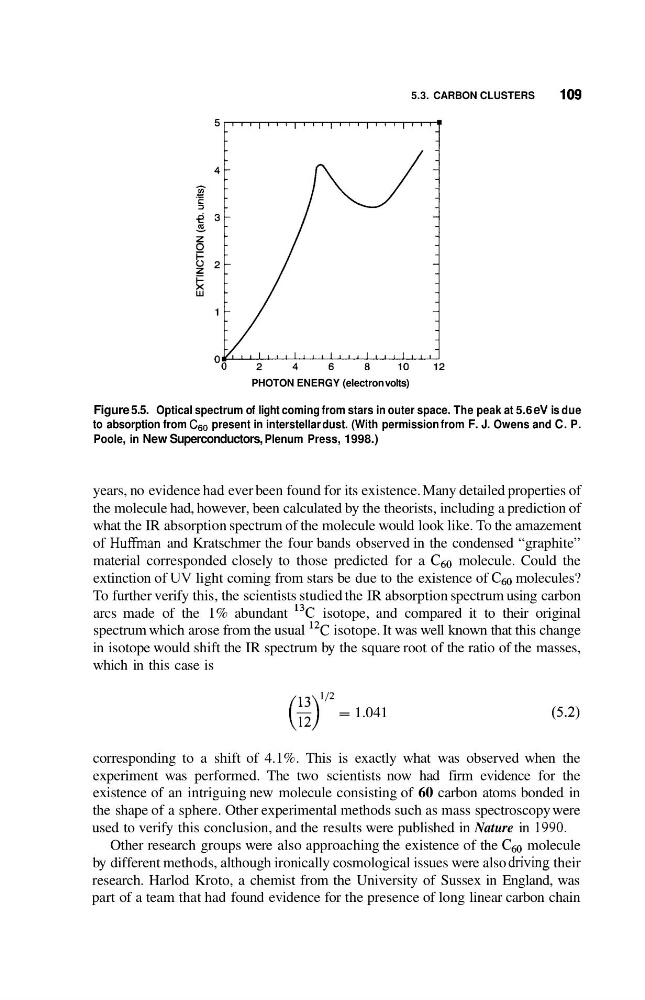
Figure 5.5. Optical spectrum of light coming from stars in outer space. The peak at 5.6 eV is due
to absorption from C6,, present in interstellar dust. (With permission from F. J. Owens and C. P.
Poole, in New Superconductors, Plenum Press, 1998.)
years, no evidence had ever been found for its existence. Many detailed properties of
the molecule had, however, been calculated by the theorists, including a prediction of
what the IR absorption spectrum of the molecule would look like. To the amazement
of Huffman and Kratschmer the four bands observed in the condensed “graphite”
material corresponded closely to those predicted for a c 6 0 molecule. Could the
extinction of UV light coming from stars be due to the existence of c 6 0 molecules?
To further verify this, the scientists studied the IR absorption spectrum using carbon
arcs made of the 1% abundant 13C isotope, and compared it to their original
spectrum which arose from the usual 12C isotope. It was well known that this change
in isotope would shift the IR spectrum by the square root of the ratio of the masses,
which in this case is
(g)”’ = 1.041
corresponding to a shift of 4.1%. This is exactly what was observed when the
experiment was performed. The two scientists now had firm evidence for the
existence of an intriguing new molecule consisting of 60 carbon atoms bonded in
the shape of a sphere. Other experimental methods such as mass spectroscopy were
used to verify this conclusion, and the results were published in Nature in 1990.
Other research groups were also approaching the existence of the c 6 0 molecule
by different methods, although ironically cosmological issues were also dnving their
research. Harlod Kroto, a chemist from the University of Sussex in England, was
part of a team that had found evidence for the presence of long linear carbon chain
109
PHOTON ENERGY (electron volts)
Figure 5.5. Optical spectrum of light coming from stars in outer space. The peak at 5.6 eV is due
to absorption from C6,, present in interstellar dust. (With permission from F. J. Owens and C. P.
Poole, in New Superconductors, Plenum Press, 1998.)
years, no evidence had ever been found for its existence. Many detailed properties of
the molecule had, however, been calculated by the theorists, including a prediction of
what the IR absorption spectrum of the molecule would look like. To the amazement
of Huffman and Kratschmer the four bands observed in the condensed “graphite”
material corresponded closely to those predicted for a c 6 0 molecule. Could the
extinction of UV light coming from stars be due to the existence of c 6 0 molecules?
To further verify this, the scientists studied the IR absorption spectrum using carbon
arcs made of the 1% abundant 13C isotope, and compared it to their original
spectrum which arose from the usual 12C isotope. It was well known that this change
in isotope would shift the IR spectrum by the square root of the ratio of the masses,
which in this case is
(g)”’ = 1.041
corresponding to a shift of 4.1%. This is exactly what was observed when the
experiment was performed. The two scientists now had firm evidence for the
existence of an intriguing new molecule consisting of 60 carbon atoms bonded in
the shape of a sphere. Other experimental methods such as mass spectroscopy were
used to verify this conclusion, and the results were published in Nature in 1990.
Other research groups were also approaching the existence of the c 6 0 molecule
by different methods, although ironically cosmological issues were also dnving their
research. Harlod Kroto, a chemist from the University of Sussex in England, was
part of a team that had found evidence for the presence of long linear carbon chain