

5.2. CARBON MOLECULES
105
methane does not have this configuration; rather, it has the tetrahedral structure
shown in Fig. 5. IC, where the carbon bonds make angles of 109'28' with each other.
The explanation lies in the concept of hybridization. In the carbon atom the energy
separation between the 2s level and the 2p levels is very small, and this allows an
admixture of the 2s wavefunction with one or more of the 2pi wavefunctions. The
un-normalized wavefunction Y in a valence state can be designated by the expression
where p indicates an admixture of pi orbitals. With this hybridization the directions
of the p lobes and the angles between them changes. The angles will depend on the
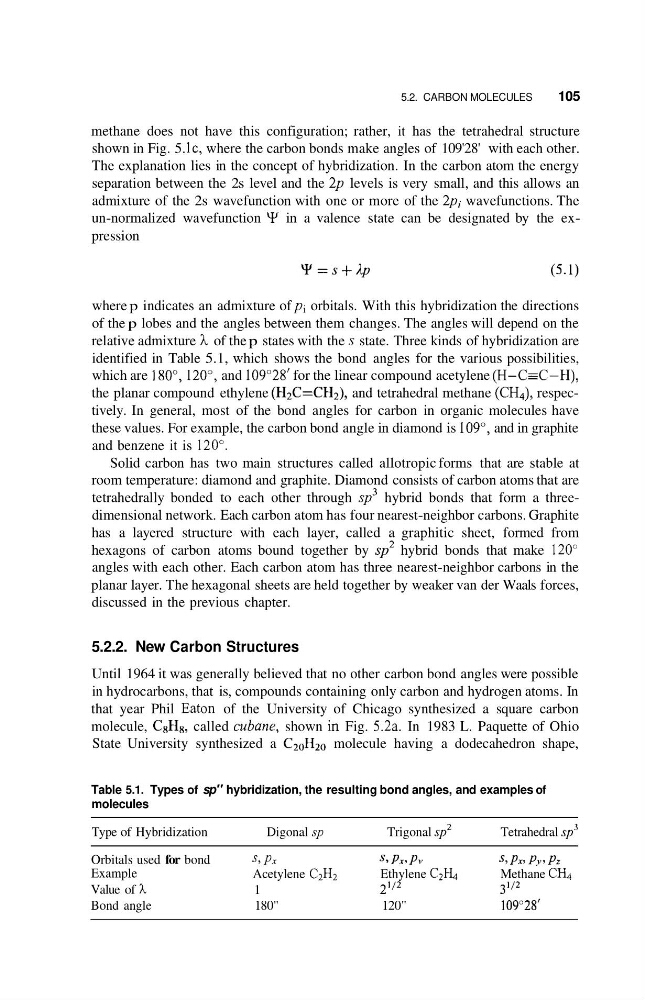
relative admixture h of the p states with the s state. Three kinds of hybridization are
identified in Table 5.1, which shows the bond angles for the various possibilities,
which are 180", 120°, and 109"28' for the linear compound acetylene ( H - C d - H ) ,
the planar compound ethylene (H2C=CH2), and tetrahedral methane (CH4), respectively. In general, most of the bond angles for carbon in organic molecules have
these values. For example, the carbon bond angle in diamond is 109", and in graphite
and benzene it is 120".
Solid carbon has two main structures called allotropic forms that are stable at
room temperature: diamond and graphite. Diamond consists of carbon atoms that are
tetrahedrally bonded to each other through sp3 hybrid bonds that form a threedimensional network. Each carbon atom has four nearest-neighbor carbons. Graphite
has a layered structure with each layer, called a graphitic sheet, formed from
hexagons of carbon atoms bound together by sp2 hybrid bonds that make 120"
angles with each other. Each carbon atom has three nearest-neighbor carbons in the
planar layer. The hexagonal sheets are held together by weaker van der Waals forces,
discussed in the previous chapter.
5.2.2. New Carbon Structures
Until 1964 it was generally believed that no other carbon bond angles were possible
in hydrocarbons, that is, compounds containing only carbon and hydrogen atoms. In
that year Phil Eaton of the University of Chicago synthesized a square carbon
molecule, C&, called cubane, shown in Fig. 5.2a. In 1983 L. Paquette of Ohio
State University synthesized a C20H20 molecule having a dodecahedron shape,
Table 5.1. Types of sp" hybridization, the resulting bond angles, and examples of
molecules
Type of Hybridization
Digonal sp
Trigonal sp2
Tetrahedral sp3
Orbitals used for bond
s, P x
s, Pr. PI.
s, P x , Py9 Pr
Example
Acetylene C2H2
Ethylene C2H,
Methane CH4
Value of h
1
2'/2
31/2
Bond angle
180"
120"
109"28'
105
methane does not have this configuration; rather, it has the tetrahedral structure
shown in Fig. 5. IC, where the carbon bonds make angles of 109'28' with each other.
The explanation lies in the concept of hybridization. In the carbon atom the energy
separation between the 2s level and the 2p levels is very small, and this allows an
admixture of the 2s wavefunction with one or more of the 2pi wavefunctions. The
un-normalized wavefunction Y in a valence state can be designated by the expression
where p indicates an admixture of pi orbitals. With this hybridization the directions
of the p lobes and the angles between them changes. The angles will depend on the
relative admixture h of the p states with the s state. Three kinds of hybridization are
identified in Table 5.1, which shows the bond angles for the various possibilities,
which are 180", 120°, and 109"28' for the linear compound acetylene ( H - C d - H ) ,
the planar compound ethylene (H2C=CH2), and tetrahedral methane (CH4), respectively. In general, most of the bond angles for carbon in organic molecules have
these values. For example, the carbon bond angle in diamond is 109", and in graphite
and benzene it is 120".
Solid carbon has two main structures called allotropic forms that are stable at
room temperature: diamond and graphite. Diamond consists of carbon atoms that are
tetrahedrally bonded to each other through sp3 hybrid bonds that form a threedimensional network. Each carbon atom has four nearest-neighbor carbons. Graphite
has a layered structure with each layer, called a graphitic sheet, formed from
hexagons of carbon atoms bound together by sp2 hybrid bonds that make 120"
angles with each other. Each carbon atom has three nearest-neighbor carbons in the
planar layer. The hexagonal sheets are held together by weaker van der Waals forces,
discussed in the previous chapter.
5.2.2. New Carbon Structures
Until 1964 it was generally believed that no other carbon bond angles were possible
in hydrocarbons, that is, compounds containing only carbon and hydrogen atoms. In
that year Phil Eaton of the University of Chicago synthesized a square carbon
molecule, C&, called cubane, shown in Fig. 5.2a. In 1983 L. Paquette of Ohio
State University synthesized a C20H20 molecule having a dodecahedron shape,
Table 5.1. Types of sp" hybridization, the resulting bond angles, and examples of
molecules
Type of Hybridization
Digonal sp
Trigonal sp2
Tetrahedral sp3
Orbitals used for bond
s, P x
s, Pr. PI.
s, P x , Py9 Pr
Example
Acetylene C2H2
Ethylene C2H,
Methane CH4
Value of h
1
2'/2
31/2
Bond angle
180"
120"
109"28'