

104
CARBON NANOSTRUCTURES
electrons with oppositely paired electron spins. The electron charge distribution in
an s state is spherically symmetric about the nucleus. These Is electrons do not
participate in the chemical bonding. The next four electrons are in the N = 2 energy
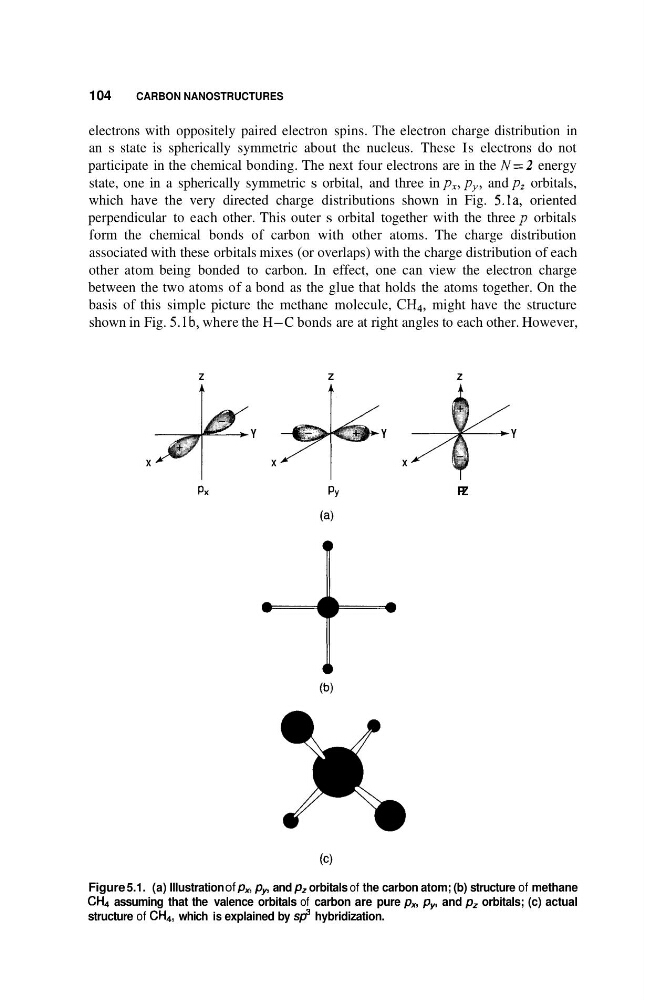
state, one in a spherically symmetric s orbital, and three in px, p y , and pz orbitals,
which have the very directed charge distributions shown in Fig. 5.la, oriented
perpendicular to each other. This outer s orbital together with the three p orbitals
form the chemical bonds of carbon with other atoms. The charge distribution
associated with these orbitals mixes (or overlaps) with the charge distribution of each
other atom being bonded to carbon. In effect, one can view the electron charge
between the two atoms of a bond as the glue that holds the atoms together. On the
basis of this simple picture the methane molecule, CH4, might have the structure
shown in Fig. 5.lb, where the H-C bonds are at right angles to each other. However,
Z
Z
Y
Y
Y
X
X
X
PZ
Figure 5.1. (a) Illustration of px, pv, and pz orbitals of the carbon atom; (b) structure of methane
CH4 assuming that the valence orbitals of carbon are pure px, p,,, and pz orbitals; (c) actual
structure of CH4, which is explained by sp' hybridization.
CARBON NANOSTRUCTURES
electrons with oppositely paired electron spins. The electron charge distribution in
an s state is spherically symmetric about the nucleus. These Is electrons do not
participate in the chemical bonding. The next four electrons are in the N = 2 energy
state, one in a spherically symmetric s orbital, and three in px, p y , and pz orbitals,
which have the very directed charge distributions shown in Fig. 5.la, oriented
perpendicular to each other. This outer s orbital together with the three p orbitals
form the chemical bonds of carbon with other atoms. The charge distribution
associated with these orbitals mixes (or overlaps) with the charge distribution of each
other atom being bonded to carbon. In effect, one can view the electron charge
between the two atoms of a bond as the glue that holds the atoms together. On the
basis of this simple picture the methane molecule, CH4, might have the structure
shown in Fig. 5.lb, where the H-C bonds are at right angles to each other. However,
Z
Z
Y
Y
Y
X
X
X
PZ
Figure 5.1. (a) Illustration of px, pv, and pz orbitals of the carbon atom; (b) structure of methane
CH4 assuming that the valence orbitals of carbon are pure px, p,,, and pz orbitals; (c) actual
structure of CH4, which is explained by sp' hybridization.