

100
PROPERTIES OF INDIVIDUAL NANOPARTICLES
400 E
.........
........... . -
.
.......
4
...
-200
m
2 u
.....
6 0 0 - 1 I I I I I I I I I I I I I _
. -
.
-
e .
-
..
-400
0.
-600 " I I ' I
' ' ' ' '
31 50
3200
3250
3300
MAGNETIC FIELD (G)
(b)
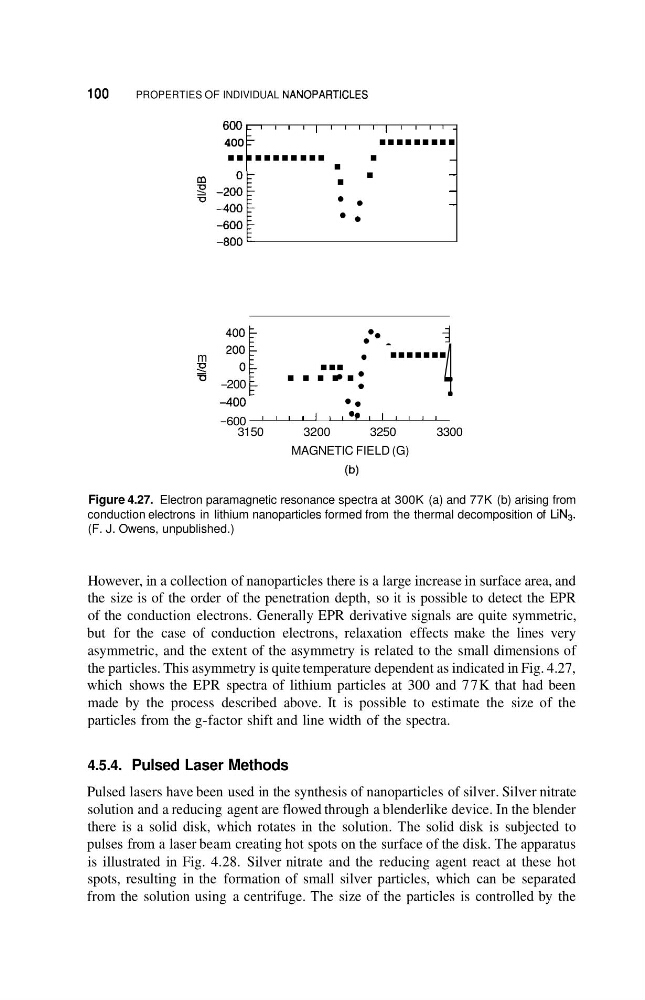
Figure 4.27. Electron paramagnetic resonance spectra at 300K (a) and 77K (b) arising from
conduction electrons in lithium nanoparticles formed from the thermal decomposition of LiN3.
(F. J. Owens, unpublished.)
However, in a collection of nanoparticles there is a large increase in surface area, and
the size is of the order of the penetration depth, so it is possible to detect the EPR
of the conduction electrons. Generally EPR derivative signals are quite symmetric,
but for the case of conduction electrons, relaxation effects make the lines very
asymmetric, and the extent of the asymmetry is related to the small dimensions of
the particles. This asymmetry is quite temperature dependent as indicated in Fig. 4.27,
which shows the EPR spectra of lithium particles at 300 and 77K that had been
made by the process described above. It is possible to estimate the size of the
particles from the g-factor shift and line width of the spectra.
4.5.4. Pulsed Laser Methods
Pulsed lasers have been used in the synthesis of nanoparticles of silver. Silver nitrate
solution and a reducing agent are flowed through a blenderlike device. In the blender
there is a solid disk, which rotates in the solution. The solid disk is subjected to
pulses from a laser beam creating hot spots on the surface of the disk. The apparatus
is illustrated in Fig. 4.28. Silver nitrate and the reducing agent react at these hot
spots, resulting in the formation of small silver particles, which can be separated
from the solution using a centrifuge. The size of the particles is controlled by the
PROPERTIES OF INDIVIDUAL NANOPARTICLES
400 E
.........
........... . -
.
.......
4
...
-200
m
2 u
.....
6 0 0 - 1 I I I I I I I I I I I I I _
. -
.
-
e .
-
..
-400
0.
-600 " I I ' I
' ' ' ' '
31 50
3200
3250
3300
MAGNETIC FIELD (G)
(b)
Figure 4.27. Electron paramagnetic resonance spectra at 300K (a) and 77K (b) arising from
conduction electrons in lithium nanoparticles formed from the thermal decomposition of LiN3.
(F. J. Owens, unpublished.)
However, in a collection of nanoparticles there is a large increase in surface area, and
the size is of the order of the penetration depth, so it is possible to detect the EPR
of the conduction electrons. Generally EPR derivative signals are quite symmetric,
but for the case of conduction electrons, relaxation effects make the lines very
asymmetric, and the extent of the asymmetry is related to the small dimensions of
the particles. This asymmetry is quite temperature dependent as indicated in Fig. 4.27,
which shows the EPR spectra of lithium particles at 300 and 77K that had been
made by the process described above. It is possible to estimate the size of the
particles from the g-factor shift and line width of the spectra.
4.5.4. Pulsed Laser Methods
Pulsed lasers have been used in the synthesis of nanoparticles of silver. Silver nitrate
solution and a reducing agent are flowed through a blenderlike device. In the blender
there is a solid disk, which rotates in the solution. The solid disk is subjected to
pulses from a laser beam creating hot spots on the surface of the disk. The apparatus
is illustrated in Fig. 4.28. Silver nitrate and the reducing agent react at these hot
spots, resulting in the formation of small silver particles, which can be separated
from the solution using a centrifuge. The size of the particles is controlled by the