

FURTHER READING
101
\
\
\
\
\
PULSED LASER BEAM
1
1
1
1
1
I
, NANOPARTICLES
/
/’
SOLUTION
ROTATING DISK
SUBSTRATE
‘I 1
ROTATING SAMPLE HOLDER
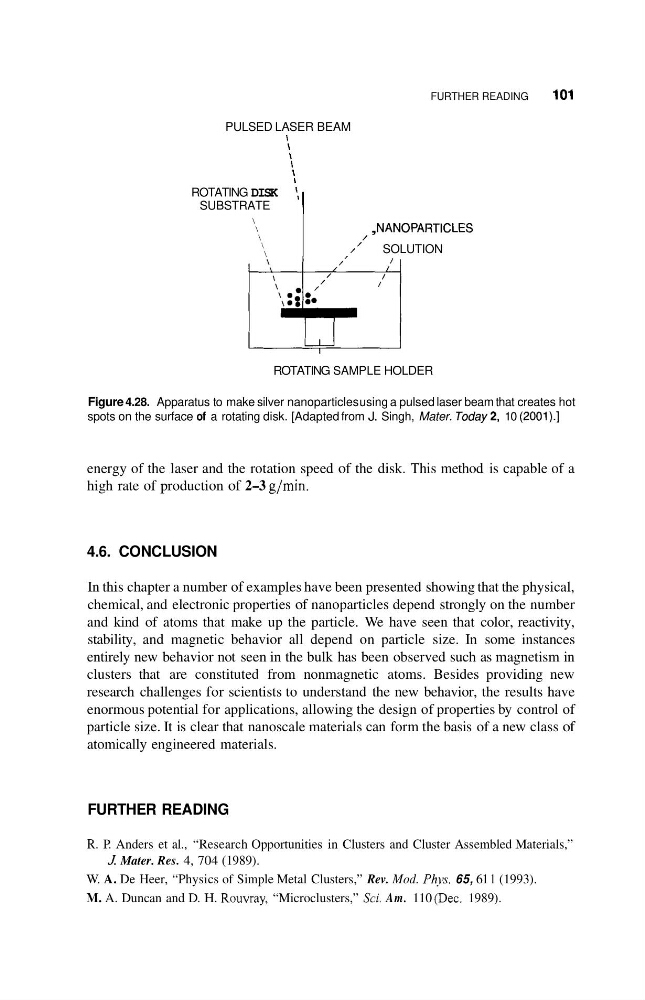
Figure 4.28. Apparatus to make silver nanoparticles using a pulsed laser beam that creates hot
spots on the surface of a rotating disk. [Adapted from J. Singh, Mater. Today2, 10 (2001).]
energy of the laser and the rotation speed of the disk. This method is capable of a
high rate of production of 2-3 g/min.
4.6. CONCLUSION
In this chapter a number of examples have been presented showing that the physical,
chemical, and electronic properties of nanoparticles depend strongly on the number
and kind of atoms that make up the particle. We have seen that color, reactivity,
stability, and magnetic behavior all depend on particle size. In some instances
entirely new behavior not seen in the bulk has been observed such as magnetism in
clusters that are constituted from nonmagnetic atoms. Besides providing new
research challenges for scientists to understand the new behavior, the results have
enormous potential for applications, allowing the design of properties by control of
particle size. It is clear that nanoscale materials can form the basis of a new class of
atomically engineered materials.
FURTHER READING
R. P. Anders et al., “Research Opportunities in Clusters and Cluster Assembled Materials,”
W. A. De Heer, “Physics of Simple Metal Clusters,” Rev. Mod. Phjs. 65, 61 1 (1993).
M. A. Duncan and D. H. Rouvray, “Microclusters,” Sci. Am. 110 (Dec. 1989).
1 Mater. Res. 4, 704 (1989).
101
\
\
\
\
\
PULSED LASER BEAM
1
1
1
1
1
I
, NANOPARTICLES
/
/’
SOLUTION
ROTATING DISK
SUBSTRATE
‘I 1
ROTATING SAMPLE HOLDER
Figure 4.28. Apparatus to make silver nanoparticles using a pulsed laser beam that creates hot
spots on the surface of a rotating disk. [Adapted from J. Singh, Mater. Today2, 10 (2001).]
energy of the laser and the rotation speed of the disk. This method is capable of a
high rate of production of 2-3 g/min.
4.6. CONCLUSION
In this chapter a number of examples have been presented showing that the physical,
chemical, and electronic properties of nanoparticles depend strongly on the number
and kind of atoms that make up the particle. We have seen that color, reactivity,
stability, and magnetic behavior all depend on particle size. In some instances
entirely new behavior not seen in the bulk has been observed such as magnetism in
clusters that are constituted from nonmagnetic atoms. Besides providing new
research challenges for scientists to understand the new behavior, the results have
enormous potential for applications, allowing the design of properties by control of
particle size. It is clear that nanoscale materials can form the basis of a new class of
atomically engineered materials.
FURTHER READING
R. P. Anders et al., “Research Opportunities in Clusters and Cluster Assembled Materials,”
W. A. De Heer, “Physics of Simple Metal Clusters,” Rev. Mod. Phjs. 65, 61 1 (1993).
M. A. Duncan and D. H. Rouvray, “Microclusters,” Sci. Am. 110 (Dec. 1989).
1 Mater. Res. 4, 704 (1989).