

4.5. METHODS OF SYNTHESIS
99
isopropoxide is added to the solution. The titanium acts as a catalyst for the reaction.
The choice of catalyst determines the size of the particles produced. For instance,
80-nm particles have been made using titanium. A surfactant such as oleic acid can
be added to the solution to coat the particles and prevent aggregation.
4.5.3. Thermolysis
Nanoparticles can be made by decomposing solids at high temperature having metal
cations, and molecular anions or metal organic compounds. The process is called
thermolysis. For example, small lithium particles can be made by decomposing
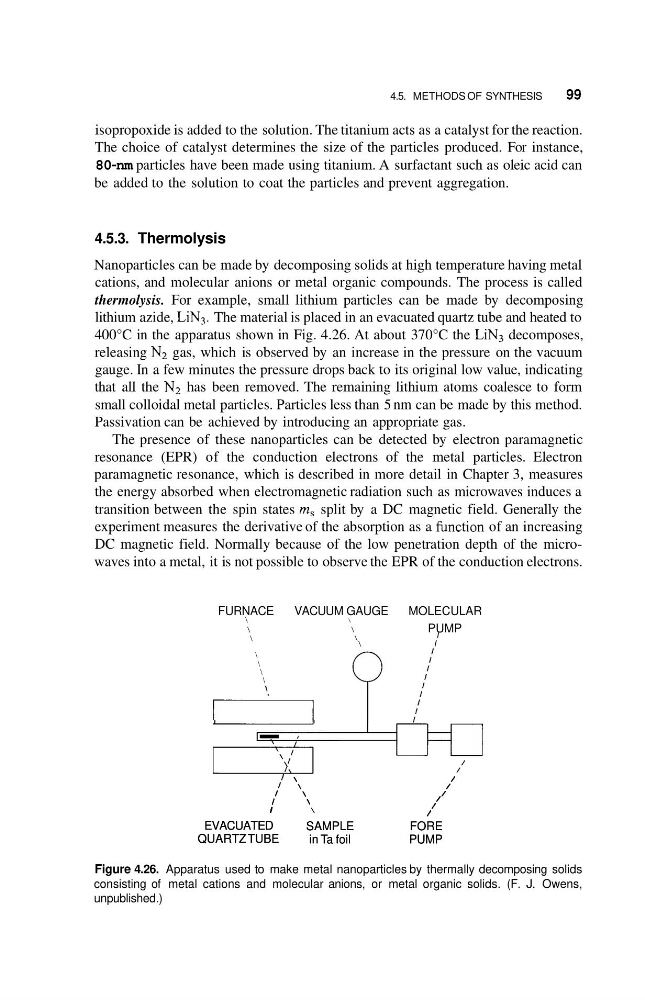
lithium azide, LiN3. The material is placed in an evacuated quartz tube and heated to
400°C in the apparatus shown in Fig. 4.26. At about 370°C the LiN3 decomposes,
releasing N2 gas, which is observed by an increase in the pressure on the vacuum
gauge. In a few minutes the pressure drops back to its original low value, indicating
that all the N2 has been removed. The remaining lithium atoms coalesce to form
small colloidal metal particles. Particles less than 5 nm can be made by this method.
Passivation can be achieved by introducing an appropriate gas.
The presence of these nanoparticles can be detected by electron paramagnetic
resonance (EPR) of the conduction electrons of the metal particles. Electron
paramagnetic resonance, which is described in more detail in Chapter 3, measures
the energy absorbed when electromagnetic radiation such as microwaves induces a
transition between the spin states m, split by a DC magnetic field. Generally the
experiment measures the derivative of the absorption as a fimction of an increasing
DC magnetic field. Normally because of the low penetration depth of the microwaves into a metal, it is not possible to observe the EPR of the conduction electrons.
FURNACE
VACUUM GAUGE
MOLECULAR
\
\
\
\
PUMP
\
\
I
\
I
\
\
\
\
/ \
/
I
\
/
/
\
/
/
\
I
\
/
/
/
EVACUATED
SAMPLE
FORE
QUARTZ TUBE
in Ta foil
PUMP
I
I
7 7
/ \
/
I
\
/
/
\
/
/
\
I
\
/
/
/
EVACUATED
SAMPLE
FORE
QUARTZ TUBE
in Ta foil
PUMP
Figure 4.26. Apparatus used to make metal nanoparticles by thermally decomposing solids
consisting of metal cations and molecular anions, or metal organic solids. (F. J. Owens,
unpublished.)
99
isopropoxide is added to the solution. The titanium acts as a catalyst for the reaction.
The choice of catalyst determines the size of the particles produced. For instance,
80-nm particles have been made using titanium. A surfactant such as oleic acid can
be added to the solution to coat the particles and prevent aggregation.
4.5.3. Thermolysis
Nanoparticles can be made by decomposing solids at high temperature having metal
cations, and molecular anions or metal organic compounds. The process is called
thermolysis. For example, small lithium particles can be made by decomposing
lithium azide, LiN3. The material is placed in an evacuated quartz tube and heated to
400°C in the apparatus shown in Fig. 4.26. At about 370°C the LiN3 decomposes,
releasing N2 gas, which is observed by an increase in the pressure on the vacuum
gauge. In a few minutes the pressure drops back to its original low value, indicating
that all the N2 has been removed. The remaining lithium atoms coalesce to form
small colloidal metal particles. Particles less than 5 nm can be made by this method.
Passivation can be achieved by introducing an appropriate gas.
The presence of these nanoparticles can be detected by electron paramagnetic
resonance (EPR) of the conduction electrons of the metal particles. Electron
paramagnetic resonance, which is described in more detail in Chapter 3, measures
the energy absorbed when electromagnetic radiation such as microwaves induces a
transition between the spin states m, split by a DC magnetic field. Generally the
experiment measures the derivative of the absorption as a fimction of an increasing
DC magnetic field. Normally because of the low penetration depth of the microwaves into a metal, it is not possible to observe the EPR of the conduction electrons.
FURNACE
VACUUM GAUGE
MOLECULAR
\
\
\
\
PUMP
\
\
I
\
I
\
\
\
\
/ \
/
I
\
/
/
\
/
/
\
I
\
/
/
/
EVACUATED
SAMPLE
FORE
QUARTZ TUBE
in Ta foil
PUMP
I
I
7 7
/ \
/
I
\
/
/
\
/
/
\
I
\
/
/
/
EVACUATED
SAMPLE
FORE
QUARTZ TUBE
in Ta foil
PUMP
Figure 4.26. Apparatus used to make metal nanoparticles by thermally decomposing solids
consisting of metal cations and molecular anions, or metal organic solids. (F. J. Owens,
unpublished.)