

98
PROPERTIES OF INDIVIDUAL NANOPARTICLES
x-.
n
COLLECTOR ROD.
CONTAINER
With METAL----_
He GAS -- -
I
EVACUATED
CHAMBER
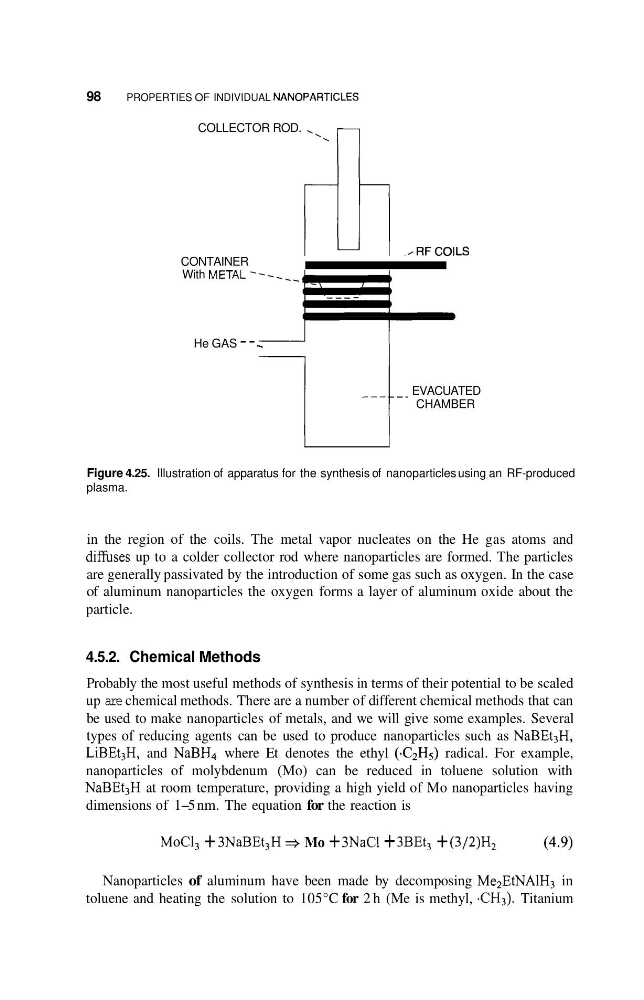
Figure 4.25. Illustration of apparatus for the synthesis of nanoparticles using an RF-produced
plasma.
in the region of the coils. The metal vapor nucleates on the He gas atoms and
diffuses up to a colder collector rod where nanoparticles are formed. The particles
are generally passivated by the introduction of some gas such as oxygen. In the case
of aluminum nanoparticles the oxygen forms a layer of aluminum oxide about the
particle.
4.5.2. Chemical Methods
Probably the most useful methods of synthesis in terms of their potential to be scaled
up are chemical methods. There are a number of different chemical methods that can
be used to make nanoparticles of metals, and we will give some examples. Several
types of reducing agents can be used to produce nanoparticles such as NaBEt3H,
LiBEt3H, and NaBH4 where Et denotes the ethyl (C2Hs) radical. For example,
nanoparticles of molybdenum (Mo) can be reduced in toluene solution with
NaBEt3H at room temperature, providing a high yield of Mo nanoparticles having
dimensions of 1-5 nm. The equation for the reaction is
MoCl, + 3NaBEt,H + Mo + 3NaCI + 3BEt, + (3/2)H2
(4.9)
Nanoparticles of aluminum have been made by decomposing Me2EtNAlH3 in
toluene and heating the solution to 105°C for 2 h (Me is methyl, CH3). Titanium
PROPERTIES OF INDIVIDUAL NANOPARTICLES
x-.
n
COLLECTOR ROD.
CONTAINER
With METAL----_
He GAS -- -
I
EVACUATED
CHAMBER
Figure 4.25. Illustration of apparatus for the synthesis of nanoparticles using an RF-produced
plasma.
in the region of the coils. The metal vapor nucleates on the He gas atoms and
diffuses up to a colder collector rod where nanoparticles are formed. The particles
are generally passivated by the introduction of some gas such as oxygen. In the case
of aluminum nanoparticles the oxygen forms a layer of aluminum oxide about the
particle.
4.5.2. Chemical Methods
Probably the most useful methods of synthesis in terms of their potential to be scaled
up are chemical methods. There are a number of different chemical methods that can
be used to make nanoparticles of metals, and we will give some examples. Several
types of reducing agents can be used to produce nanoparticles such as NaBEt3H,
LiBEt3H, and NaBH4 where Et denotes the ethyl (C2Hs) radical. For example,
nanoparticles of molybdenum (Mo) can be reduced in toluene solution with
NaBEt3H at room temperature, providing a high yield of Mo nanoparticles having
dimensions of 1-5 nm. The equation for the reaction is
MoCl, + 3NaBEt,H + Mo + 3NaCI + 3BEt, + (3/2)H2
(4.9)
Nanoparticles of aluminum have been made by decomposing Me2EtNAlH3 in
toluene and heating the solution to 105°C for 2 h (Me is methyl, CH3). Titanium