

4.5. METHODS OF SYNTHESIS
97
d
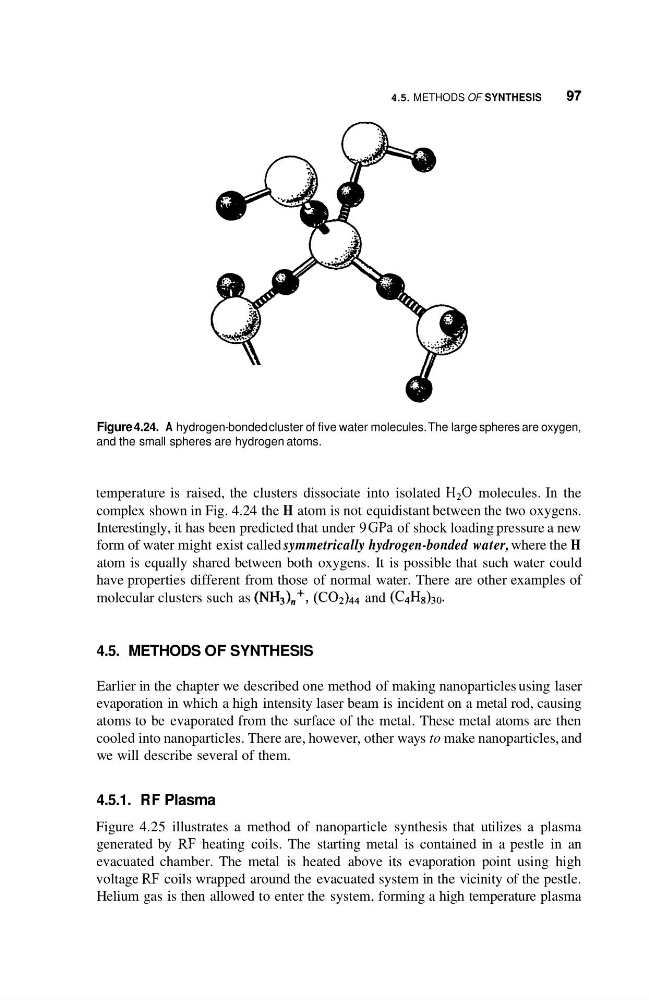
Figure 4.24. A hydrogen-bonded cluster of five water molecules. The large spheres are oxygen,
and the small spheres are hydrogen atoms.
temperature is raised, the clusters dissociate into isolated H 2 0 molecules. In the
complex shown in Fig. 4.24 the H atom is not equidistant between the two oxygens.
Interestingly, it has been predicted that under 9 GPa of shock loading pressure a new
form of water might exist called symmetrically hydrogen-bonded water, where the H
atom is equally shared between both oxygens. It is possible that such water could
have properties different from those of normal water. There are other examples of
molecular clusters such as (NH3),+, (C02)44 and (C4H&0.
4.5. METHODS OF SYNTHESIS
Earlier in the chapter we described one method of making nanoparticles using laser
evaporation in which a high intensity laser beam is incident on a metal rod, causing
atoms to be evaporated from the surface of the metal. These metal atoms are then
cooled into nanoparticles. There are, however, other ways to make nanoparticles, and
we will describe several of them.
4.5.1. RF Plasma
Figure 4.25 illustrates a method of nanoparticle synthesis that utilizes a plasma
generated by RF heating coils. The starting metal is contained in a pestle in an
evacuated chamber. The metal is heated above its evaporation point using high
voltage RF coils wrapped around the evacuated system in the vicinity of the pestle.
Helium gas is then allowed to enter the system, forming a high temperature plasma
97
d
Figure 4.24. A hydrogen-bonded cluster of five water molecules. The large spheres are oxygen,
and the small spheres are hydrogen atoms.
temperature is raised, the clusters dissociate into isolated H 2 0 molecules. In the
complex shown in Fig. 4.24 the H atom is not equidistant between the two oxygens.
Interestingly, it has been predicted that under 9 GPa of shock loading pressure a new
form of water might exist called symmetrically hydrogen-bonded water, where the H
atom is equally shared between both oxygens. It is possible that such water could
have properties different from those of normal water. There are other examples of
molecular clusters such as (NH3),+, (C02)44 and (C4H&0.
4.5. METHODS OF SYNTHESIS
Earlier in the chapter we described one method of making nanoparticles using laser
evaporation in which a high intensity laser beam is incident on a metal rod, causing
atoms to be evaporated from the surface of the metal. These metal atoms are then
cooled into nanoparticles. There are, however, other ways to make nanoparticles, and
we will describe several of them.
4.5.1. RF Plasma
Figure 4.25 illustrates a method of nanoparticle synthesis that utilizes a plasma
generated by RF heating coils. The starting metal is contained in a pestle in an
evacuated chamber. The metal is heated above its evaporation point using high
voltage RF coils wrapped around the evacuated system in the vicinity of the pestle.
Helium gas is then allowed to enter the system, forming a high temperature plasma