

4.3. SEMICONDUCTING NANOPARTICLES
93
where hv is a photon of light energy. Similar results have been obtained for germanium nanoparticles. When the cluster size is greater than 30 atoms, the fragmentation has been observed to occur explosively.
4.3.3. Coulombic Explosion
Multiple ionization of clusters causes them to become unstable, resulting in very
rapid high-energy dissociation or explosion. The fragment velocities from this process are very high. The phenomena is called Coulombic explosion. Multiple ionizations of a cluster cause a rapid redistribution of the charges on the atoms of the
cluster, making each atom more positive. If the strength of the electrostatic repulsion
between the atoms is greater than the binding energy between the atoms, the atoms
will rapidly fly apart from each other with high velocities. The minimum number of
atoms N required for a cluster of charge Q to be stable depends on the kinds of
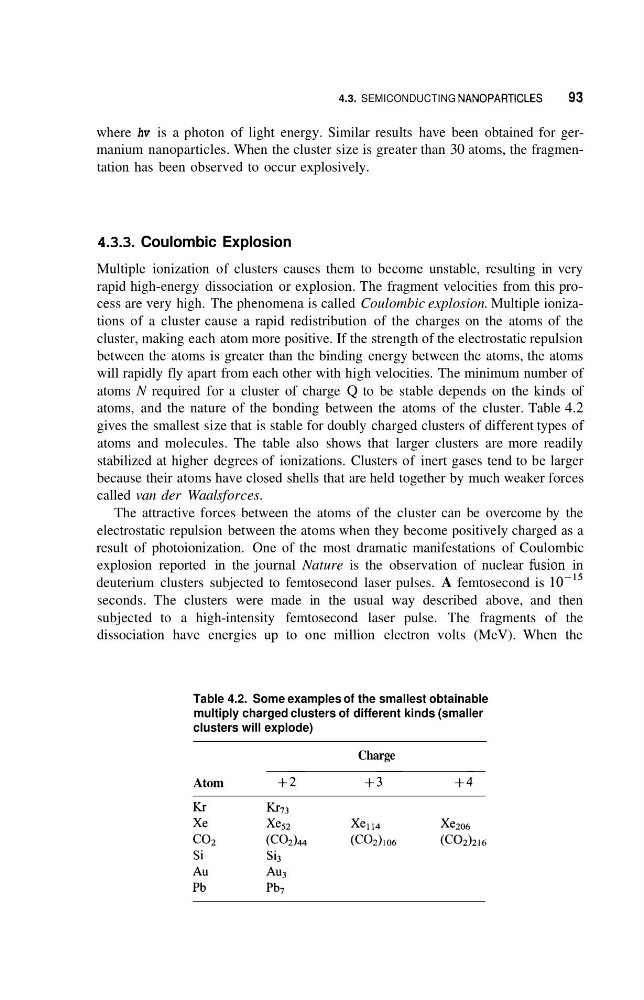
atoms, and the nature of the bonding between the atoms of the cluster. Table 4.2
gives the smallest size that is stable for doubly charged clusters of different types of
atoms and molecules. The table also shows that larger clusters are more readily
stabilized at higher degrees of ionizations. Clusters of inert gases tend to be larger
because their atoms have closed shells that are held together by much weaker forces
called van der Waals forces.
The attractive forces between the atoms of the cluster can be overcome by the
electrostatic repulsion between the atoms when they become positively charged as a
result of photoionization. One of the most dramatic manifestations of Coulombic
explosion reported in the journal Nature is the observation of nuclear hsion in
deuterium clusters subjected to femtosecond laser pulses. A femtosecond is
seconds. The clusters were made in the usual way described above, and then
subjected to a high-intensity femtosecond laser pulse. The fragments of the
dissociation have energies up to one million electron volts (MeV). When the
Table 4.2. Some examples of the smallest obtainable
multiply charged clusters of different kinds (smaller
clusters will explode)
Charge
~
~
~
Atom
+2
+ 3
+ 4
93
where hv is a photon of light energy. Similar results have been obtained for germanium nanoparticles. When the cluster size is greater than 30 atoms, the fragmentation has been observed to occur explosively.
4.3.3. Coulombic Explosion
Multiple ionization of clusters causes them to become unstable, resulting in very
rapid high-energy dissociation or explosion. The fragment velocities from this process are very high. The phenomena is called Coulombic explosion. Multiple ionizations of a cluster cause a rapid redistribution of the charges on the atoms of the
cluster, making each atom more positive. If the strength of the electrostatic repulsion
between the atoms is greater than the binding energy between the atoms, the atoms
will rapidly fly apart from each other with high velocities. The minimum number of
atoms N required for a cluster of charge Q to be stable depends on the kinds of
atoms, and the nature of the bonding between the atoms of the cluster. Table 4.2
gives the smallest size that is stable for doubly charged clusters of different types of
atoms and molecules. The table also shows that larger clusters are more readily
stabilized at higher degrees of ionizations. Clusters of inert gases tend to be larger
because their atoms have closed shells that are held together by much weaker forces
called van der Waals forces.
The attractive forces between the atoms of the cluster can be overcome by the
electrostatic repulsion between the atoms when they become positively charged as a
result of photoionization. One of the most dramatic manifestations of Coulombic
explosion reported in the journal Nature is the observation of nuclear hsion in
deuterium clusters subjected to femtosecond laser pulses. A femtosecond is
seconds. The clusters were made in the usual way described above, and then
subjected to a high-intensity femtosecond laser pulse. The fragments of the
dissociation have energies up to one million electron volts (MeV). When the
Table 4.2. Some examples of the smallest obtainable
multiply charged clusters of different kinds (smaller
clusters will explode)
Charge
~
~
~
Atom
+2
+ 3
+ 4