

94
PROPERTIES OF INDIVIDUAL NANOPARTICLES
deuterium fragments collide, they have sufficient energy to undergo nuclear fusion
by the following reaction:
D + D j 3He + neutron
(4.6)
This reaction releases a neutron of 2.54 MeV energy. Evidence for the occurrence of
fusion is the detection of the neutrons using neutron scintillation detectors coupled to
photomultiplier tubes.
4.4. RARE GAS AND MOLECULAR CLUSTERS
4.4.1. Inert-Gas Clusters
Table 4.2 lists a number of different kinds of nanoparticles. Besides metal atoms and
semiconducting atoms, nanoparticles can be assembled from rare gases such as
krypton and xenon, and molecules such as water. Xenon clusters are formed by
adiabatic expansion of a supersonic jet of the gas through a small capillary into a
vacuum. The gas is then collected by a mass spectrometer, where it is ionized by an
electron beam, and its mass : charge ratio measured. As in the case of metals, there
are magic numbers, meaning that clusters having a certain number of atoms are more
stable than others. For the case of xenon, the most stable clusters occur at particles
having 13, 19, 25, 55, 71, 87, and 147 atoms. Argon clusters have similar structural
magic numbers. Since the inert-gas atoms have filled electronic shells, their magic
numbers are structural magic numbers as discussed in Chapter 2. The forces that
bond inert-gas atoms into clusters are weaker than those that bond metals and
semiconducting atoms. Even though inert-gas atoms have filled electron shells,
because of the movement of the electrons about the atoms, they can have an
instantaneous electric dipole moment, P1. An electric dipole moment occurs when a
positive charge and a negative charge are separated by some distance. This dipole
produces an electric field 2P1/R3 at another atom a distance R away. This, in turn,
induces a dipole moment, P2, on the second atom, 20!PI/R3, where o! is called the
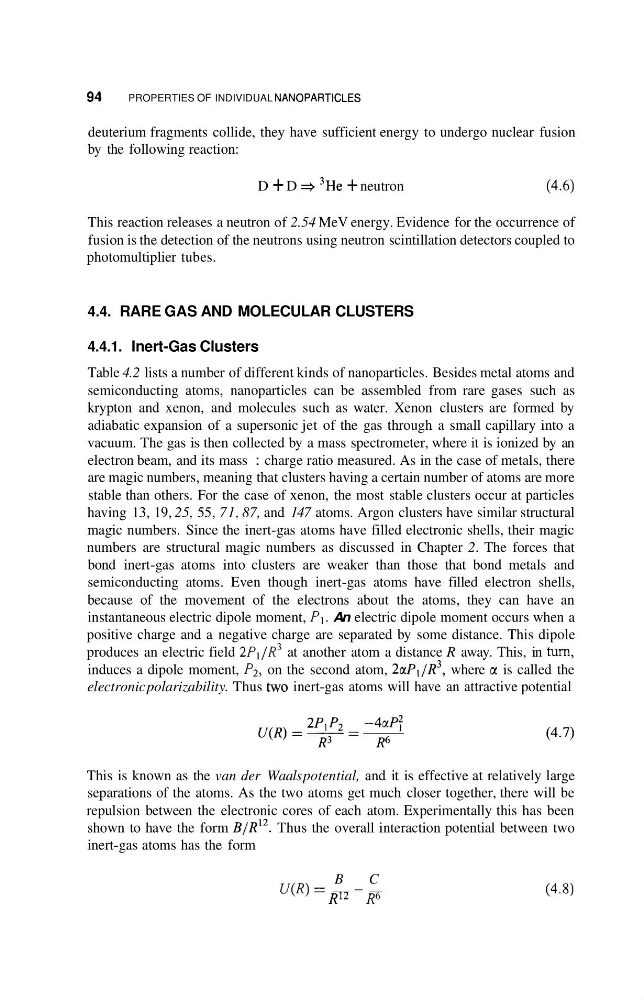
electronic polarizability. Thus two inert-gas atoms will have an attractive potential
This is known as the van der Waals potential, and it is effective at relatively large
separations of the atoms. As the two atoms get much closer together, there will be
repulsion between the electronic cores of each atom. Experimentally this has been
shown to have the form BIR”. Thus the overall interaction potential between two
inert-gas atoms has the form
B
C
R12 R6
U(R) = - - -
(4.8)
PROPERTIES OF INDIVIDUAL NANOPARTICLES
deuterium fragments collide, they have sufficient energy to undergo nuclear fusion
by the following reaction:
D + D j 3He + neutron
(4.6)
This reaction releases a neutron of 2.54 MeV energy. Evidence for the occurrence of
fusion is the detection of the neutrons using neutron scintillation detectors coupled to
photomultiplier tubes.
4.4. RARE GAS AND MOLECULAR CLUSTERS
4.4.1. Inert-Gas Clusters
Table 4.2 lists a number of different kinds of nanoparticles. Besides metal atoms and
semiconducting atoms, nanoparticles can be assembled from rare gases such as
krypton and xenon, and molecules such as water. Xenon clusters are formed by
adiabatic expansion of a supersonic jet of the gas through a small capillary into a
vacuum. The gas is then collected by a mass spectrometer, where it is ionized by an
electron beam, and its mass : charge ratio measured. As in the case of metals, there
are magic numbers, meaning that clusters having a certain number of atoms are more
stable than others. For the case of xenon, the most stable clusters occur at particles
having 13, 19, 25, 55, 71, 87, and 147 atoms. Argon clusters have similar structural
magic numbers. Since the inert-gas atoms have filled electronic shells, their magic
numbers are structural magic numbers as discussed in Chapter 2. The forces that
bond inert-gas atoms into clusters are weaker than those that bond metals and
semiconducting atoms. Even though inert-gas atoms have filled electron shells,
because of the movement of the electrons about the atoms, they can have an
instantaneous electric dipole moment, P1. An electric dipole moment occurs when a
positive charge and a negative charge are separated by some distance. This dipole
produces an electric field 2P1/R3 at another atom a distance R away. This, in turn,
induces a dipole moment, P2, on the second atom, 20!PI/R3, where o! is called the
electronic polarizability. Thus two inert-gas atoms will have an attractive potential
This is known as the van der Waals potential, and it is effective at relatively large
separations of the atoms. As the two atoms get much closer together, there will be
repulsion between the electronic cores of each atom. Experimentally this has been
shown to have the form BIR”. Thus the overall interaction potential between two
inert-gas atoms has the form
B
C
R12 R6
U(R) = - - -
(4.8)