

92
PROPERTIES OF INDIVIDUAL NANOPARTICLES
the confinement of the exciton that was discussed above. Essentially, as the particle
size is reduced, the hole and the electron are forced closer together, and the
separation between the energy levels changes. This subject will be discussed in
greater detail in Chapter 9.
4.3.2. Photofragmentation
It has been observed that nanoparticles of silicon and germanium can undergo
fragmentation when subjected to laser light from a Q-switched Nd:YAG laser. The
products depend on the size of the cluster, the intensity of the laser light, and the
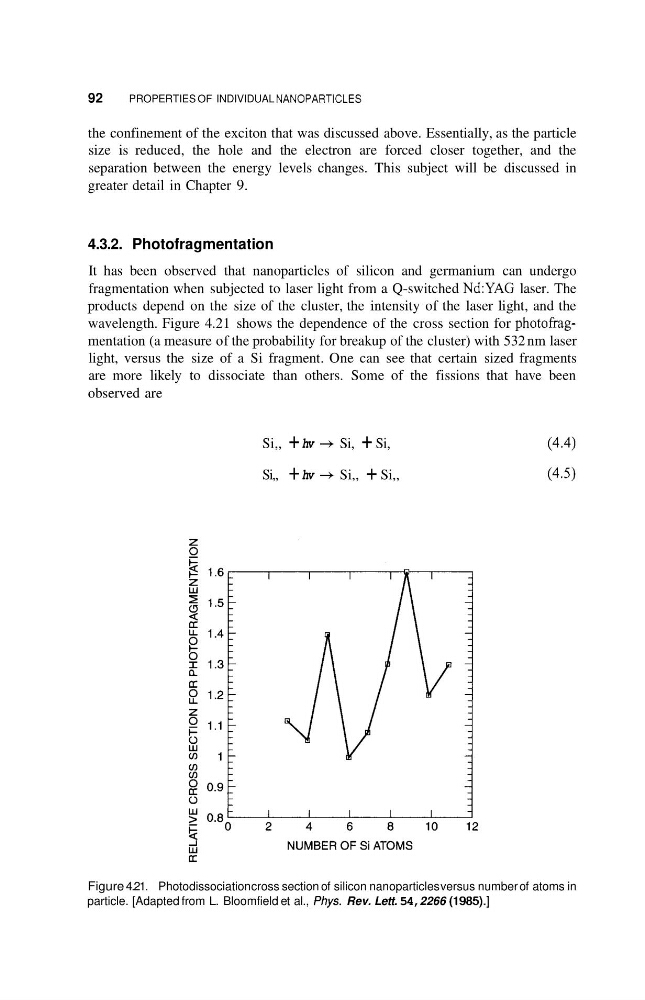
wavelength. Figure 4.21 shows the dependence of the cross section for photofragmentation (a measure of the probability for breakup of the cluster) with 532 nm laser
light, versus the size of a Si fragment. One can see that certain sized fragments
are more likely to dissociate than others. Some of the fissions that have been
observed are
Si,, + hv + Si, + Si,
(4.4)
Si,, + hv + Si,, + Si,,
(4.5)
Figure 4.21. Photodissociation cross section of silicon nanoparticles versus number of atoms in
particle. [Adapted from L. Bloomfield et al., fhys. Rev. Lett. 54, 2266 (1985).]
PROPERTIES OF INDIVIDUAL NANOPARTICLES
the confinement of the exciton that was discussed above. Essentially, as the particle
size is reduced, the hole and the electron are forced closer together, and the
separation between the energy levels changes. This subject will be discussed in
greater detail in Chapter 9.
4.3.2. Photofragmentation
It has been observed that nanoparticles of silicon and germanium can undergo
fragmentation when subjected to laser light from a Q-switched Nd:YAG laser. The
products depend on the size of the cluster, the intensity of the laser light, and the
wavelength. Figure 4.21 shows the dependence of the cross section for photofragmentation (a measure of the probability for breakup of the cluster) with 532 nm laser
light, versus the size of a Si fragment. One can see that certain sized fragments
are more likely to dissociate than others. Some of the fissions that have been
observed are
Si,, + hv + Si, + Si,
(4.4)
Si,, + hv + Si,, + Si,,
(4.5)
Figure 4.21. Photodissociation cross section of silicon nanoparticles versus number of atoms in
particle. [Adapted from L. Bloomfield et al., fhys. Rev. Lett. 54, 2266 (1985).]