

4.3. SEMICONDUCTING NANOPARTICLES
91
3
4 2.5
cn
0
g
2
0
z
d 1.5
t
a
9
1
0.5
2.12
2.13
2.14
2.15
2.16
PHOTON ENERGY (eV)
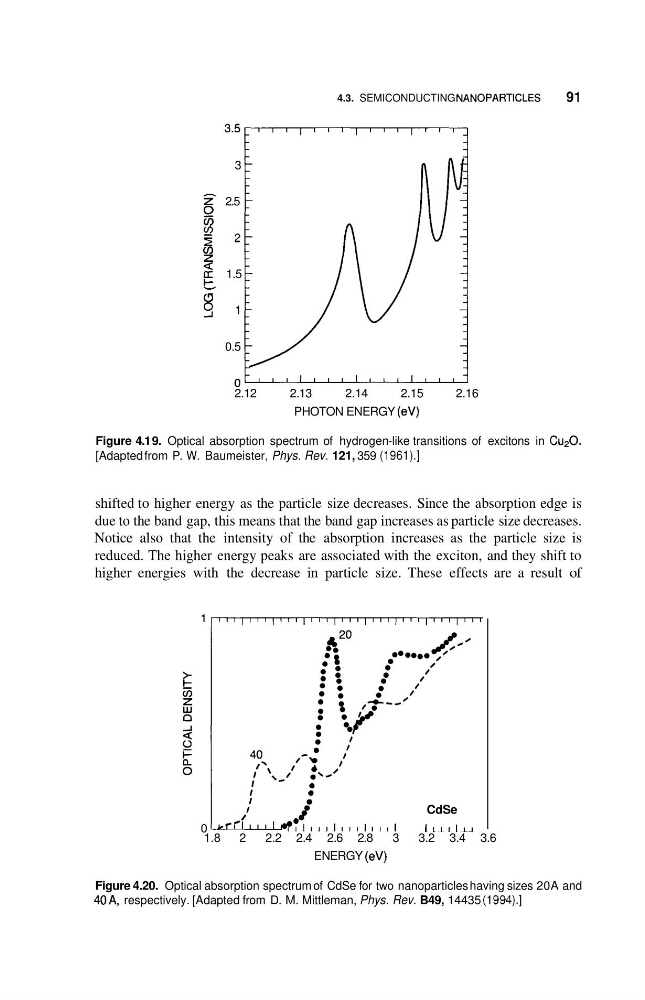
Figure 4.1 9. Optical absorption spectrum of hydrogen-like transitions of excitons in Cu20.
[Adapted from P. W. Baumeister, Phys. Rev. 121, 359 (1961).]
shifted to higher energy as the particle size decreases. Since the absorption edge is
due to the band gap, this means that the band gap increases as particle size decreases.
Notice also that the intensity of the absorption increases as the particle size is
reduced. The higher energy peaks are associated with the exciton, and they shift to
higher energies with the decrease in particle size. These effects are a result of
I
I
CdSe
1.8
2
2.2 2.4 2.6 2.8
3
3.2 3.4 3.6
/
i
. t o , , , , I , , , I , , ( I
0 I . l - ; l ' ' ' I '
1 , , I I , ,
ENERGY (eV)
Figure 4.20. Optical absorption spectrum of CdSe for two nanoparticles having sizes 20A and
40A, respectively. [Adapted from D. M. Mittleman, Phys. Rev. B49, 14435 (1994).]
91
3
4 2.5
cn
0
g
2
0
z
d 1.5
t
a
9
1
0.5
2.12
2.13
2.14
2.15
2.16
PHOTON ENERGY (eV)
Figure 4.1 9. Optical absorption spectrum of hydrogen-like transitions of excitons in Cu20.
[Adapted from P. W. Baumeister, Phys. Rev. 121, 359 (1961).]
shifted to higher energy as the particle size decreases. Since the absorption edge is
due to the band gap, this means that the band gap increases as particle size decreases.
Notice also that the intensity of the absorption increases as the particle size is
reduced. The higher energy peaks are associated with the exciton, and they shift to
higher energies with the decrease in particle size. These effects are a result of
I
I
CdSe
1.8
2
2.2 2.4 2.6 2.8
3
3.2 3.4 3.6
/
i
. t o , , , , I , , , I , , ( I
0 I . l - ; l ' ' ' I '
1 , , I I , ,
ENERGY (eV)
Figure 4.20. Optical absorption spectrum of CdSe for two nanoparticles having sizes 20A and
40A, respectively. [Adapted from D. M. Mittleman, Phys. Rev. B49, 14435 (1994).]