

E1C02 09/14/2010
13:35:18 Page 51
This linear, second-order differential equation with constant coefficients describes the motion of the
idealized spring mass system when there is no external force applied. The general form of the solution
to this equation is
y ¼ A cos vt þ B sin vt
ð2:8Þ
where v ¼
ffiffiffiffiffiffiffiffiffi
k=m
p
. Physically we know that if the mass is displaced from the equilibrium point and
released, it will oscillate about the equilibrium point. The time required for the mass to finish one
complete cycle of the motion is called the period, and is generally represented by the symbol T.
Frequency is related to the period and is defined as the number of complete cycles of the motion
per unit time. This frequency, f, is measured in cycles per second (Hz; 1 cycle/s ¼ 1 Hz). The term v
is also a frequency, but instead of having units of cycles per second it has units of radians per second.
This frequency, v, is called the circular frequency since it relates directly to cycles on the unit circle,
as illustrated in Figure 2.10. The relationship among v, f, and the period, T, is
T ¼
2p
v
¼
1
f
ð2:9Þ
In Equation 2.8, the sine and cosine terms can be combined if a phase angle is introduced such that
y ¼ C cos vt À f
ð
Þ
ð2:10aÞ
or
y ¼ C sin vt þ f
Ã
ð
Þ
ð 2:10bÞ
The values of C, f, and f
à are found from the following trigonometric identities:
A cos vt þ B sin vt ¼
ffiffiffiffiffiffiffiffiffiffiffiffiffiffiffiffi
A
2
þ B
2
p
cos vt À f
ð
Þ
A cos vt þ B sin vt ¼
ffiffiffiffiffiffiffiffiffiffiffiffiffiffiffiffi
A
2
þ B
2
p
sin vt þ f
Ã
ð
Þ
f ¼ tan
À1 B
A
f
Ã
¼ tan
À1 A
B
f
Ã
¼
p
2
À f
ð2:11Þ
Unextended
length of spring
Restoring
force
Velocity:
Equilibrium position
m
m
m
dy
dt
+ y
Acceleration:
d
2
y
dt
2
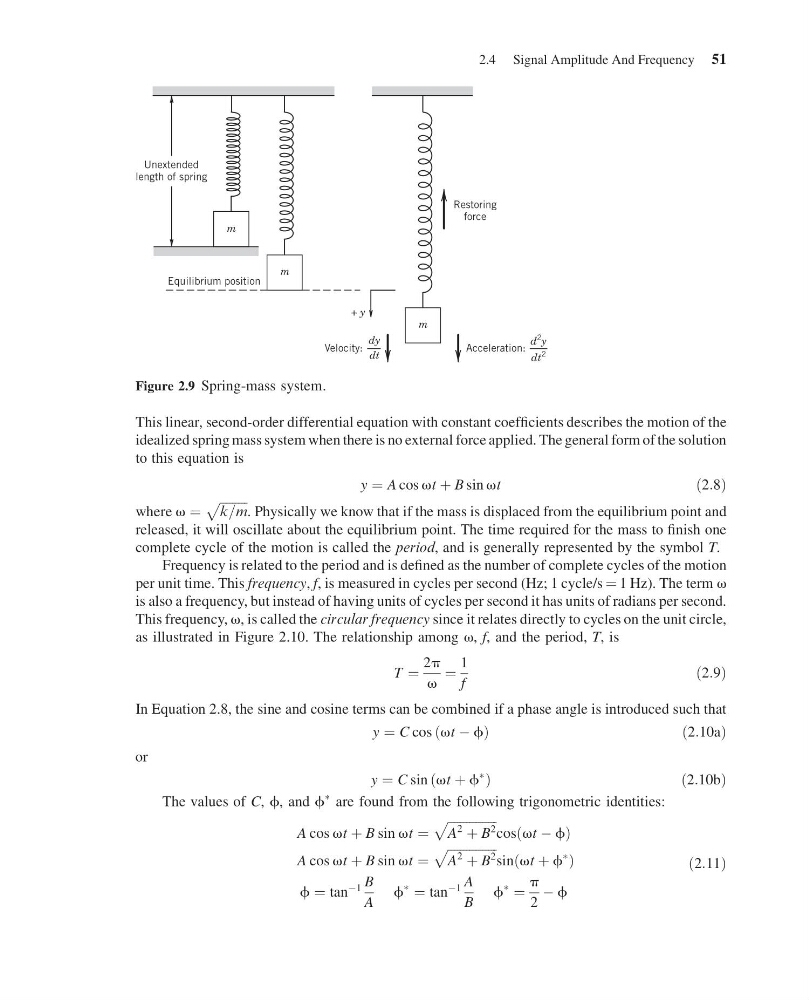
Figure 2.9 Spring-mass system.
2.4 Signal Amplitude And Frequency 51
13:35:18 Page 51
This linear, second-order differential equation with constant coefficients describes the motion of the
idealized spring mass system when there is no external force applied. The general form of the solution
to this equation is
y ¼ A cos vt þ B sin vt
ð2:8Þ
where v ¼
ffiffiffiffiffiffiffiffiffi
k=m
p
. Physically we know that if the mass is displaced from the equilibrium point and
released, it will oscillate about the equilibrium point. The time required for the mass to finish one
complete cycle of the motion is called the period, and is generally represented by the symbol T.
Frequency is related to the period and is defined as the number of complete cycles of the motion
per unit time. This frequency, f, is measured in cycles per second (Hz; 1 cycle/s ¼ 1 Hz). The term v
is also a frequency, but instead of having units of cycles per second it has units of radians per second.
This frequency, v, is called the circular frequency since it relates directly to cycles on the unit circle,
as illustrated in Figure 2.10. The relationship among v, f, and the period, T, is
T ¼
2p
v
¼
1
f
ð2:9Þ
In Equation 2.8, the sine and cosine terms can be combined if a phase angle is introduced such that
y ¼ C cos vt À f
ð
Þ
ð2:10aÞ
or
y ¼ C sin vt þ f
Ã
ð
Þ
ð 2:10bÞ
The values of C, f, and f
à are found from the following trigonometric identities:
A cos vt þ B sin vt ¼
ffiffiffiffiffiffiffiffiffiffiffiffiffiffiffiffi
A
2
þ B
2
p
cos vt À f
ð
Þ
A cos vt þ B sin vt ¼
ffiffiffiffiffiffiffiffiffiffiffiffiffiffiffiffi
A
2
þ B
2
p
sin vt þ f
Ã
ð
Þ
f ¼ tan
À1 B
A
f
Ã
¼ tan
À1 A
B
f
Ã
¼
p
2
À f
ð2:11Þ
Unextended
length of spring
Restoring
force
Velocity:
Equilibrium position
m
m
m
dy
dt
+ y
Acceleration:
d
2
y
dt
2
Figure 2.9 Spring-mass system.
2.4 Signal Amplitude And Frequency 51