

E1C02 09/14/2010
13:35:18 Page 52
The size of the maximum and minimum displacements from the equilibrium position, or the value C,
is the amplitude of the oscillation. The concepts of amplitude and frequency are essential for the
description of time-dependent signals.
Frequency Analysis
Many signals that result from the measurement of dynamic variables are nondeterministic in nature
and have a continuously varying rate of change. These signals, having complex waveforms, present
difficulties in the selection of a measurement system and in the interpretation of an output signal.
However, it is possible to separate a complex signal, or any signal for that matter, into a number of
sine and cosine functions. In other words, any complex signal can be thought of as made up of sines
and cosines of differing periods and amplitudes, which are added together in an infinite trigonometric series. This representation of a signal as a series of sines and cosines is called a Fourier
series. Once a signal is broken down into a series of periodic functions, the importance of each
frequency can be easily determined. This information about frequency content allows proper choice
of a measurement system, and precise interpretation of output signals.
In theory, Fourier analysis allows essentially all mathematical functions of practical interest to
be represented by an infinite series of sines and cosines.
2
t
–
2
y
y = sin t
y = 1
y = –1
2
2
3
2
5
2
t
t = 0
sin t
t =
t = 2
t =
y
P
3
2
t = 2
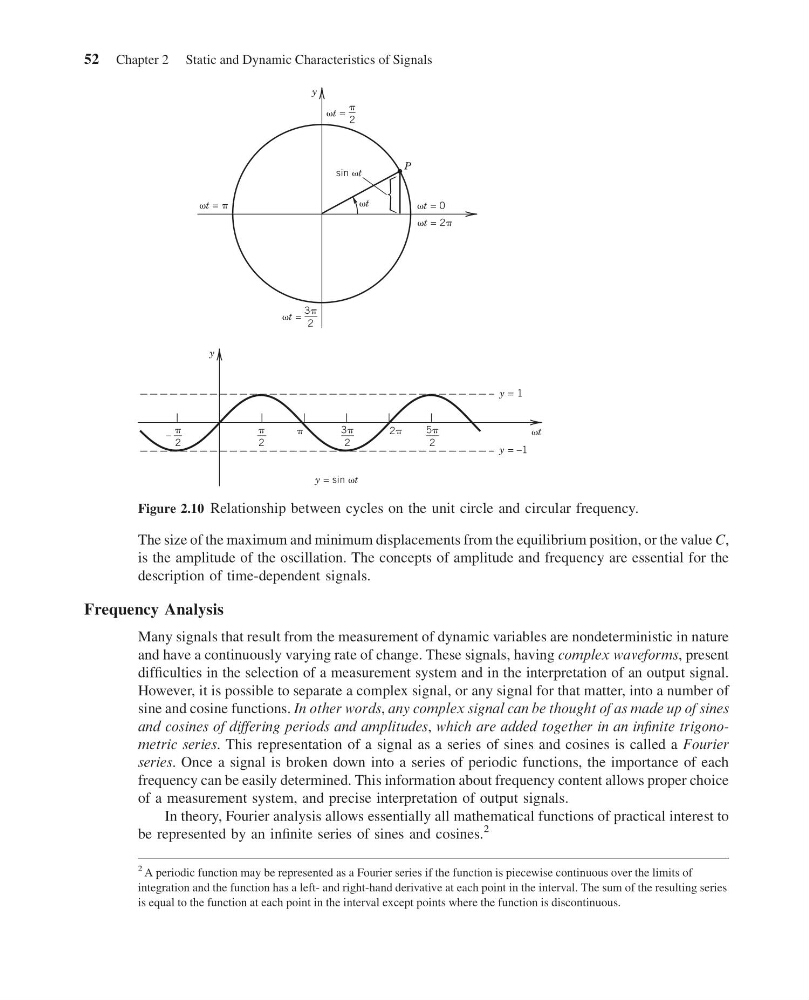
Figure 2.10 Relationship between cycles on the unit circle and circular frequency.
2 A periodic function may be represented as a Fourier series if the function is piecewise continuous over the limits of
integration and the function has a left- and right-hand derivative at each point in the interval. The sum of the resulting series
is equal to the function at each point in the interval except points where the function is discontinuous.
52 Chapter 2 Static and Dynamic Characteristics of Signals
13:35:18 Page 52
The size of the maximum and minimum displacements from the equilibrium position, or the value C,
is the amplitude of the oscillation. The concepts of amplitude and frequency are essential for the
description of time-dependent signals.
Frequency Analysis
Many signals that result from the measurement of dynamic variables are nondeterministic in nature
and have a continuously varying rate of change. These signals, having complex waveforms, present
difficulties in the selection of a measurement system and in the interpretation of an output signal.
However, it is possible to separate a complex signal, or any signal for that matter, into a number of
sine and cosine functions. In other words, any complex signal can be thought of as made up of sines
and cosines of differing periods and amplitudes, which are added together in an infinite trigonometric series. This representation of a signal as a series of sines and cosines is called a Fourier
series. Once a signal is broken down into a series of periodic functions, the importance of each
frequency can be easily determined. This information about frequency content allows proper choice
of a measurement system, and precise interpretation of output signals.
In theory, Fourier analysis allows essentially all mathematical functions of practical interest to
be represented by an infinite series of sines and cosines.
2
t
–
2
y
y = sin t
y = 1
y = –1
2
2
3
2
5
2
t
t = 0
sin t
t =
t = 2
t =
y
P
3
2
t = 2
Figure 2.10 Relationship between cycles on the unit circle and circular frequency.
2 A periodic function may be represented as a Fourier series if the function is piecewise continuous over the limits of
integration and the function has a left- and right-hand derivative at each point in the interval. The sum of the resulting series
is equal to the function at each point in the interval except points where the function is discontinuous.
52 Chapter 2 Static and Dynamic Characteristics of Signals