

E1C12 09/14/2010
13:54:14 Page 550
Employing partial fractions yields
Q s
ð Þ ¼ u 1 C 2
1
s
À
1
s þ 1=C 1
!
ð12:49Þ
From Table C.1 we can determine the time-domain solution corresponding to this Laplace transform
as
u t
ð Þ ¼ u 1 C 2 1 À e
Àt = C1
h
i
ð12:50Þ
Recall that we have assumed u 0
ð Þ ¼ 0. In the limit as t ! 1
u t
ð Þ ¼ u 1 C 2 ¼
k p k m u 1
UA s þ k p k m
For a step change input, we have found that u t
ð Þ 6 ¼ u 1 unless
k p k m
UA s þ k p k m
¼ 1. This will not in
general be the case. Thus we find that a proportional controller, in general, is characterized by a
nonzero steady-state error.
Example 12.5
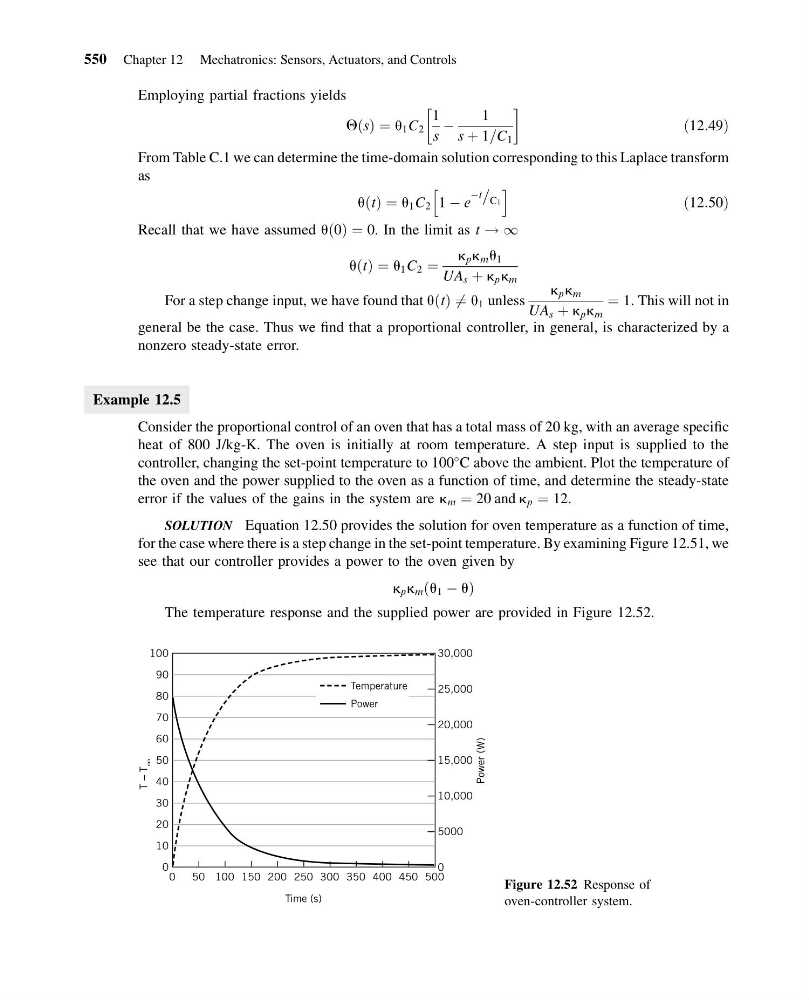
Consider the proportional control of an oven that has a total mass of 20 kg, with an average specific
heat of 800 J/kg-K. The oven is initially at room temperature. A step input is supplied to the
controller, changing the set-point temperature to 100
C above the ambient. Plot the temperature of
the oven and the power supplied to the oven as a function of time, and determine the steady-state
error if the values of the gains in the system are k m ¼ 20 and k p ¼ 12.
SOLUTION Equation 12.50 provides the solution for oven temperature as a function of time,
for the case where there is a step change in the set-point temperature. By examining Figure 12.51, we
see that our controller provides a power to the oven given by
k p k m u 1 À u
ð
Þ
The temperature response and the supplied power are provided in Figure 12.52.
0
0
10
20
30
40
50
60
70
80
90
30,000
100
25,000
20,000
15,000
10,000
5000
0
250
200
150
100
50
Time (s)
Power (W)
T
− T
oo
500
450
400
350
300
Temperature
Power
Figure 12.52 Response of
oven-controller system.
550 Chapter 12 Mechatronics: Sensors, Actuators, and Controls
13:54:14 Page 550
Employing partial fractions yields
Q s
ð Þ ¼ u 1 C 2
1
s
À
1
s þ 1=C 1
!
ð12:49Þ
From Table C.1 we can determine the time-domain solution corresponding to this Laplace transform
as
u t
ð Þ ¼ u 1 C 2 1 À e
Àt = C1
h
i
ð12:50Þ
Recall that we have assumed u 0
ð Þ ¼ 0. In the limit as t ! 1
u t
ð Þ ¼ u 1 C 2 ¼
k p k m u 1
UA s þ k p k m
For a step change input, we have found that u t
ð Þ 6 ¼ u 1 unless
k p k m
UA s þ k p k m
¼ 1. This will not in
general be the case. Thus we find that a proportional controller, in general, is characterized by a
nonzero steady-state error.
Example 12.5
Consider the proportional control of an oven that has a total mass of 20 kg, with an average specific
heat of 800 J/kg-K. The oven is initially at room temperature. A step input is supplied to the
controller, changing the set-point temperature to 100
C above the ambient. Plot the temperature of
the oven and the power supplied to the oven as a function of time, and determine the steady-state
error if the values of the gains in the system are k m ¼ 20 and k p ¼ 12.
SOLUTION Equation 12.50 provides the solution for oven temperature as a function of time,
for the case where there is a step change in the set-point temperature. By examining Figure 12.51, we
see that our controller provides a power to the oven given by
k p k m u 1 À u
ð
Þ
The temperature response and the supplied power are provided in Figure 12.52.
0
0
10
20
30
40
50
60
70
80
90
30,000
100
25,000
20,000
15,000
10,000
5000
0
250
200
150
100
50
Time (s)
Power (W)
T
− T
oo
500
450
400
350
300
Temperature
Power
Figure 12.52 Response of
oven-controller system.
550 Chapter 12 Mechatronics: Sensors, Actuators, and Controls